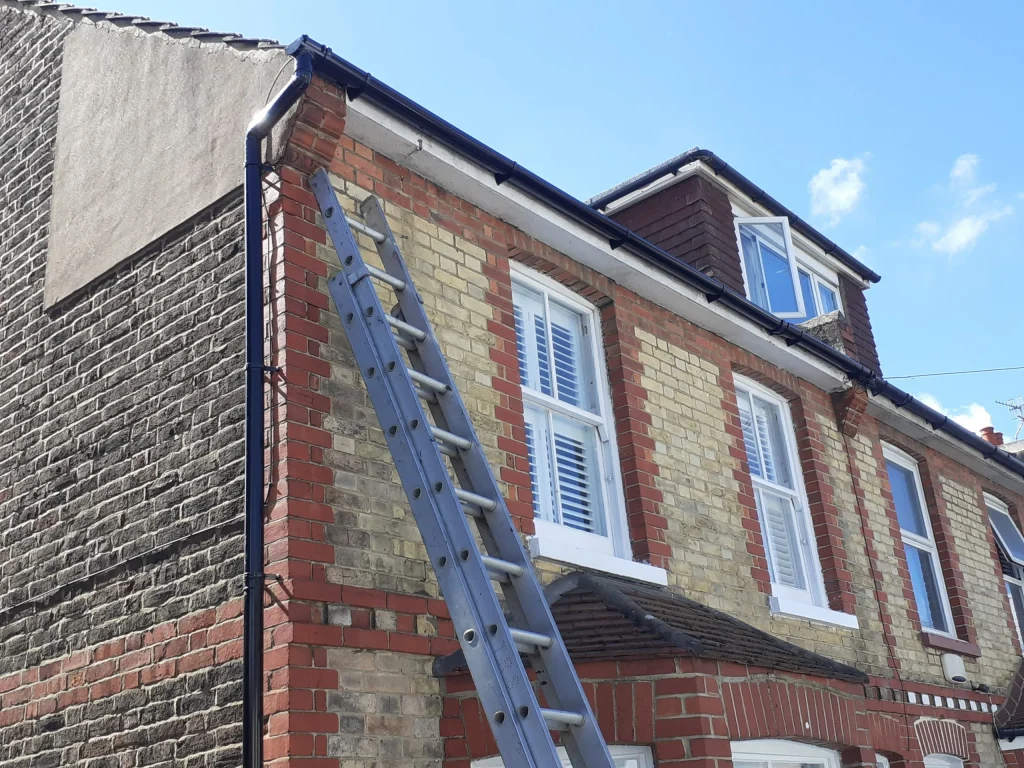
Damp Walls Aren’t Always a Roof Leak
I regularly get called out to properties in Hove and Worthing where damp patches have suddenly appeared at the top of an upstairs bedroom wall. The owner often assumes the main covering has failed badly, but once I get up on the ladders, the tiles, slates, or membrane are often still doing their job. The real culprit is frequently a failing rainwater system sending hundreds of litres of water straight down the external brickwork.
When rainwater is not carried away from the property correctly, solid walls quickly absorb moisture. What looks at first like a complex low-slope covering issue can often be traced back to worn joints, poor falls, or a gutter run that no longer drains properly.
Why Patch Repairs Stop Working
Most people think of gutters as something that simply needs clearing once a year. In reality, plastic and cast iron systems do not last forever. I often inspect properties where homeowners have spent years paying for silicone to be smeared over leaking joints. At that stage, short-term water ingress fixes stop making financial sense, and a full replacement becomes the only reliable way to prevent serious damp problems.
1. Substrate Movement and Warped Plastics
After years of exposure to changing Sussex weather, uPVC gutters expand and contract. This thermal movement causes older plastic lengths to twist or sag. Once the fall, meaning the slight slope needed to drain water, is lost, standing water sits in the run permanently. The constant weight of trapped water eventually snaps brackets, pulls the gutter away from the roof edge, and degrades the rubber seals beyond reliable use.
2. Coastal Corrosion on Victorian Properties
On Victorian and Edwardian terraced houses across Brighton, I still see many original cast iron rainwater systems. They suit the character of the property, but decades of coastal salt exposure eventually rust the back of the pipes, often in places you cannot see from the ground. Rainwater then leaks quietly down the wall, penetrates the brickwork, and blows the interior plaster.
The Hidden Danger of Capillary Action
A poorly performing gutter does not only damage the brickwork below; it can also destroy the roofline above. When water continually drips from a sagging or blocked run, it frequently travels backwards. Through capillary action, moisture is drawn into the timber board that the brackets are fixed to.
If you ignore overflowing gutters for too long, the timber softens and rots. Eventually, new brackets have nothing solid to screw into. In these cases, fitting a new rainwater system alongside a durable uPVC roofline upgrade is often the most cost-effective way to protect the eaves for the long term.
Doing the Job Properly
When fitting replacement guttering, I never just clip new plastic into old, weakened brackets. That is a recipe for failure, especially during strong coastal winds. A proper installation means stripping the old system back, checking the structural timber underneath, and fitting a modern setup with the correct flow capacity.
Heavy downpours in Sussex demand high-capacity, deep-flow profiles, not simply the cheapest narrow option available from a builder’s merchant. Working with someone familiar with Sussex coastal properties helps ensure the capacity, bracket spacing, and falls are right for the building rather than guessed on site.
Water will always find the path of least resistance. If your gutters are visibly sagging, leaking at several joints, or overflowing even after moss and leaves have been cleared, it is time to replace them before they cause expensive internal damage. If you are unsure what the work may involve, you can use the calculator on my website to estimate a full rainwater system replacement in about 30 seconds.