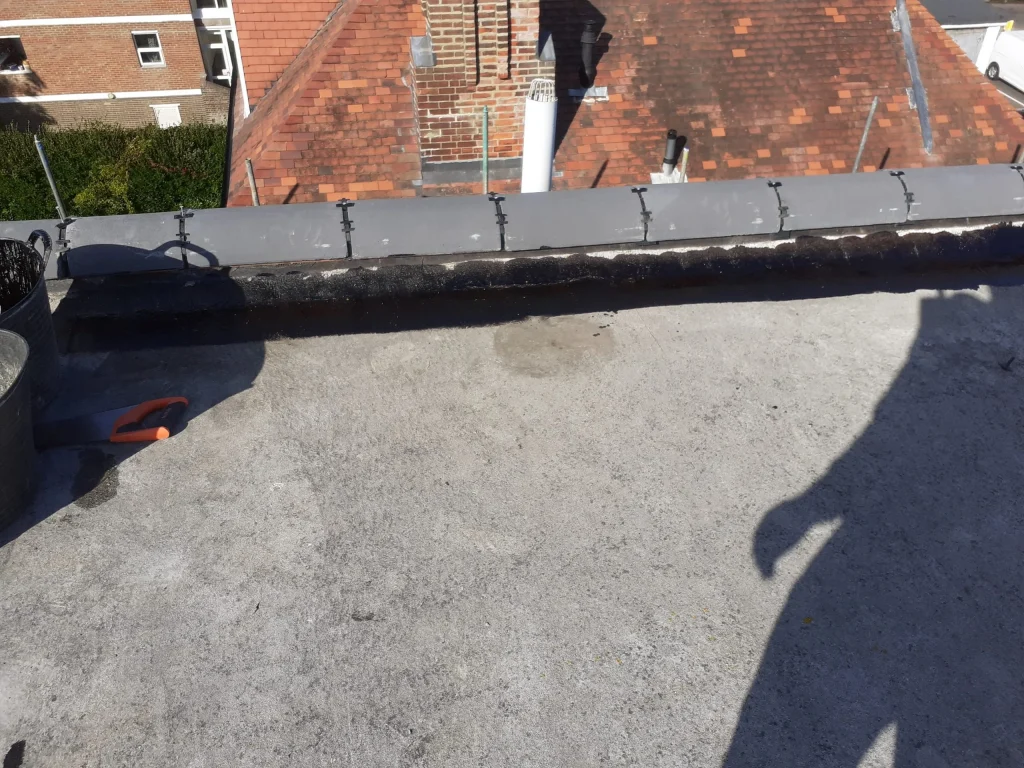
I have spent over 18 years diagnosing and repairing roofs, with the last 12 focused purely on Brighton, Hove, and the surrounding Sussex coast. If there is one thing I hear constantly, it is property owners groaning about their flat roofs. For many, the term flat roof roofing instantly brings to mind damp patches, buckets catching drips, and endless, costly maintenance.
But here is the truth: high-quality low-slope installations are not inherently flawed. They simply do not tolerate outdated materials or poor workmanship. A well-constructed full structural renovation should keep your property dry for decades, even when battered by brutal coastal weather. Let me explain why they usually fail, and what actually works.
Why Older Flat Roofs Fail in Sussex
Most of the failing flat roofs I inspect on rear extensions, dormers, or garages were built using outdated pour-and-roll felt or cheap mineral caps. These older materials have a fatal flaw: they are incredibly rigid.
In Brighton, a roof faces intense summer UV rays followed by freezing, wet winter gales. This drastic temperature change causes the building to expand and contract. Because older felt cannot stretch, it becomes brittle and cracks under the strain of this natural substrate movement.
Once a microscopic crack forms, you are at the mercy of ponding water. Flat roofs are never completely flat; they are built with a slight fall to direct rainwater into the gutters. But if the structural deck begins to sag over time, water pools in the centre. Through capillary action, that standing water is slowly drawn into the weakened seams of the felt, quietly rotting the timber deck below.
The Modern Standard: SBS Torch-On Felt
When I am called out to inspect an active leak, homeowners often ask if we can just paint some liquid sealant over the split. I almost never recommend this. Temporary paints and mastics break down incredibly quickly under coastal salt corrosion and UV exposure.
Instead, when dealing with modern flat roof roofing, I rely on high-performance SBS torch-on felt systems. SBS (Styrene Butadiene Styrene) is a bitumen membrane modified with synthetic rubber. This gives the material incredible elasticity. When the timber structure below shifts, or the Sussex weather swings from hot to freezing, an SBS membrane stretches with the building rather than snapping.
Deck Failure vs Condensation: Diagnosing the Real Problem
One of the hardest things for property owners to identify is whether their roof has actually failed at all. I frequently inspect damp stains on the ceilings of Victorian terraced house extensions. The homeowner naturally assumes the external felt is leaking.
However, when I inspect the roof, I often find the waterproof membrane is perfectly intact. The real culprit is internal condensation. If a roof lacks proper roof ventilation, the warm, moist air from your kitchen or bathroom rises and hits the freezing cold timber deck above your ceiling. It condenses into water and drips back down. This thermal bridging mimics a roof leak perfectly.
If this moisture remains trapped for years, it leads to complete deck failure, meaning the plywood structure itself turns to mush. In these scenarios, throwing new felt on top is useless. I usually recommend upgrading to a warm roof system, where the insulation is moved to the outside of the structure, entirely eliminating the condensation trap.
When is it Time to Replace?
If you are spotting internal damp, noticing large blisters on the felt, or seeing significant moss growth (a prime indicator of trapped moisture), the membrane has likely reached the end of its service life.
For those wondering about the logistics and costs, you can read more about transparent pricing for new felt systems to understand what a proper, long-term fix actually involves.
Good roofing is about diagnosing the root cause, not just hiding the symptoms with a quick patch. If you are worried about an ageing flat roof and want to budget for upcoming works, you can use the quick pricing calculators on my website to get a realistic cost estimate in around 30 seconds before we even need to speak.