Tearing Up a Five-Year-Old Roof: Where Installations Go Wrong
Last month in Worthing, I found myself stripping back a felt surface that was barely five years old. The homeowner was understandably frustrated; they had invested significantly in a new installation, yet moisture was already damaging their ceiling. When I peeled back the top layer, the issue was clear: the timber deck had rotted into wet mush. The previous contractors had applied cheap felt but completely neglected the structural requirements beneath.
After 18 years of working on properties across Sussex, I can tell you that a successful professional low-slope installation in Hove involves much more than just applying a waterproof layer. It is about how you construct the layers below to handle the local climate and structural stresses.
The Foundation: Timber Decking and Drainage Falls
A well-designed waterproof surface must always incorporate a slight pitch. If rainwater cannot run off quickly, you end up with ponding water. Over time, the sheer weight of this standing water strains the structure and weakens the felt seams. When I begin a project, the first thing I check is the timber joists. If they have bowed over the years, I install treated timber firrings to create a subtle gradient.
Once the slope is correct, I lay a completely new, exterior-grade structural deck. Reusing old, compromised decking to save a little money is the fastest route to premature failure of the entire system.
Beating Condensation: Warm Roof Systems
If the covering sits above a heated living space—such as the covering for rear kitchen extensions—proper insulation becomes critical. In older properties, we often see ‘cold roofs’ where insulation sits between the ceiling joists, leaving a cold void above. Without perfect ventilation, warm air from your home rises, hits the freezing deck, and turns into water.
I spend a lot of time explaining the difference between condensation and genuine external leaks because the internal damp patches look identical. To solve this during a new installation, I typically build warm deck systems. This involves placing rigid PIR insulation boards directly on top of the timber deck, completely eliminating thermal bridging. Your ceiling stays warm, and condensation never has a chance to form.
The Waterproofing: SBS Torch-On Felt
The Sussex coast experiences brutal weather conditions. The extreme shift between freezing winter winds and intense summer sun causes older buildings to naturally expand and contract. If you use cheap, rigid materials, this substrate movement will eventually tear the membrane apart.
That is why my standard installation uses a three-layer SBS torch-on felt system. SBS-modified bitumen is enhanced with synthetic rubber, giving it the elasticity needed to stretch and flex without snapping. I install a venting base layer, a reinforced underlay, and a heavy-duty mineral cap sheet. When properly torched together, they form a highly durable barrier that easily withstands heavy rainfall and coastal salt corrosion.
Edge Details and Parapet Walls
A surface rarely leaks in the dead centre; water usually finds its way in at the edges. If the perimeter drips are poorly formed, water wraps around the edge, leading to rapid fascia and soffit deterioration.
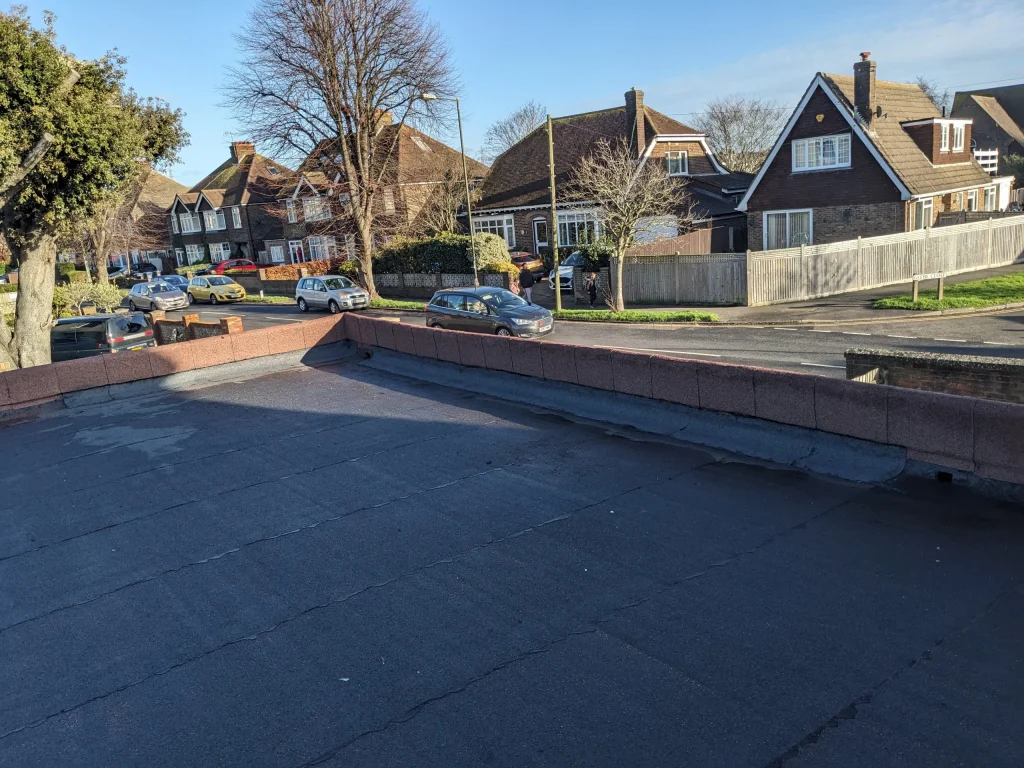
Furthermore, many Victorian and Edwardian terraced houses in Sussex have parapet walls bordering the area. If the felt upstands are not installed high enough, or if the lead flashing is poorly chased into the brickwork, capillary action will draw rainwater straight up and over the waterproof layer. I always ensure upstands are robust and leadwork is properly dressed to seal these vulnerable junctions permanently.
Final Thoughts on Installation Quality
Whether you require a garage waterproofing project or a completely new system for a large domestic extension, the technical principles remain the same. Do not just look at the top layer of felt; make sure the decking, drainage, and insulation are built to last.
If you are planning an installation and want to understand the potential costs involved, you can use the quick pricing calculators on my website to get an honest estimate in about 30 seconds before we even need to speak.