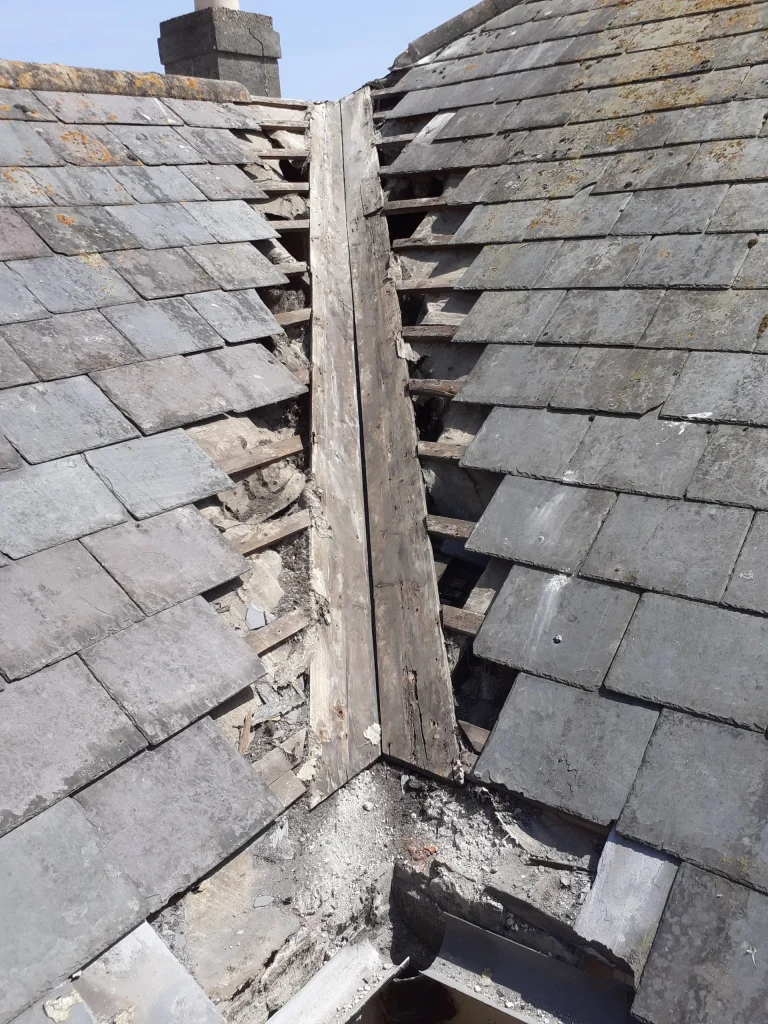
Why That Damp Patch Might Not Be a Roof Leak
If you look up at a traditional Victorian or Edwardian terrace in Brighton, Hove, or Worthing, you will often see a parapet wall at the roof boundary separating one property from the next. I inspect these high-level walls every week, and they are one of the most misunderstood parts of working on older Sussex coastal properties.
When a homeowner calls me about a mysterious damp patch appearing high on a bedroom wall, their first instinct is usually to blame the low-slope waterproofing system or the tiles. But when I get up on the scaffolding, the SBS torch-on membrane or slate covering is often in perfectly sound condition. The actual culprit is frequently the exposed brickwork of the parapet wall itself.
What Does a Parapet Wall Actually Do?
For anyone unfamiliar with the term, a parapet is the low brick wall that continues vertically past the roofline. Historically, Victorian builders constructed these walls as fire barriers to help slow the spread of flames from one terraced house to the next.
While they performed an important safety function, they can create a serious waterproofing challenge today. Unlike the main external walls of a house, which are partly protected by overhangs and drainage details, a parapet is exposed to weather from the top, front, and rear. This is why it should always be considered as part of the wider building-envelope and replacement-cost assessment rather than treated as a separate cosmetic feature.
The Coastal Sussex Weather Factor
In my 18 years of working on local properties, I have seen exactly how aggressive the coastal weather can be. When heavy rain is driven by strong sea winds, it constantly batters these exposed upper walls. Over a century, the original mortar pointing crumbles, and the bricks themselves can become highly porous.
Through a process called capillary action, the masonry absorbs rainwater like a sponge. Gravity then pulls that moisture slowly downward, past the roofline, and directly into the internal plaster. It can look exactly like water entry on a sloped tiled or slate covering, even though no water is actually passing through the main membrane or tiles. Instead, it is travelling straight through the solid brickwork.
Warning Signs of Parapet Moisture Ingress
If you are trying to work out whether your parapet is failing, these are the typical signs I look for during a diagnosis:
- Delayed dampness: Water marks appear on the ceiling or upper party wall a few days after a heavy storm, rather than immediately while it is raining.
- Peeling wallpaper or bubbling paint: This is usually concentrated in the top corners of a room that shares a boundary wall with a neighbouring property.
- White salt marks: Powdery white streaks, known as efflorescence, appear on the external brickwork when moisture is moving through the masonry.
- Cracked coping stones: The concrete or stone caps on the very top of the wall are loose, fractured, or missing their mortar joints.
How I Fix Parapet Wall Failures
One of the biggest mistakes I see is someone trying to solve parapet damp by simply painting the bricks with a clear waterproof liquid sealant. In my experience, this rarely works long-term on old Sussex properties. It can trap existing moisture inside the wall, causing the bricks to spall and lose their faces when temperatures drop below freezing.
To solve the problem properly, we have to stop water entering both the top and the base of the structure. Depending on the condition of the brickwork, protective capping for parapet and firewall details usually involves several practical steps.
First, the top of the wall must be sealed correctly. Sometimes this means re-bedding the original coping stones on fresh mortar, but in many cases I recommend installing a heavy-duty felt or lead capping system over the top of the firewall to remove the weak open joints entirely. Second, the lead flashing, which bridges the gap between the roof covering and the wall, must be checked and replaced if it has deteriorated or pulled away from the brickwork.
The Shared Boundary Dilemma
Because parapets usually sit exactly on the boundary line, half of the wall belongs to you and half belongs to your neighbour. I often find situations where one side has been neatly re-pointed and sealed, while the neighbour’s side is still crumbling. Water does not respect property lines. If it enters their side of the brickwork, it can still soak through and cause damp inside your home too.
When dealing with party walls, it is always best for both homeowners to tackle the whole structure at the same time. A partial fix may reduce the symptoms for a while, but it often leaves the same moisture pathway active on the untreated side.
Final Thoughts
Dealing with high-level damp can be stressful, but diagnosing it correctly is the most important step. If you suspect the parapet wall above your property is allowing moisture in, do not rush to replace the entire external covering until the upper brickwork has been properly investigated.
If you are wondering what it might cost to have a parapet wall capped, re-pointed, or re-flashed, you can use the quick pricing calculators on my website. They take about 30 seconds to fill out and will give you a realistic idea of costs before we arrange a physical inspection to see exactly what is going on.