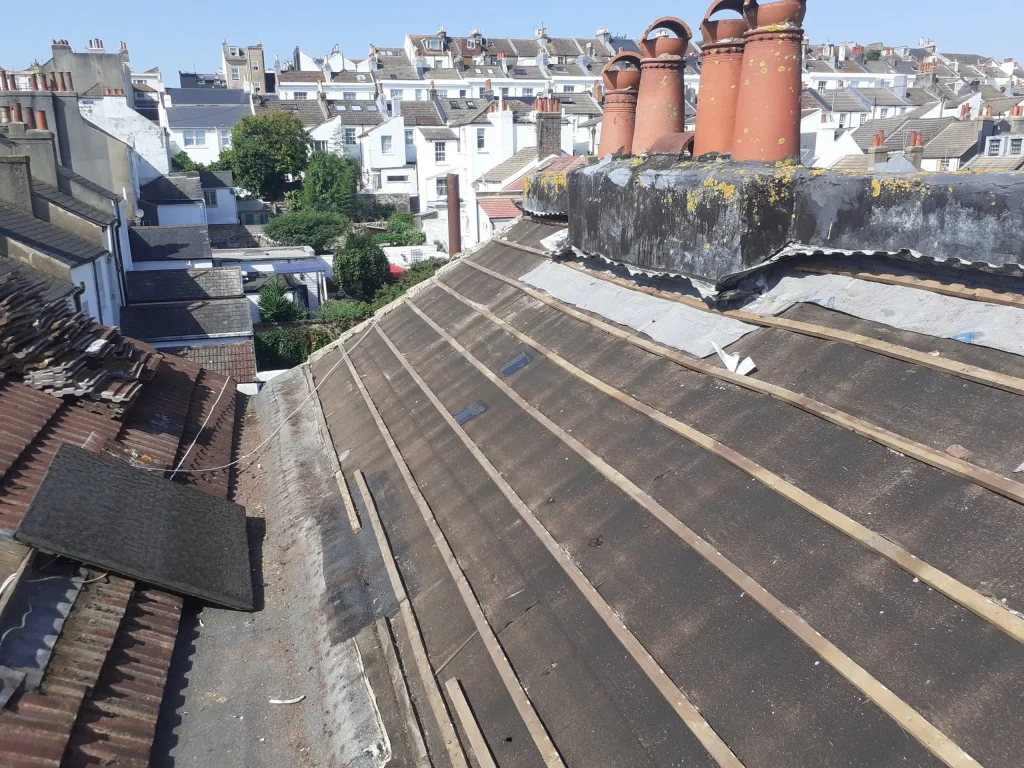
Cost to Fix a Pitched Roof Leak in Hove
The cost to fix a pitched roof leak in Hove depends mainly on safe access, the exact source of the water entry, and whether the work can be completed properly from ladders. In my experience, many small leaks on tiled or slate slopes can be repaired during one visit after an order is made, especially when the problem area can be reached with standard ladders and a roof ladder hooked securely over the ridge.
The important point is this: the visible leak is not always the part that controls the price. Access often decides whether the job stays simple or becomes more complicated.
Why Access Affects the Price So Much
On a sloped tiled or slate covering, I first need to know whether the damaged area can be reached safely. If the leak is near the lower slope, around a slipped tile, cracked slate, small flashing defect, or roof-edge detail, it may be possible to carry out the work from ladders. For a wider explanation of how different coverings behave, my guide to sloped and low-slope roof systems explains why diagnosis changes depending on the roof type.
If the repair area is higher up the slope, I may use a roof ladder that hooks over the ridge. This gives safer access across the surface without putting full pressure on tiles or slates. When that setup is possible, the work is usually faster and cheaper because scaffolding is not needed.
Access becomes more complicated when the roof is very steep, fragile, above a conservatory, above a narrow alley, or close to a public pavement. In those situations, scaffolding or specialist access may be needed, and that can change the overall price completely. If water is also overflowing at the roof edge, it may be worth comparing the issue with common rainwater-system pricing factors, because drainage faults can sometimes look like leaks from the main covering.
Common Pitched Roof Leaks I See in Hove
Hove has many older terraced and semi-detached houses, often with ageing slate or tiled coverings. Coastal wind and driving rain can expose weak areas that may have been slowly deteriorating for years. On some homes, nearby roofline details also contribute to damp problems, so my notes on modern roof-edge drainage choices for local properties can be useful when the issue is close to the eaves.
- Slipped or cracked tiles: often caused by nail fatigue, frost damage, or previous movement in the roof covering.
- Failed lead flashing: especially around chimneys, abutment walls, and party walls.
- Loose ridge or hip tiles: wind exposure can weaken old mortar beds.
- Blocked valleys: leaves, moss, and debris can push water sideways under the covering.
- Chimney leaks: sometimes caused by flashing failure, but sometimes by porous brickwork or cracked flaunching.
- Condensation mistaken for water ingress: poor loft ventilation can create moisture staining that looks like rainwater entering from outside.
When I Can Usually Repair It in One Visit
If photos show a clear and accessible defect, I can often arrive prepared and deal with the problem during the same visit. Typical one-visit work includes replacing a few broken tiles, repositioning slipped slates, sealing a small flashing defect, clearing a valley, or making a localised repair around a chimney detail.
This works best when the roof is structurally sound and the source of the leak is visible or strongly suspected before I arrive. Good photos from ground level, loft photos, and internal damp photos make a big difference because I can judge access and likely materials before the visit.
For older terraced properties, I often recommend checking my tile and slate work for terraced homes if the leak involves slates, tiles, ridges, or traditional roof details.
When the Cost Becomes Higher
A pitched roof leak becomes more expensive when the problem is not just a small surface defect. If water has been entering for a long time, it can damage battens, underlay, rafters, insulation, and ceilings. At that point, the visible damp patch is only part of the issue.
The cost may increase if I find:
- rotten battens beneath tiles or slates
- perished old underlay across a larger section
- multiple leak points instead of one clear defect
- dangerous or awkward access requiring scaffolding
- chimney or parapet wall defects allowing moisture through masonry
- previous patch work that has trapped water instead of solving the cause
I do not like guessing prices blindly because two roofs can leak into the same room but need completely different solutions. One may only need a slipped slate replaced. Another may need leadwork, timber attention, and safe access equipment.
Why the Leak May Not Be Directly Above the Stain
One thing homeowners often miss is that water does not always fall straight down from the entry point. On pitched roofs, water can travel along underlay, rafters, battens, or the back of masonry before appearing inside the house. This is why a stain on the bedroom ceiling does not automatically mean the tile directly above it is damaged.
Capillary action can also pull moisture into tiny gaps around lead flashing or old mortar joints. In Hove, I see this often around chimneys and party walls on older properties. The roof covering may look acceptable from the street, but the water can be entering through a small junction failure.
Repair First or Replace the Roof?
I do not automatically recommend replacement for a pitched roof leak. If the roof is generally sound and the problem is localised, a targeted repair is usually the sensible first option. A few damaged tiles, a loose ridge section, or a small flashing defect should not be treated like a full roof failure.
Replacement becomes more realistic when the roof has widespread nail sickness, brittle slates, failing underlay, repeated leaks in different areas, or timber deterioration beneath the covering. In that case, repeated small repairs can become false economy.
What I Need Before Giving a Realistic Cost
To judge the likely cost properly, I usually need to understand four things: where the leak appears inside, what the roof covering looks like outside, whether the area is safely accessible, and whether there are signs of long-term moisture damage.
Useful photos include:
- the outside roof area from ground level
- the damp patch inside the property
- any loft staining or daylight visible through the roof
- chimneys, valleys, ridges, and flashing details near the leak
- the front or rear access route for ladders
If the leak is active or you are unsure where water is entering, a priority visit for active water ingress is usually the quickest practical route.
My Practical View on Pitched Roof Leak Costs in Hove
For many Hove properties, the best-case scenario is a safe ladder-access repair that can be completed in one visit. That keeps the job simple, avoids unnecessary scaffolding, and gets the leak stopped quickly.
The worst mistake is ignoring a small leak until it damages plaster, insulation, battens, or timber. A minor slipped tile can become a much larger job if water keeps entering through repeated rainfall.
If the roof is accessible with ladders and a ridge-hook roof ladder, I can often deal with the problem during one visit after the order is created. If safe access is not possible, I will explain that clearly rather than pretending a risky ladder setup is sensible.
Interested in this service?
Check out the complete details and get a quote on our main page.
Go to: Urgent Leak Booking