Dealing with Garage Roofs: From Single Units to Large Blocks
Many calls I get in Brighton and Hove are about failing garage roofs. Often, it comes down to an old mineral felt covering that has become brittle, cracked, or loose after years of UV exposure and weathering. The bigger challenge, and something I regularly deal with, is diagnosing entire rows of terraced garages rather than one isolated unit. Whether you are responsible for a single garage or a block of 20, the principles of finding the defect remain similar, although the planning, access, detailing, and workmanship become more demanding.
Technical Reasons Garage Roofs Fail
Before water starts dripping inside, there are usually warning signs that the covering is reaching the end of its working life. I explain these early signs in more detail in my guide to when a garage covering should be renewed, but on site I normally find the same technical causes behind most failures.
A leaking weatherproof covering over a garage is rarely a sudden event; it is usually the result of predictable material ageing, poor drainage, or weak detailing. Here is what I typically find during an inspection:
1. Aged Bitumen Felt and UV Degradation
The most common material on older garages is a simple roll-on mineral felt. Over 10 to 15 years, ultraviolet radiation from the sun breaks down the bitumen and makes it rigid. Thermal movement, from hot summer days to cold winter nights, then causes this brittle material to crack. Once that happens, rainwater can find direct paths through the covering and into the deck below.
2. Poor Drainage and Structural Sagging
Many older garage roofs were built with too little fall, meaning rainwater cannot drain away properly. This leads to ponding, where standing water sits on the surface long after rainfall. That extra weight can cause the timber deck to sag, while the constant moisture accelerates the breakdown of the felt membrane and exposes weak seams, laps, or pinholes.
3. The Terraced Garage Problem: Adjoining Details
On a terraced block, the weakest areas are often the junctions between neighbouring units. A defect on one side can allow water to track sideways and appear inside another garage, making the source of the leak harder to identify. This often happens because of:
- Failed Upstands: The felt has not been turned up correctly against the dividing party walls, or it has slumped down over time.
- Porous Brickwork: Rainwater soaks into unprotected brick party walls above the covering and then travels down into the structure below.
- Poor Lap or Joint Detailing: The original trade workmanship on the covering may have left a weak seal directly over the dividing line between two garages.
The Modern Solution: A High-Performance System
My approach is not to keep patching isolated splits if the whole system has reached the end of its service life. I look at the condition of the deck, the perimeter edges, drainage, and adjoining details, because problems at the roofline can sometimes overlap with wider rainwater management issues. For that reason, homeowners may also find it useful to compare related Hove rainwater system price factors when water is not being carried away properly from the edge of the structure.
For a proper renewal, the work needs to be methodical. My online pricing tool for garage covering work is based on the same practical installation steps I use on site.
First, I strip everything back to the structural timber deck. This is non-negotiable because it allows me to check for rot, movement, soft spots, or weakened boards. Any defective timber must be repaired before the new waterproofing system is installed.
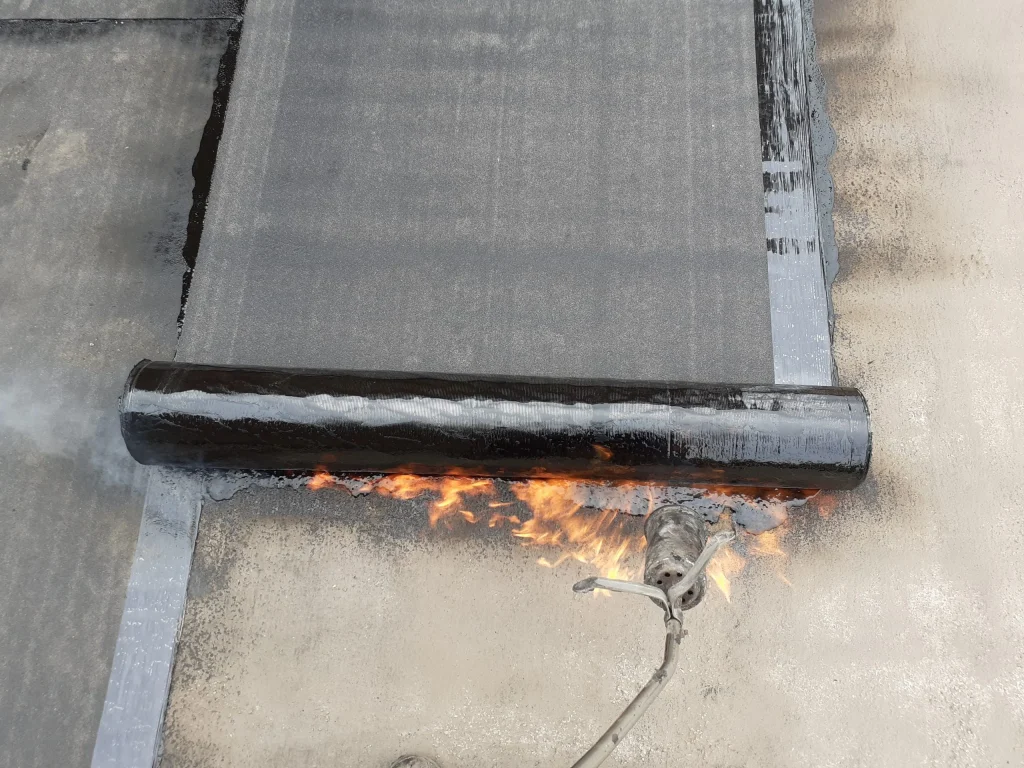
Once the deck is sound, I install a modern two-layer SBS-modified torch-on felt system. This is not the brittle felt of the past. SBS-modified bitumen contains rubber polymers, giving the material enough flexibility to handle normal expansion and contraction without cracking under typical weather movement.
For a terraced block, the detailing is especially important. I create a continuous, properly bonded membrane across the units being renewed, seal the upstands against party walls, and make sure every perimeter and junction is watertight. Done correctly, this greatly reduces the risk of water tracking from one unit to the next.
Get an Instant Price for Your Garage Roof
Understanding the technical failure points is the first step. The next step is understanding the likely cost. Once you know what a proper long-lasting installation involves, you can use my online calculator to get an instant fixed price for your specific garage roof. There is no need to wait for a site visit just to get an initial estimate; you can usually receive a detailed quote in under 30 seconds.
Interested in this service?
Check out the complete details and get a quote on our main page.
Go to: Garage Roof