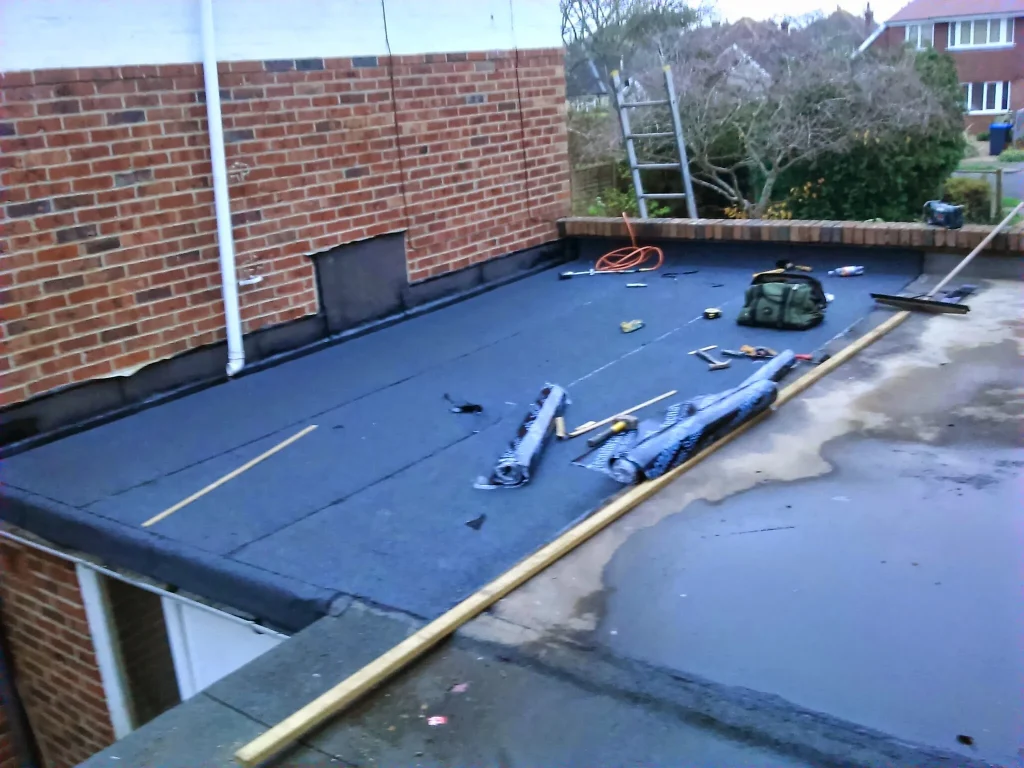
If you are searching for flat roofing near me, you are probably not looking for a lecture about materials. You want to know whether the person you call understands local challenges, can identify the cause properly, and will not recommend a full replacement when a careful repair would do the job.
When I inspect properties featuring both low-slope and sloped systems around Hove, Worthing and nearby Sussex areas, I usually start with the same question: is the covering actually failing, or is water getting in through one of the surrounding details? That distinction matters because many installations are blamed for leaks that actually start at parapet walls, cracked lead flashing, blocked outlets, poor upstands or condensation inside the build-up.
What a local flat roofer should check first
A good inspection should not begin and end with looking at the felt from above. I want to understand how the structure behaves during rain, where the water drains, whether the deck feels firm, and whether the leak appears only after bad weather or also during cold dry periods.
On local Sussex properties, especially older terraces and rear extensions, I normally check:
- The surface: splits, blisters, open laps, cracked mineral felt and areas where the membrane has gone brittle.
- Drainage: blocked outlets, slow-flowing gutters, standing water and poor falls across the area.
- Edges and trims: loose drip edges, weak perimeter details and wind-lifted felt at exposed corners.
- Wall junctions: failed lead flashing, porous brickwork, cracked mortar joints and damp tracking through parapet walls.
- The deck: soft boards, movement underfoot, sagging areas and signs that moisture has reached the substrate.
- Internal symptoms: ceiling stains, mould, condensation patterns and damp that does not match normal rainwater entry.
That process is important because a leak can travel sideways before it appears inside the property. The damp patch on the ceiling is not always directly below the defect.
Why choosing someone genuinely local matters
Working on properties in coastal areas is not quite the same as working in a sheltered inland town. Coastal wind can push rain under weak laps. Salt in the air can accelerate corrosion on trims, fixings and old flashing clips. Victorian and Edwardian properties often have awkward junctions where newer systems meet old brickwork that was never designed for modern waterproofing.
I often see problems around rear extensions where the surface itself has been re-felted, but the wall detail above it was left untouched. Water then enters through old pointing, runs behind the felt upstand and appears inside as if the new work has failed. A professional who works regularly on Sussex properties should be alert to that kind of issue.
For general replacement work, my guide to high-performance torch-on waterproofing systems is a useful starting point if you want to understand the typical methods used on domestic properties.
Common flat roofing problems I see near Brighton, Hove and Worthing
Most failures I inspect fall into a few repeat patterns. The details change from property to property, but the underlying causes are usually familiar.
Old felt becoming brittle
Older felt eventually loses flexibility. The surface becomes dry, cracked and less able to move with the deck. Once the laps open or the edges split, wind-driven rain can get underneath. This is common on outbuildings, dormers, porches and older rear extensions.
Ponding water
A surface should not behave like a shallow pond for days after rainfall. Persistent ponding usually means the structure has insufficient fall, the deck has sagged, or the outlet is too high. Standing water accelerates wear because it keeps the membrane wet and increases stress during freeze-thaw weather.
Failed flashing
Lead flashing is often the real weak point where a horizontal surface meets a wall. Lead expands and contracts with temperature changes, and over time it can crack, pull out of the mortar joint or become badly sealed with temporary mastic. If the flashing fails, even a good covering can leak.
Condensation mistaken for a leak
Not every damp ceiling means rainwater is coming through. On cold constructions, warm moist air from inside the room can hit the cold underside of the deck and condense. This often causes damp patches during cold weather rather than directly after rain. Replacing the felt alone will not fix that.
Parapet wall moisture
Local terraces often have parapet walls and party wall details that hold moisture. If the coping stones, mortar or felt capping fail, water can soak into the brickwork and track downward. This can look like a leak even when the horizontal covering is still serviceable.
Repair or replacement: what I look for
I do not believe every problem needs a full replacement. Some faults are local and can be repaired properly if the rest of the system is still sound. The decision depends on the condition of the membrane, the deck, the edges and the surrounding details.
A repair may make sense when the felt is still flexible, the leak has one clear source, the deck is firm and there are no signs of widespread moisture underneath. Examples include a split around an outlet, a small puncture, a lifted trim or a short section of failed flashing.
Replacement becomes more sensible when I find multiple patches, brittle felt, soft decking, long-term ponding, repeated leaks, poor insulation, open laps across the area or moisture trapped below the membrane. At that point, another patch may only delay the same problem returning somewhere else.
What a proper flat roof job should include
A successful installation is a system, not just a top layer of felt. The visible covering matters, but the preparation and detailing usually decide how long the work lasts.
For a typical domestic project, I would normally expect careful attention to:
- Deck preparation: the surface must be dry, stable and suitable for the chosen membrane.
- Falls: water should move toward the outlet instead of sitting in low areas.
- Upstands: the waterproofing should rise high enough at walls and penetrations to resist wind-driven rain.
- Flashings: leadwork or compatible detailing must protect the wall junction properly.
- Ventilation or insulation: the build-up must reduce the risk of condensation where rooms below are heated.
- Edge security: trims and perimeter details need to cope with coastal wind exposure.
When these details are rushed, the work may look finished from the ground but still be vulnerable at the edges, corners and outlets.
SBS torch-on felt, EPDM and liquid systems
Different systems have different strengths. I use the structure type, exposure, access and expected use to decide what is suitable.
SBS torch-on felt is a strong practical option for many domestic projects. It handles normal movement well, can be detailed neatly around edges and is well suited to outbuildings, extensions, porches, dormers and bay windows when installed correctly.
EPDM rubber can work well on simple shapes with fewer awkward details. It needs careful bonding and good edge restraint, especially in exposed positions.
Liquid-applied systems can be useful around complex details, awkward penetrations and certain refurbishment situations. They rely heavily on preparation, reinforcement and correct curing conditions.
The best system is not always the most expensive one. It is the one that matches the structure, drainage, exposure and detailing requirements.
Garage flat roofing near me
Outbuildings are some of the most common structures I inspect. They often fail because old felt has cracked, water has been ponding for years, or the timber deck has started to soften around the edges. On rows of these buildings, I also check whether neighbouring structures are draining across each other, because water from one can shorten the life of the next one.
If your search for local help is specifically about an outbuilding, the page on specialised outbuilding waterproofing services is more specific than a general guide.
Questions to ask before choosing a flat roofer
Before agreeing to any work, I would suggest asking practical questions rather than only comparing the final price.
- Will the old covering be removed or overlaid?
- Is the timber deck included if it turns out to be rotten?
- How will the falls and drainage be handled?
- What happens around the wall junctions and lead flashing?
- Is condensation a possible issue below the surface?
- What waterproofing system is being used and why?
- Are the edges suitable for local wind exposure?
A clear answer to these questions usually tells you more than a cheap headline price. An installation that ignores drainage, insulation or wall details can become expensive later.
When local inspection is more useful than guessing online
Photos help, but they rarely show the full story. I can often see whether felt is old or whether there is obvious ponding, but I cannot always judge deck condition, hidden moisture, poor falls or condensation risk from images alone.
A proper local inspection is especially useful if the leak is intermittent, if the ceiling stain is away from the obvious defect, if the area has already been patched several times, or if the damp appears during cold weather. Those situations need diagnosis, not guesswork.
Final thoughts on finding flat roofing near you
Searching for flat roofing near me should be about more than finding the nearest person with a ladder. The right professional should understand why the system failed, whether it can be repaired, and what details need changing so the same fault does not return.
For Sussex properties, I pay close attention to wind exposure, old brickwork, parapet walls, drainage and condensation because those are the details that often decide whether an installation lasts properly. A clean new membrane is only part of the job. The real value is in the diagnosis and the detailing.
If you are only trying to get a rough idea of likely cost, an online calculator can be useful and takes around 30 seconds. For an accurate decision, the structure itself needs to be checked carefully, especially around the edges, outlets and wall junctions.