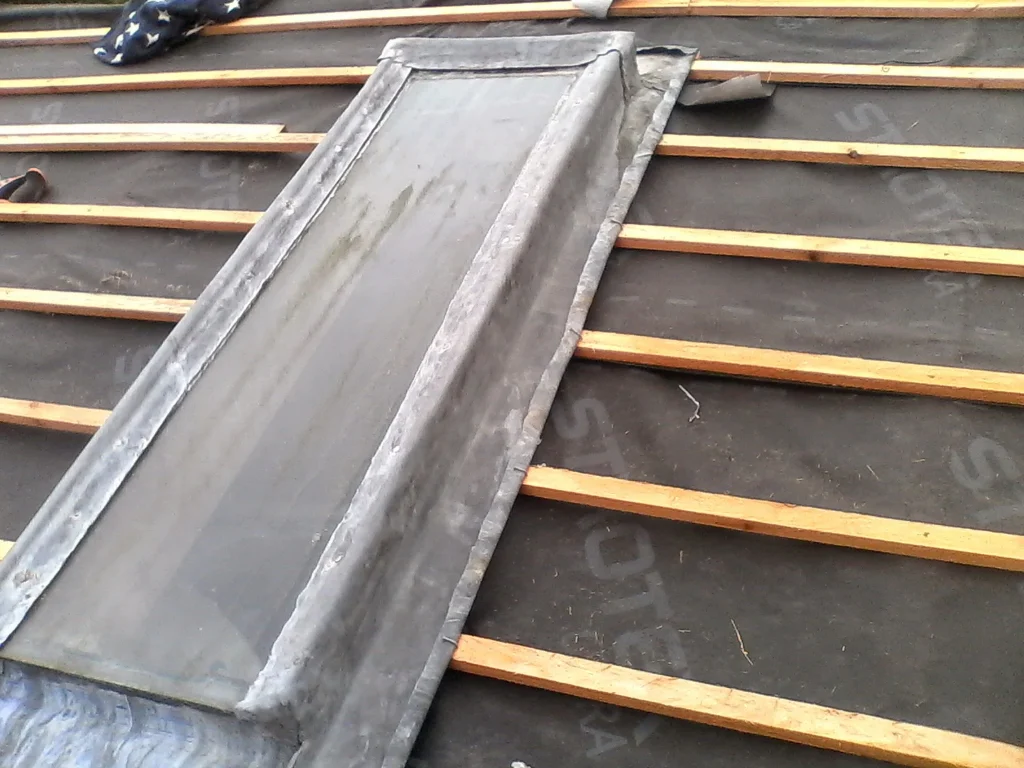
What it means to replace lead flashing
Replacing lead flashing involves completely stripping out old metalwork at a roof-to-wall junction, preparing the brickwork, and installing fresh, correctly sized lead to restore long-term waterproofing. Unlike a simple surface repair—which might involve resealing a minor mortar gap—a full replacement is required when the original materials are structurally exhausted, incorrectly fitted, or repeatedly failing.
For a property owner, deciding whether to repair or replace flashing usually comes down to the condition of the metal itself and how effectively it still behaves during severe weather. When rainwater runs down an exposed chimney breast or wall, it relies entirely on a secure mechanical overlap of lead to divert the moisture over the roof slates, tiles, or flat roof felt below. Once this core function breaks down, replacement becomes the only sensible option to prevent water ingress into the building.
The impact of coastal weather on Sussex roof joints
On traditional Victorian and Edwardian properties across Brighton, Hove, Worthing, and Sussex, lead flashing does a massive amount of heavy lifting. Shared chimney stacks, long stepped parapet walls, and single-storey bay window junctions are highly exposed to coastal winds and wind-driven rain.
Building substrates—like brickwork, timber rafters, and tiles—shift slightly as temperatures fluctuate. Lead is chosen for roof abutments precisely because it is highly malleable and absorbs this structural movement. However, constant exposure to seasonal freeze-thaw cycles and severe Channel gales eventually causes metal fatigue. While lead can easily last several decades if installed correctly, no waterproofing material lasts indefinitely under these coastal stresses.
Warning signs that local repair is no longer sensible
A reliable roofer will generally attempt to save existing leadwork if the core installation is sound. However, trying to fix a junction is not practical when the flashing displays clear signs of permanent degradation. The following are typical situations where a roof junction needs to be rebuilt properly rather than patched.
Thermal fatigue and split lead
Metal expands significantly under the heat of the summer sun and contracts when it cools. To allow for this, roofers use calculated, overlapping lengths of lead rather than a single continuous strip. If the original installer used sections that were too long, the repeated expansion eventually causes the metal to buckle and tear. A split piece of lead cannot be reliably fixed; smearing sealant over the split merely covers the tension. The crack will simply reopen, and the flashing must be replaced.
Shallow chasing and wind uplift
To anchor flashing, the metal is wedged into a horizontal groove cut directly into the brickwork joint, known as a mortar chase. If this chase is too shallow—often cut only a few millimetres deep instead of the recommended 25mm—the lead will never sit securely. High winds will continually peel the flashing out of the wall. Re-cementing shallow flashing rarely solves the problem, as it requires grinding a deeper chase into the wall to lock the replacement lead mechanically in place.
Poor overlapping and capillary action
Good flashing relies on deep vertical overlapping to combat gravity and the elements. If the lead does not lap far enough over the tiles below, or if the individual pieces of lead are barely joined together, wind-driven rain will blow upwards into the gaps—a process exacerbated by capillary action. You cannot patch inadequate coverage; new, properly sized sheets must be dressed onto the roof correctly.
Layers of old temporary patching
If you look at the flashing around a dormer window or chimney and see thick coatings of silicone mastic, black bitumen tar, or repair tape spanning the joint, the waterproofing below is likely finished. Multiple historic patch repairs usually suggest a junction has failed repeatedly. Scraping all this old material off only to attempt another temporary seal is often poor value. Stripping it all back and establishing a clean, permanent detail makes far more sense for the integrity of the property.
When is it possible to retain existing flashing?
Not every loose edge means a massive replacement job. You may not need to replace lead flashing if the metal itself is visibly thick (typically Code 4 lead or heavier), is shaped correctly over the tiles without buckling, and holds an adequate length down the roofline. In these scenarios, the only failure may be the superficial pointing in the chase where old mortar has turned to dust. A roofer can clear out the chase, add fresh securing wedges, and apply flexible sealant or fresh mortar, keeping the fundamental detail intact for minimal cost.
Understanding the factors affecting replacement prices
When the metal must be stripped out, the total quote depends heavily on accessibility and wall condition.
- Height and scaffolding requirements: Working around a prominent shared chimney on a terraced house roof naturally demands safe scaffold access. A ground-floor porch flashing job may simply require staging platforms, heavily altering the quote.
- Surrounding masonry condition: New lead cannot be securely chased into crumbling brickwork. In many Sussex properties, deteriorating chimney mortar requires isolated pointing repairs before a firm joint can be cut for the new flashing.
- Profile complexity: Simple, straight abutment flashings covering the side of a modern flat roof extension are less labor-intensive to measure and cut than intricate ‘stepped’ flashing tracking up a steep pitched roof alongside a chimney breast.
- Associated roof disturbance: In most pitched roof repairs, surrounding slates or clay tiles have to be lifted up so that side-flashing or lead soakers can be integrated safely beneath them, taking extra labor time.
When an online calculator can be a useful tool
Before bringing a professional out for an evaluation, taking a look at a lead flashing replacement cost estimator can be a helpful, pressure-free step. By factoring in straightforward criteria such as whether the affected junction sits high up on a chimney or is easier to access over an extension, an online calculator clarifies the basic labour scope. It establishes a helpful price window before making a financial commitment to the full rebuilding process.
Practical next steps
Persistent internal damp marking on bedroom ceilings or upper structural walls shouldn’t just trigger the purchase of more sealant. Attempting another surface repair onto a fundamentally tired roof-to-wall junction rarely keeps out heavy rain for long. If the flashing sits loose from a shallow chase, exhibits split metal due to old thermal tension, or vanishes underneath ugly patchwork tapes, replacing it from scratch offers the safest and most permanent solution for coastal households.