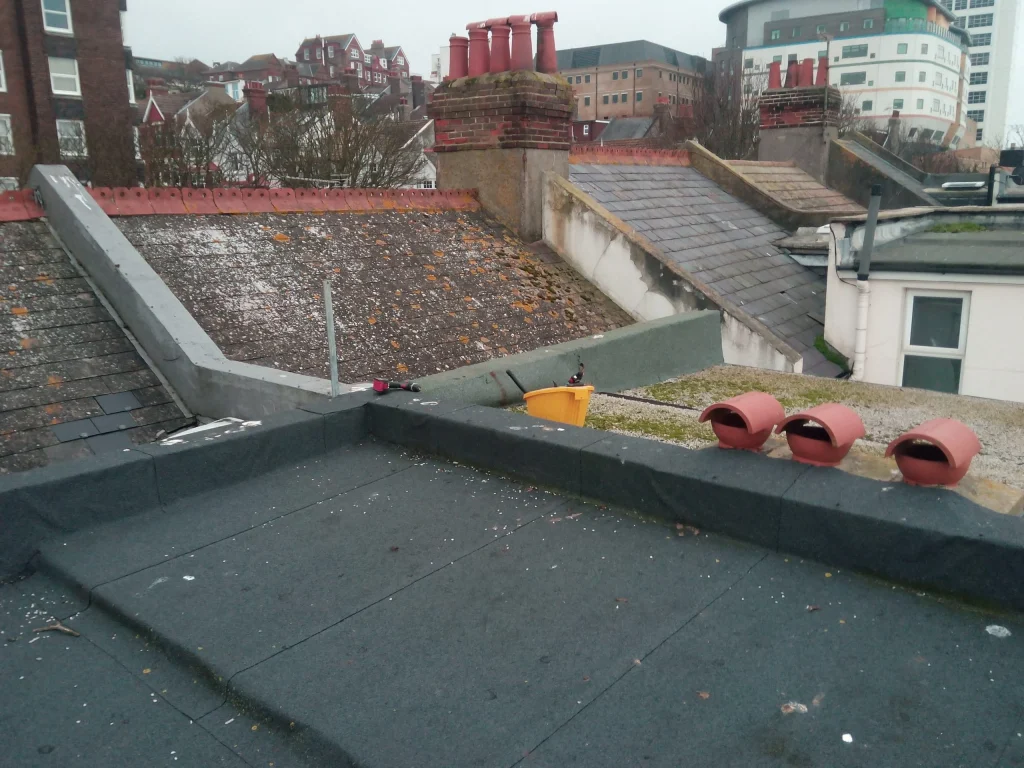
As an independent roofer living and working in the Brighton and Hove area for the last 12 years, and with 18 years of total experience in the trade, I am often asked the same question by homeowners: which material should I choose for a flat roof? The answer depends on the structure, the details, the drainage, the budget and the condition of the existing roof. But when I look at real domestic roofs across Brighton, Hove, Worthing and the wider Sussex coast, one system continues to stand out for practical reliability: modern SBS torch-on felt.
There are many high-performance roofing materials available today. EPDM rubber, GRP fibreglass, liquid-applied membranes and older asphalt systems all have their own place. However, for many extensions, dormers, garages, porches, bay roofs and standard domestic flat roofs, a properly installed SBS bitumen felt system remains one of the most dependable choices.
The important word here is properly. Felt does not fail simply because it is felt. Most of the failed roofs I inspect have problems because the deck was soft, the falls were wrong, the edges were weak, the laps were poorly bonded, or the wall junctions were never detailed correctly. A good flat roof is not just a surface covering. It is a complete waterproofing system, and every part of that system has to work together.
What homeowners mean by felt roof, bitumen roof and torch-on felt
Homeowners often use several different names for the same general type of flat roof. Some people call it a felt roof. Others call it flat roof bitumen, torch-on felt, mineral felt, SBS felt or simply black felt. In modern roofing, these names usually refer to a bitumen-based membrane system that is applied in layers and bonded with heat.
Older felt roofs had a reputation for becoming brittle over time. Many of the old coverings I remove have lost flexibility completely. They crack at corners, split at laps, lift around edges and eventually allow water into the timber deck below. That older experience is one reason some property owners assume felt is outdated. But modern SBS-modified bitumen felt is not the same as the thin, tired felt found on many old garages and extensions.
SBS stands for Styrene-Butadiene-Styrene. In simple terms, it is a rubberised additive blended into the bitumen to help the material stay flexible. That flexibility matters because flat roofs are never completely still. Timber decks expand and contract. Buildings move slightly. Temperature changes affect the surface. Wind can stress the perimeter. A material that can tolerate normal movement is much better suited to real roofs than a rigid surface that cracks when conditions change.
A proper torch-on felt roof is normally built in layers. The exact build-up depends on the roof, but the principle is always the same: create a continuous waterproof covering with strong laps, secure edges, reliable outlets and correctly sealed details around walls, upstands, parapets and penetrations. The membrane itself is important, but the quality of the preparation and detailing is just as important.
Why I recommend Tecnatorch SBS Torch-On Mineral Felt Charcoal
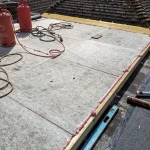
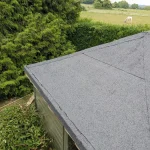
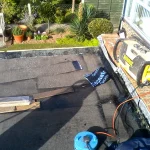
For my own work, I trust Tecnatorch SBS Torch-On Mineral Felt in Charcoal. If I were replacing my own flat roof tomorrow, this is the material I would choose. I have worked with many roofing products over the years, but this specific SBS torch-on mineral felt has proven itself to be strong, flexible and practical in the conditions we face along the Sussex coast.
The charcoal mineral finish is not only there for appearance. The mineral surface protects the bitumen below from UV exposure and helps the roof resist weathering over time. Without a protective mineral cap, sunlight can gradually break down the waterproofing layer. On an exposed flat roof, especially one facing coastal winds and summer heat, UV protection is not a small detail. It is a major part of long-term performance.
The SBS modification gives the felt the elasticity needed to cope with normal expansion and contraction. During winter, a roof can become cold and stiff. During summer, the same roof can heat up quickly. A poor-quality or badly aged material may crack or blister under that cycle. A good SBS torch-on felt system is designed to deal with those changes without losing its waterproofing integrity.
When installed correctly, torch-on felt also creates strong welded laps. The back of the felt is heated with a propane torch until it bonds to the layer below. A skilled installer looks for the correct molten bead at the lap, because that bead shows the material has fused properly. Too little heat can leave a weak seam. Too much heat can damage the membrane. This is why the installer matters as much as the product.
Why Sussex coastal weather is so demanding on flat roofs
Brighton, Hove and Worthing are not gentle environments for flat roofs. We get coastal wind, driving rain, salt air, temperature changes and strong UV exposure during summer. A flat roof sits directly under these conditions every day. Unlike a pitched roof, it does not shed water as quickly, so the quality of the falls, outlets, laps and wall details becomes critical.
Wind-driven rain is one of the biggest issues I see locally. Rain does not always fall straight down. On exposed properties, especially near the coast, water can be pushed sideways into laps, under loose trims, behind weak flashing or into porous brickwork above the flat roof. This is why I never inspect only the centre of the roof. The real problem is often at the edge, the outlet, the parapet, the lead flashing or the wall junction.
Older Sussex properties can make the diagnosis more complicated. Victorian and Edwardian buildings often have brickwork, parapets, party walls and extensions that have been altered many times over the years. Sometimes the flat roof covering is blamed for a leak, but the water is actually entering through cracked mortar, porous brickwork or failed flashing above the roof. In that situation, replacing the felt alone may not solve the real problem.
This is why I always think of a flat roof as a complete system. The membrane, the deck, the insulation, the outlets, the wall details, the edge trims, the fascia line and the surrounding masonry all affect whether the roof performs properly. A premium felt laid over a poor base is still a poor roof. A good roof starts below the surface.
Where SBS torch-on felt works best
Modern SBS torch-on felt is suitable for many domestic flat roofs when the structure and details are right. I use it regularly on extensions, garages, dormers, porches, bay roofs and other flat roof areas where a tough, repairable and proven waterproofing system is needed. Whether the project is a standard rear extension or a flat roof dormer, the same principles apply: the deck must be sound, the surface must be dry, and the details must be formed correctly.
A felt roof works best when the timber deck is firm, dry and stable. If the plywood or OSB below the roof has become soft, swollen or delaminated, the new covering cannot be expected to perform properly. The roof also needs reasonable falls toward the gutter or outlet. Felt can cope with normal rain, but persistent ponding water puts extra stress on the roof and can shorten the lifespan of any flat roofing system.
Good edges are also essential. The perimeter of a flat roof is exposed to wind uplift, water run-off and temperature movement. If the felt is not dressed correctly over the edge, or if trims are loose, the roof can start failing from the outside inward. This is one of the most common problems I see on cheaper installations.
Wall junctions are another major factor. Where a flat roof meets a wall, the upstand, flashing and masonry condition all matter. If the upstand is too low, the flashing is weak or the wall above is porous, water may bypass the roof covering completely. A roof can look fine from above and still leak because the wall detail is wrong.
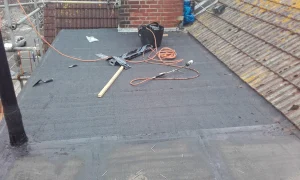
1-layer and 2-layer felt roof systems
Not every flat roof needs the same specification. Depending on the use of the building, the condition of the structure and the customer’s budget, a felt roof may be installed as a single-layer or two-layer system. The important point is that the system must match the roof. Choosing the cheapest option for the wrong roof can become expensive later.
The 2-layer system
For most residential flat roofs, I normally recommend a two-layer torch-on felt system. This usually includes a robust underlay followed by a mineral-finished top layer. The underlay gives the system additional strength and security, while the top layer provides the weatherproof finish and UV protection. For main property roofs and extensions, this is usually the best long-term value.
A two-layer system is especially useful where the roof is exposed, where the roof protects a living space, or where long-term durability matters more than the lowest initial cost. When a homeowner is planning a full upgrade, a properly installed flat roof replacement using SBS torch-on felt can provide decades of watertight protection when the deck, falls and details are also correct.
The 1-layer system
A one-layer felt system can still be useful in the right situation. It is a more budget-conscious option and may be suitable for simple outbuildings, small garage roofs or lower-risk areas where the structure is straightforward and the customer wants a practical waterproof covering without the full cost of a two-layer build-up.
The single-layer approach should not be confused with a poor repair or a quick patch. It still needs proper preparation, correct bonding, secure edges and attention to details. But it is not the system I would normally choose for a main roof over a living space if the goal is maximum long-term performance.
Planning a modern waterproofing system
Before choosing any material, the roof should be assessed as a complete structure. A modern felt installation is not only about rolling out a membrane and heating it down. The installer has to understand the deck, the falls, the outlet position, the wall junctions, the risk of condensation, the condition of the old layers and the surrounding building fabric.
On some roofs, the correct decision is a full strip and replacement. On others, an overlay may be possible if the existing roof is dry, stable and firmly bonded. Sometimes the membrane is not the main problem at all, and the real issue is a parapet, a blocked outlet, failed lead flashing or moisture forming inside the roof build-up. This is why a proper inspection matters before making a decision.
If you are comparing systems or thinking about a new modern waterproofing system, SBS torch-on felt deserves serious consideration. It is proven, flexible, repairable and well suited to many flat roofs in Brighton, Hove, Worthing and the wider Sussex area when installed with the right preparation and workmanship.
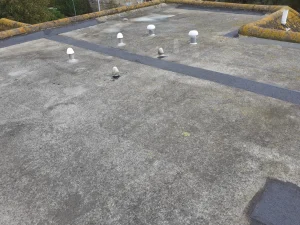
Overlaying an existing felt roof: when it is sensible and when it is risky
One of the most common questions I receive from homeowners is whether an old flat roof must always be stripped before a new felt system is installed. The honest answer is no. In some cases, overlaying an existing felt roof can be a practical, cost-effective and low-disruption option. But it only makes sense when the roof below is dry, stable and structurally sound.
An overlay means installing a new felt layer or new felt system over the existing roof covering. This can reduce waste, shorten the project and avoid unnecessary stripping. If the old felt is still firmly bonded, the deck beneath is solid, the surface is reasonably flat and there is no trapped moisture, an overlay may provide a strong waterproofing upgrade without rebuilding everything from scratch.
However, overlaying is not a shortcut for hiding serious problems. If water has already reached the plywood or OSB deck, covering the roof with more bitumen will trap the moisture inside the structure. The surface may look better for a while, but the timber below can continue to deteriorate. That is why I always check the roof underfoot, inspect the edges, look for blistering and consider whether previous leaks have already damaged the build-up.
I avoid overlays when the roof has soft decking, heavy blistering, major ponding, unknown old layers, poor falls, repeated patches or signs of long-term water ingress. In those cases, a new layer on top may only delay the real repair. A flat roof needs a sound base. If the base has failed, the correct solution is usually to strip back to the structure, replace damaged boards and rebuild the system properly.
The installation process behind a reliable torch-on felt roof
A good torch-on felt installation requires more than simply rolling out a membrane. The preparation, heating, bonding and detailing all have to be controlled carefully. A roof can fail early if the installer rushes the laps, ignores the edges, torches over dirt, traps moisture or fails to form the wall junctions correctly.
The surface must be suitable before any new felt is applied. Loose material should be removed, the roof should be dry, and the deck must be firm enough to support the system. If the old roof is being overlaid, the existing surface needs to be checked for adhesion and stability. If the roof is being stripped, the new boards must be fitted correctly and any rotten or weakened timber must be replaced.
During torch-on installation, the back of the felt is heated with a propane torch until the bitumen softens and bonds to the surface below. At the lap, the installer should create a visible molten bead. This bead is important because it shows the sheets have fused together rather than merely sitting on top of each other. A weak lap can become a water path, especially during wind-driven rain.
Heat control is critical. Too little heat leaves poor adhesion. Too much heat can damage the membrane, burn the felt or weaken the finish. The installer has to understand how the material behaves and how quickly it reacts. Corners, outlets, upstands and edges all require extra care because they are the areas where leaks most often begin.
Why the details matter more than the middle of the roof
When homeowners imagine a leaking flat roof, they often picture a hole somewhere in the middle of the surface. In reality, that is not where most leaks start. The central area of a felt roof can look perfectly acceptable while water is entering through an open lap, a failed outlet, a cracked edge, a low upstand, a weak flashing detail or masonry above the roof.
This is why I do not inspect only the visible felt surface. I look at the full roof perimeter, the drainage route, the wall connections and the surrounding building. On Sussex properties, especially older houses around Brighton, Hove and Worthing, the leak source can be higher than the flat roof itself. Water may enter through brickwork or lead flashing and then appear inside as if the roof membrane has failed.
The edge detail is especially important. Edges deal with wind uplift, rainwater run-off and temperature movement. If trims are loose, if the felt has not been dressed properly, or if the fascia below is starting to rot, water can begin working its way into the system from the perimeter. Once water reaches the deck, the damage can spread quietly before the homeowner sees a clear internal stain.
Outlets are another common weak point. They collect water from the whole roof, so any blockage, poor seal or badly formed outlet detail can cause serious problems. Leaves, moss and debris can slow drainage and create standing water. If water backs up around the outlet, it will search for the easiest route into the building.
Common failure points on bitumen and felt flat roofs
Most failed felt and bitumen roofs I inspect have one or more predictable weaknesses. The material itself is often blamed, but the real cause is usually poor preparation, weak bonding, bad drainage or incorrect detailing. Understanding these failure points helps homeowners decide whether they are looking at a local repair or a more serious roof problem.
Open laps
The laps are the joints between felt sheets. If the sheets were not heated and bonded correctly, water can work into the seam. On exposed coastal roofs, wind-driven rain can make this worse because water is pushed sideways rather than simply falling down the slope. A small opening at a lap can create a persistent leak, especially during heavy weather.
Cracked or lifted edges
Edges are under constant stress. They experience wind uplift, movement, rainwater flow and changes in temperature. If the felt is poorly dressed over the edge, or if trims move, crack or loosen, the roof can start to fail from the outside inward. This is one reason cheap edge details often become expensive later.
Ponding water
Bitumen can cope with normal rain, but persistent ponding water is different. If water remains on the roof for days after rain, the surface is under constant stress. Dirt collects, algae grows, UV wear becomes uneven and older bitumen can blister or soften over time. Ponding also makes small defects more serious because water has more time to find a way into the roof.
Failed outlets
Outlets are natural leak risks because they combine drainage, joints, movement and debris. A blocked outlet may cause water to back up across the roof. A poorly formed outlet detail may allow water to pass beneath the felt. Before blaming the whole roof covering, I always check the drainage route carefully.
Wall junctions and flashing
Where a flat roof meets a wall, the upstand and flashing must be reliable. Failed lead flashing, cracked mortar, porous brickwork or a low upstand can allow water behind the roof covering. In that situation, the felt may be perfectly sound, but water still appears inside the property because it has entered from above the membrane.
Warning signs that your felt or bitumen roof needs attention
Homeowners can often spot early warning signs before a roof becomes an emergency. One sign does not automatically mean the whole roof needs replacing, but it does mean the roof should be inspected properly. The earlier the source is found, the more likely it is that a practical repair may still be possible.
- Cracks appearing in the felt surface
- Blisters or bubbles in the bitumen
- Water sitting on the roof several days after rain
- Loose trims around the roof edge
- Lifted felt at the perimeter
- Open seams between felt sheets
- Soft areas underfoot
- Repeated small patches in different places
- Damp marks near a wall junction or parapet
- Rotting fascia boards below the roof edge
- Water stains appearing after heavy wind-driven rain
- Overflowing or blocked outlets and gutters
If you are experiencing active water ingress, the first priority is to stop further damage. A localised repair may be enough if the leak source is clear and the surrounding roof is still in reasonable condition. For urgent situations, you can arrange a professional leak consultation so the source can be traced and the correct repair can be planned.
When a felt roof repair is usually enough
A felt or bitumen roof does not always need full replacement. Many roofs can be repaired successfully if the defect is local and the rest of the system is still healthy. The key is to identify whether the roof has one isolated weakness or whether the whole covering is failing across multiple areas.
Repair may be sensible when one lap has opened but the felt around it is still flexible and sound. It may also be appropriate when there is a small puncture, a split in a limited area, a failed outlet detail, a short section of lifted edge trim or a flashing issue above an otherwise good roof. In these cases, a targeted repair can often restore the waterproofing without replacing the entire roof.
One advantage of torch-on felt is that compatible new felt can often be bonded securely to the existing system. When the surface is prepared correctly, a patch or reinforced detail can be torch-welded into place to form a robust repair. This is very different from simply smearing general sealant over a crack, which is usually only a temporary emergency measure.
In many straightforward cases, a half-day or full-day repair slot may be enough to trace the leak, prepare the surface and complete a proper repair. The condition of the existing roof matters, though. If the felt is brittle, contaminated, wet underneath or lifting in several areas, even a neat-looking patch may not solve the underlying problem.
When replacement becomes the better decision
Replacement becomes more realistic when the roof has failed as a system rather than in one isolated place. If the felt is brittle across the roof, blistered in multiple areas, cracked at several laps, lifting around more than one edge or covered with repeated patches, another small repair may only move the leak somewhere else.
The condition of the deck is one of the biggest deciding factors. A bitumen roof depends on the structure below it. If water has reached the plywood or OSB and the boards have become soft, swollen or delaminated, the roof covering cannot be trusted. Installing more felt over a weak deck is not a proper long-term solution.
Replacement should also be considered when the roof has major ponding, poor falls, badly positioned outlets or old details that were never formed correctly. In these cases, the best value is often not another patch, but a proper rebuild that considers the deck, falls, insulation, outlets, upstands, edges and flashing as one complete system.
A cheap repair can be useful when it buys time or solves a genuinely local defect. But if the roof is at the end of its life, patching can become false economy. The money spent on repeated temporary fixes may be better invested in rebuilding the roof correctly once, with a modern SBS torch-on felt system and properly formed details.
Why torch-on felt is one of the most repairable flat roof systems
One of the strongest practical advantages of torch-on felt is that it can often be repaired cleanly and securely. If the existing roof is still in reasonable condition, compatible new felt can be bonded to the old system and integrated into the surface. A proper repair is not just a smear of sealant. It is a prepared, heated and welded repair that becomes part of the waterproofing layer.
This repairability matters for real homeowners. A flat roof may be mostly sound but still develop one weak lap, one damaged outlet, one lifted edge or one split caused by movement. In that situation, it is not always necessary to replace the whole roof. If the defect is local and the surrounding felt is still flexible, a targeted torch-on repair can be a very sensible solution.
General-purpose mastics and emergency sealants have their place during bad weather, but they should not be confused with a long-term repair. They may slow water ingress temporarily, but they rarely rebuild the detail properly. On a bitumen felt roof, the best repairs are usually made with compatible materials, correct preparation and proper heat bonding.
This is one reason I still consider SBS torch-on felt so practical. Some flat roof systems can become difficult to patch once they age or degrade. With felt, if the surface is suitable and the system has not failed completely, a professional repair can often be completed efficiently and with a clear technical logic behind it.
Condensation can look like a roof leak
Not every damp ceiling is caused by rainwater entering through the felt. On older flat roof constructions, condensation is sometimes mistaken for roof failure. This is especially common on cold roof structures where warm moist air from inside the property reaches the cold underside of the roof deck and condenses.
Condensation can behave differently from a rainwater leak. It may appear mainly in cold weather. It may affect a wider area of ceiling rather than one obvious drip point. It may be associated with mould, poor ventilation or high internal humidity. A rain leak, by contrast, often appears after heavy rain, wind-driven rain or when water has been sitting on the roof.
This distinction is important because adding another layer of bitumen on top of the roof will not solve a condensation problem. If moisture is forming inside the roof build-up, the insulation, ventilation and internal moisture conditions need to be considered. A new waterproof membrane may look like the answer, but it will not stop warm air condensing below the deck.
Before deciding on repair, overlay or replacement, I always want to know where the water is really coming from. Is it passing through the felt? Is it entering through a wall junction? Is the outlet blocked? Is the lead flashing above the roof failing? Or is the damp actually condensation forming within the structure? The correct diagnosis matters more than guessing.
How long should an SBS bitumen flat roof last?
A well-installed SBS bitumen flat roof can often last around 20 to 25 years. Some roofs last longer when they are sheltered, well drained and properly maintained. Others fail much earlier because of poor installation, trapped moisture, weak edges, standing water or unresolved wall problems.
The lifespan of a felt roof depends on the whole system, not only the brand of membrane. A premium felt installed over a damp or soft deck will not perform properly. A roof with poor falls may hold water for too long. A roof with weak edges may fail around the perimeter. A roof with bad flashing may leak even though the felt itself is still intact.
The best results come from combining a good membrane with good preparation. The deck should be firm and dry. The falls should move water toward the outlet or gutter. The laps should be fully bonded. The edges should resist wind uplift. The outlets should be formed correctly. The wall junctions should be high enough, sealed correctly and protected by suitable flashing.
Maintenance also matters. Keeping outlets clear, watching for lifted trims, checking for ponding water and dealing with small defects early can help protect the roof. A flat roof should not be ignored until water appears inside. By the time damp reaches the ceiling, the deck or insulation may already have been affected.
How SBS torch-on felt compares with other flat roofing materials
There are several flat roofing materials available today, and I do not believe every roof should be judged by one simple rule. EPDM rubber, GRP fibreglass, liquid-applied systems, asphalt and felt all have different characteristics. The right choice depends on the roof, the details, the movement, the budget and the expected use of the area.
My preference for many domestic flat roofs in Sussex is SBS torch-on felt because it is proven, flexible, repairable and well suited to the type of roofs I work on regularly. It has a long track record in the UK, it can be detailed effectively around many common flat roof shapes, and it can often be repaired without replacing the whole system when the defect is local.
Older poured asphalt had a very different character. It was often rigid, and as buildings moved or temperatures changed, cracking could become a problem. Modern SBS felt is more elastic because the bitumen has been modified to tolerate normal movement. This difference is one reason I would not compare modern SBS torch-on felt directly with old brittle felt or old asphalt systems.
GRP fibreglass and EPDM rubber can work in certain situations, but they require their own correct preparation and detailing. No material is immune to poor workmanship. A badly detailed roof will eventually expose the weakness of the installation, regardless of the product used. For my own work, I prefer a system I know well, can install with precision and can repair logically if a local issue appears later.
The details that decide whether a flat roof succeeds
Most serious flat roof problems are decided at the details. The middle of the roof may look clean, but the leak may be coming from a parapet, outlet, corner, wall junction, roof edge, pipe penetration, failed flashing or porous brickwork. This is why a flat roof should never be assessed only by standing back and looking at the surface.
Parapet walls and firewalls are especially important on many Sussex properties. These areas can hold moisture, crack, allow water through old mortar joints or let rain pass behind the waterproofing layer. In some situations, proper parapet wall waterproofing and felt capping is more important than another patch on the flat roof surface.
Outlets need the same attention. A roof can have excellent felt across the main area, but if the outlet is too high, blocked, poorly sealed or badly formed, water will collect and stress the roof. Standing water around an outlet is never something I ignore. It tells me the drainage route needs to be checked before deciding what repair is appropriate.
Lead flashing and wall junctions also need careful diagnosis. If the wall above the roof is cracked or porous, water can enter the building from above the felt. In that case, the flat roof covering may be blamed unfairly. A proper inspection should include the masonry, mortar, flashing, upstand height and the way water moves down the wall during heavy rain.
My practical approach to choosing repair, overlay or replacement
When I inspect a flat roof, I do not start by assuming the most expensive option. I look for the cause first. A roof with one local defect may only need a repair. A dry, stable old felt roof may be suitable for an overlay. A roof with soft decking, trapped moisture, poor falls and repeated failures is much more likely to need replacement.
The decision should be based on evidence. I want to know whether the felt is still flexible, whether the deck feels firm, whether water is draining properly, whether the outlets are clear, whether the edges are secure and whether any wall detail is allowing water to bypass the membrane. Without those checks, the wrong solution can be chosen.
A repair is usually best when the problem is isolated and the rest of the roof has life left in it. An overlay may be suitable when the existing covering is dry, well bonded and structurally stable. A full replacement is usually the better choice when the roof has failed across multiple areas, the deck is soft, the details are fundamentally wrong or the roof has already been patched many times.
This is also why I do not like judging every roof by age alone. Some older SBS felt roofs remain serviceable because they were installed correctly and maintained reasonably. Some newer roofs fail early because the preparation, drainage or detailing was poor. The condition of the system matters more than the date it was installed.
Transparent pricing and a clear roofing process
I know many homeowners want to plan roof work without pressure. They may not be ready to book immediately, but they still need a realistic idea of cost. Waiting days for a rough estimate or dealing with pushy sales tactics is frustrating, especially when you are only trying to understand your budget.
That is why I use online calculators for many of my roofing services. In around 30 seconds, you can calculate an estimated price for your project yourself, with no commitment. This gives you a clear starting point before arranging a site visit or making a final decision.
Once a project moves forward, I carry out a free on-site survey where the roof can be assessed properly. After that, I provide a formal fixed-price quote. If the work is approved, the project is managed through a secure client portal where schedules, daily photo logs, documents and warranties can be kept in one place.
This process is designed to make the work transparent. You should know what is being done, why it is being done and how the price has been calculated. A flat roof is an important part of the property, and the customer should not be left guessing about the specification, the progress or the guarantee.
Final view on felt, bitumen and torch-on flat roofs
Modern SBS torch-on felt is not an outdated flat roofing material. When it is installed on the right base, with proper falls, secure edges, strong laps, reliable outlets and correctly formed wall details, it remains one of the most practical and dependable systems for many domestic flat roofs in Brighton, Hove, Worthing and across Sussex.
The failures I see are usually not caused by felt being a bad material. They are usually caused by bad preparation, weak detailing, trapped moisture, poor drainage, soft decking or water entering from nearby walls and flashing. A roof should be judged as a complete system, not just by the visible black surface.
If your flat roof is leaking, showing cracks, holding water, lifting at the edges or developing damp near a wall junction, the most important step is diagnosis. The answer may be a local repair, a carefully considered overlay or a full replacement. The right choice depends on the condition of the membrane, the structure below it and the details around it.
If you are concerned about the condition of your current flat roof, you can book a free on-site roof inspection and get a clear assessment before deciding what to do next. With the correct inspection, the correct specification and the correct workmanship, an SBS torch-on felt roof can provide strong, repairable and long-lasting protection for your property.