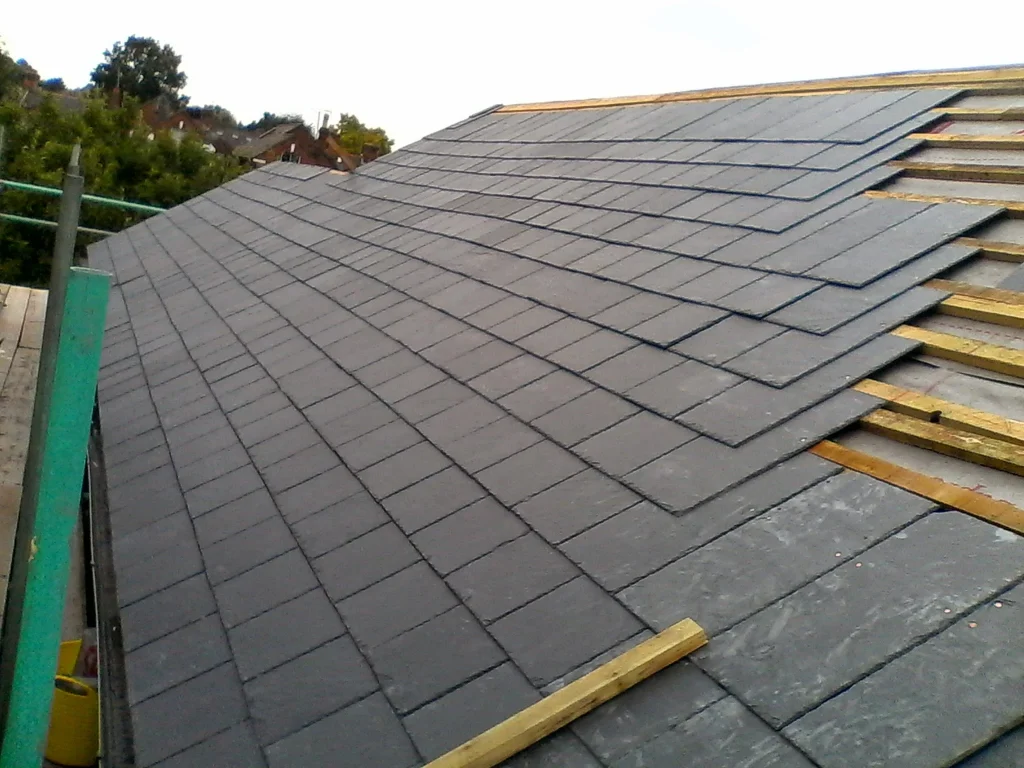
A flat roof and pitched roof behave very differently, even when they are part of the same property. I see this a lot on Sussex homes: a main tiled or slate roof over the house, then a flat roof over a rear extension, dormer, porch, bay window or garage. The mistake is treating both roofs as if they fail for the same reasons.
A pitched structure is designed to shed water quickly. However, when issues arise, addressing a water ingress problem requires understanding how the slope affects drainage. A flat surface has to hold back water for longer and guide it carefully toward an outlet or gutter. That one difference changes the materials, the detailing, the way leaks appear and the kind of maintenance the system needs.
The simple difference between a flat roof and pitched roof
A pitched roof uses slope as its main defence. Tiles or slates overlap each other so rain runs down the surface and away into the gutter. The covering is not normally meant to be completely sealed like a membrane. It works because each piece overlaps the one below it.
A flat roof works more like a waterproof tray. Even when it has a slight fall, water moves slowly. The surface has to be continuous, sealed and correctly detailed at edges, outlets, upstands, walls and penetrations. If a seam, flashing or outlet detail fails, water can sit there and slowly find its way into the building.
That is why work on low-pitched surfaces is usually more sensitive to preparation and detailing. A pitched roof can sometimes tolerate a small amount of wind-driven rain under the tiles if the underlay and battens are sound. A flat membrane cannot rely on that same principle.
Where I usually see flat roofs added to pitched roof homes
Across Brighton, Hove and Worthing, many older homes have a mixture of both roof types. The original house may have a pitched slate or tiled roof, while later additions use flat roofing because the shape, height or access makes a pitched roof impractical.
The most common examples I inspect are:
- Rear extensions: often built with flat roofs because of window heights and boundary lines.
- Dormers: usually flat-roofed, with vulnerable cheeks and flashing details.
- Bay windows: small flat roofs that often leak where they meet the front wall.
- Porches: small roof areas where wall junctions matter more than roof size.
- Garages: simple flat roofs that often suffer from old felt, ponding water and soft decking.
- Parapet areas: flat or low-slope sections hidden behind brickwork on older terraced houses.
These mixed layouts are normal, but they need the right diagnosis. A leak inside the property may come from the lower section, the pitched area above it, a wall junction between them, or even failed drainage components sending water where it should not go.
How water behaves on a pitched roof
On a pitched roof, rainwater should move quickly from the ridge down to the eaves. The tiles or slates overlap, the battens hold them in place, and the underlay provides a secondary defence if wind-driven rain gets underneath.
Problems usually start when that water path is interrupted. A slipped tile, cracked slate, loose ridge, failed valley, blocked gutter or damaged lead flashing can redirect water into the structure. In Brighton and Hove, I also see wind-driven rain pushed under older coverings, especially on exposed elevations facing strong coastal weather.
The common pitched roof failures I look for include:
- slipped or broken tiles and slates
- nail sickness on older slate roofs
- cracked ridge or hip mortar
- failed lead flashing around chimneys and abutments
- blocked valleys and gutters
- rotting battens or underlay failure
With a pitched roof, a small visible defect can sometimes be repaired locally, but the surrounding condition matters. One slipped slate may be a simple repair. Several slipped slates can suggest the fixings are failing across the slope.
How water behaves on a flat roof
Flat roofs are different because water has more time to test every weak point. Even a well-built system is not perfectly flat. It should have a slight fall toward a drain, gutter or outlet. When that fall is missing, water sits on the membrane and accelerates wear.
On these systems, I look closely at the laps, edges, outlets, trims, upstands and wall junctions. The middle of the roof may look fine, while a small failed detail at the edge lets water creep underneath by capillary action. That means the leak inside is not always directly below the visible problem.
The common flat roof failures I inspect include:
- old felt becoming brittle and cracked
- open laps or poorly sealed seams
- ponding water caused by poor falls or deck sagging
- soft timber decking below the membrane
- failed lead flashing at wall junctions
- condensation inside cold roof build-ups
- parapet wall moisture tracking behind the roof covering
For many domestic properties, SBS torch-on felt is a practical system when the deck is sound and the detailing is done properly. But no membrane will perform well if it is laid over damp boards, poor falls or unresolved wall moisture.
The junction between a flat roof and pitched roof
The point where a flat roof meets a pitched roof or vertical wall is often where trouble starts. I see this on rear extensions below a tiled roof, dormers cut into pitched roofs, and small flat bay roofs below front elevations.
The junction has to deal with water coming from above, wind pushing rain sideways, and movement between different materials. Timber, felt, lead, brickwork, tiles and mortar all expand, shrink and age differently. If the detail is weak, water will find the join.
Important junction details include:
- Lead flashing: it must be properly chased or dressed into the wall, not just sealed with surface mastic.
- Upstand height: the membrane should rise high enough to resist splashback and wind-driven rain.
- Tile abutments: the pitched roof covering must discharge water onto the flat section correctly.
- Gutters and outlets: water from the pitched roof should not overload the flat roof drainage.
- Brickwork condition: porous or cracked masonry can bypass the roof covering completely.
If this junction is not inspected properly, a homeowner may replace the lower roof and still have a leak because the water is entering through the pitched roof or masonry above it.
Flat roof repairs versus pitched roof repairs
Flat roof repairs and pitched roof repairs need different thinking. On a pitched roof, a repair may involve replacing slates, refixing ridge tiles, renewing lead flashing, clearing a valley or repairing damaged underlay. The goal is usually to restore the water path down the roof.
On a flat roof, the repair may involve sealing a split, renewing an outlet detail, repairing a lap, improving an edge trim or dealing with ponding. The goal is to restore a continuous waterproof layer and make sure water drains correctly.
The wrong repair method can cause more problems. I have seen pitched roof issues covered with sealant that traps water behind the detail. I have also seen flat roofs patched repeatedly without checking why water is ponding in the first place. A repair should match the roof type and the cause of failure.
When a flat roof needs replacement
A flat roof usually needs replacement when the problem is no longer isolated. If the felt is brittle across the roof, the deck is soft, water ponds for days, several patches already exist, or the insulation build-up is causing condensation, another small repair may only delay the inevitable.
Replacement gives the chance to rebuild the roof properly. That may include new decking, better falls, a warm roof system, improved drainage, new trims and correct flashing details. For domestic projects, my guide on SBS torch-on felt installations and pricing in Brighton and Hove gives a useful overview of the kind of work involved.
When a pitched roof needs more than a small repair
A pitched roof may need more substantial work when defects are widespread rather than local. One cracked tile is a small repair. Widespread nail sickness, failing battens, rotten underlay or repeated slipped slates suggest the roof covering has reached a different stage.
On older Brighton terraced houses, I often check whether the problem is only the visible tile or whether the roof structure beneath is ageing as well. If several areas are failing at once, patching one section may not be the most honest long-term answer.
For traditional tiled or slate roofs, especially on terraced properties, my overview of slated or tiled coverings on Brighton terraced properties is more relevant than general advice.
Condensation is different on each roof type
Condensation can affect both flat and pitched roofs, but it tends to show up differently. In pitched roofs, poor loft ventilation can allow warm moist air to condense on the underside of the felt or roof covering. This may cause damp timbers, mould and water droplets in the loft.
On flat roofs, condensation is often more hidden. Warm air from the room below can reach the cold underside of the deck, especially in older cold roof constructions. The homeowner may think the roof is leaking, but the damp appears during cold weather rather than after rain.
This distinction matters because waterproofing alone will not solve a ventilation or insulation problem. If condensation is the cause, the roof build-up needs to be considered, not just the outer covering.
Maintenance for a property with both roof types
If your home has both a flat roof and pitched roof, the maintenance routine should cover both systems. They fail in different ways, but they often affect each other.
- Keep gutters clear so pitched roof water does not overflow onto flat roof edges.
- Check flat roof outlets after autumn leaves and heavy rain.
- Look for slipped tiles or slates above flat roof areas.
- Watch for cracking in lead flashing where roofs meet walls.
- Do not ignore ponding water on flat roofs.
- Check internal damp patterns before assuming the leak source.
- Inspect parapet walls, coping stones and mortar on older Sussex properties.
Small maintenance checks can prevent confusion later. A damp patch below an extension roof might be caused by the extension flat roof, but it might also be caused by gutter overflow or a pitched roof defect feeding water onto the area below.
My practical view on flat roof and pitched roof work
The main thing I tell homeowners is not to judge the leak by the roof shape alone. A flat roof and pitched roof manage water in different ways, but the leak often happens where systems meet: walls, gutters, flashings, valleys, outlets and edges.
On Sussex properties, especially older homes around Brighton, Hove and Worthing, mixed roof types are common. A proper inspection should follow the water from the