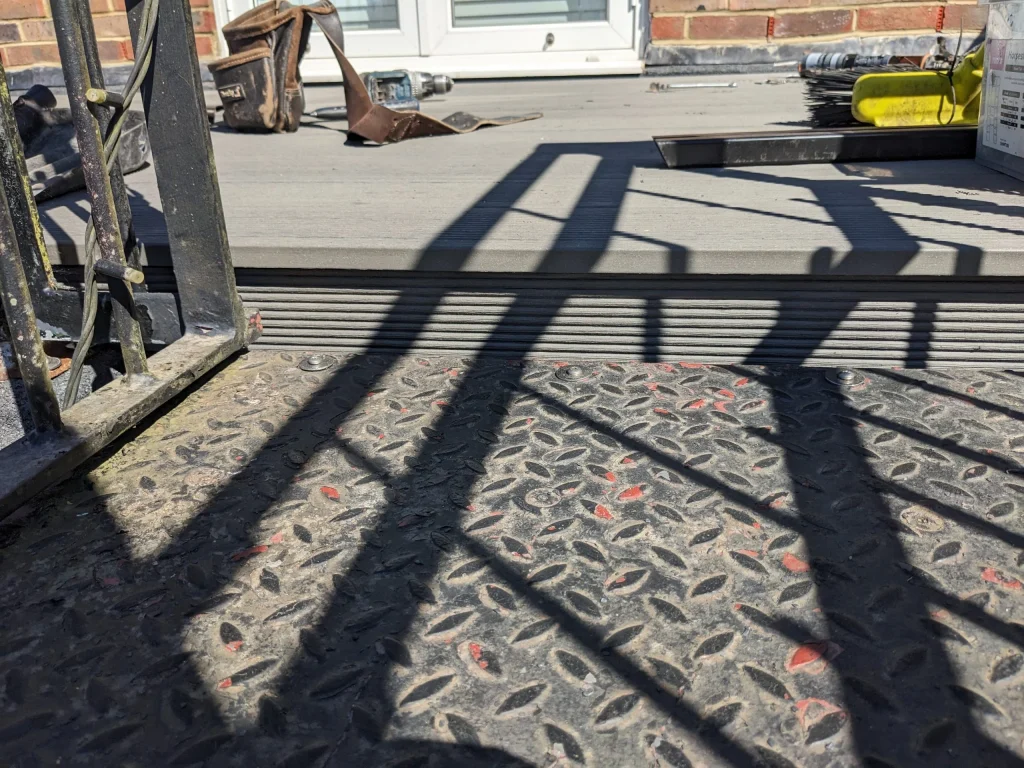
A roof and terrace area has to do more than keep rain out. It also has to cope with foot traffic, furniture, planters, trapped moisture, drainage problems and movement in the structure below. I repair flat roofs and roof terraces across Brighton, Hove, Worthing and Sussex, and one thing I always check first is whether the waterproofing below the surface is still doing its job before anyone spends money on new decking or cosmetic finishes.
Composite decking can look excellent on a terrace, but it should never be treated as the waterproof layer. The real protection is underneath: the flat roof covering, upstands, outlets, wall junctions, parapet details and the roof deck itself. If those parts fail, the decking may hide the problem until damp appears indoors.
Roof and terrace repairs need proper diagnosis first
When I inspect a leaking roof terrace, I do not start by blaming the visible surface. I look at the whole build-up. A terrace may have composite boards, timber bearers, pedestals, insulation, felt, old asphalt, GRP, liquid coating, or several repair layers from previous years. The leak may be coming from one weak outlet, a parapet wall, a split in the waterproofing, a loose flashing, or water tracking under the decking by capillary action.
This is why roof and terrace repairs can be more complicated than a standard flat roof repair. The leak may not appear directly below the defect. Water can travel sideways under decking, run along insulation, enter a wall, or sit around fixings before finally showing inside the property.
Common problems I find on roof terraces
Most failed terraces I inspect have one or more of these issues:
- Ponding water where the roof has poor falls or blocked drainage.
- Loose or failed lead flashing where the terrace meets a wall.
- Parapet wall moisture ingress through porous brickwork, weak coping stones or failed capping.
- Decking fixed through the waterproof layer, creating small but serious leak points.
- Rotten timber supports under decking boards where moisture has been trapped.
- Blocked outlets hidden beneath boards, leaves, moss or debris.
- Thermal bridging and condensation inside poorly insulated flat roof build-ups.
- Old patch repairs that cover the symptom but not the cause.
In Brighton and Hove, I also see plenty of weather-related problems. Coastal wind can push rain under weak details, and salt in the air can speed up corrosion on fixings, trims and metal components. On older Victorian and Edwardian properties, parapet walls and ageing brickwork often become part of the leak path.
Composite decking is useful, but it must be installed correctly
I like composite decking when it is used properly. It is low-maintenance compared with softwood timber, it does not rot in the same way, and it can make a roof terrace much easier to use. But it must sit above a reliable waterproofing system. It should not be used to hide a tired roof covering.
The most important rule is simple: do not damage the waterproofing below. I am very cautious when I see decking frames screwed straight through a flat roof covering. Even one fixing through the membrane can become a leak point, especially when water sits around it after rain. A better approach is usually to use suitable supports, pads or pedestal systems that spread the load without piercing the roof covering.
Good composite decking on a roof terrace should also allow access for inspection. If every board is permanently trapped in place, cleaning outlets or checking a leak becomes far harder. I prefer practical designs where key drainage points can still be reached.
The waterproofing matters more than the decking
A roof terrace is only as good as the waterproofing below it. If the deck underneath is soft, wet or moving, new composite boards will not solve the real issue. I often remove sections of decking and find that the roof covering below has been holding water for a long time.
For many domestic flat roofs and terraces, I often prefer a well-installed SBS torch-on felt system where the structure allows it. SBS felt has flexibility, is repairable, and can be detailed carefully around upstands, edges and outlets. It still needs correct installation, proper preparation and a sound deck below it, but from a repair point of view it is usually more practical than repeatedly coating over a failed surface.
For general flat roof replacement and repair options, my page on SBS torch-on felt flat roof work in Brighton and Hove explains the type of system I normally consider for domestic low-slope roofs.
Roof terrace drainage is not optional
Drainage is one of the first things I check on a roof and terrace inspection. A terrace may look level, but it still needs controlled falls so rainwater moves towards outlets or gutters. If water sits beneath composite decking, it can keep the waterproof layer damp for long periods. That shortens the life of repairs and makes small defects show up faster.
Blocked outlets are especially common when decking is installed over the roof. Leaves, grit and moss can collect below the boards where the homeowner cannot easily see them. If the outlet blocks, water can rise higher than the upstand or find a weakness at the wall junction.
A good roof terrace repair should always include a drainage check. Sometimes the roof covering is not the only problem; the water simply has nowhere reliable to go.
Parapet walls and upstands need careful attention
Many roof terraces in Sussex are bordered by parapet walls. These details can be troublesome because water does not only attack the horizontal roof surface. It can enter through brickwork, coping joints, cracked render, poor flashing or failed capping. Once moisture gets into a parapet, it may appear inside as a roof leak even if the main flat roof covering is still mostly sound.
When I repair a roof and terrace area, I always look at the wall details. A new waterproof surface will not last properly if rain is still entering behind it through the masonry. Where parapet walls are part of the problem, parapet wall waterproofing and felt capping may be just as important as the terrace surface itself.
When a roof terrace can be repaired
A repair may be realistic when the problem is local and the roof structure is still sound. For example, one failed flashing detail, a blocked outlet, a small split in a stable membrane, or one weak edge detail may be repairable without rebuilding the entire terrace.
Before I recommend that, I would want to see that the roof deck is firm, the waterproofing is still bonded properly, the insulation is not saturated, and there are no repeated leaks in different places. I would also want to know whether the decking can be lifted and reinstated without causing more damage.
When replacement is the more honest option
Replacement becomes more sensible when the terrace has widespread failure. Warning signs include soft decking, rotten supports, several old patches, ponding water across large areas, damp insulation, failed upstands, cracked waterproofing, or leaks returning after every heavy rainfall.
In those situations, patching one visible area may only move the problem somewhere else. The better approach is usually to strip back enough of the terrace to understand the condition of the roof deck, rebuild the waterproofing properly, check drainage, and then reinstall composite decking in a way that protects the new roof covering.
My practical approach to roof and terrace work
For roof and terrace repairs, I normally work in this order:
- Check the internal damp pattern and when the leak appears.
- Inspect the decking, outlets, edges, walls and flashing details.
- Lift sample areas where needed to see the waterproofing below.
- Check whether the deck or insulation has been damaged by moisture.
- Decide whether a local repair, partial rebuild or full replacement is the fair answer.
- Make sure any composite decking is installed without compromising the waterproof layer.
This order matters because the visible terrace surface is not always the real problem. A neat-looking deck can hide a failed roof, while a messy-looking surface may only need a local repair and better drainage.
A roof terrace should be built for access, drainage and movement
The best roof terraces are not just attractive. They are serviceable. Outlets can be cleaned. Flashing can be inspected. Decking can be lifted where necessary. The waterproofing below has enough protection from foot traffic, but it is not trapped in a way that makes future maintenance impossible.
That is especially important on Sussex properties where wind-driven rain, older walls and coastal exposure can test weak details quickly. A roof terrace needs to be treated as a roofing system first and an outdoor living space second.
Final view
If you are planning roof and terrace repairs, or you want composite decking installed over an existing flat roof, the first question should be whether the waterproofing below is reliable. Decking can improve how the terrace looks and feels, but it cannot rescue a roof that is already wet, cracked or poorly drained.
My advice is to diagnose the roof properly, repair or replace the waterproofing where needed, then fit the composite decking in a way that protects the roof rather than damaging it. That gives the terrace a much better chance of staying dry, usable and maintainable over time. For some roofing services on my website, homeowners can also estimate likely costs online in around 30 seconds before deciding whether to arrange an inspection.