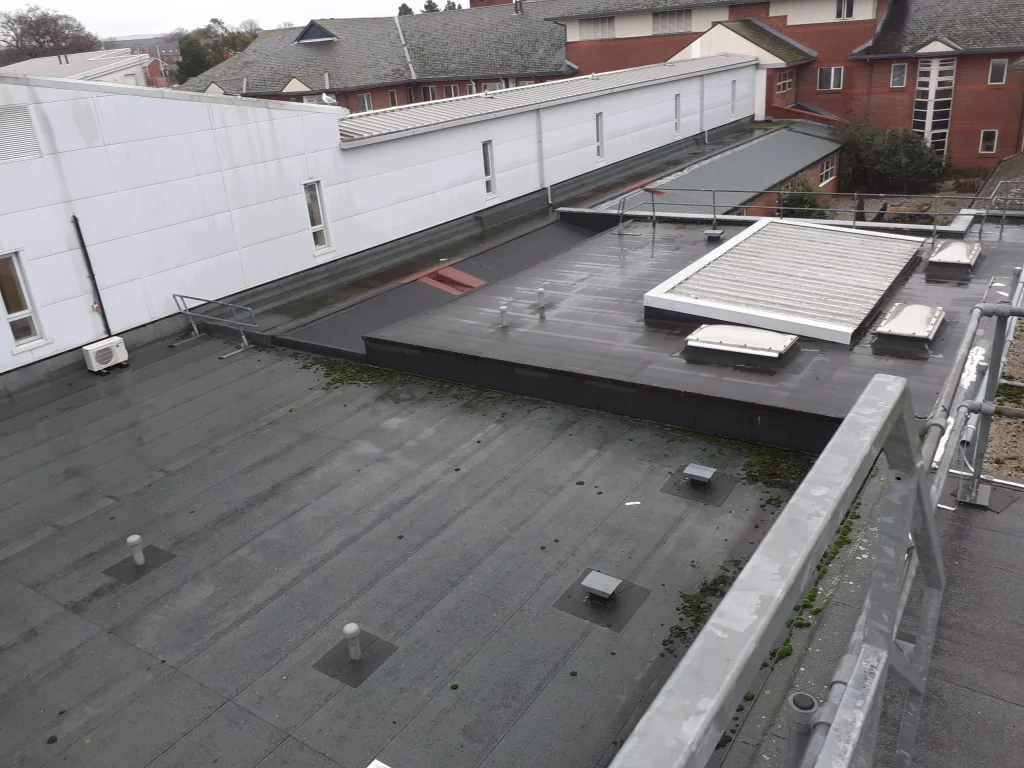
Finding the Weak Links on a Brighton Flat Roof
When a flat roof starts weeping, the immediate reaction is often to hunt for a quick fix. However, in my 18 years of diagnosing roofs across Brighton, Hove, and Worthing, I have learned that flat roof leaks are rarely straightforward. The salt-heavy air and relentless channel winds on the Sussex coast create a highly demanding environment for flat roofing materials. A small split that might survive inland for years can quickly become a major structural problem here.
Before rushing to apply a patch or assuming you need a complete rebuild, it is vital to understand exactly where and why the system is failing. Water has a habit of tracking along period-correct tiling materials and supporting timbers, meaning the damp patch on your ceiling is rarely directly beneath the actual entry point on the deck.
The Mechanical Failures I Frequently Diagnose
Most flat roof systems in our area fail at specific vulnerable points rather than across the main field of the roof. When I inspect properties, I usually focus my investigation on three key areas:
- Failed Joint Seams: Traditional felt roofs rely on heat-sealed seams. Over time, UV radiation and thermal movement—where the roof expands in the midday sun and contracts at night—cause these seams to fatigue, dry out, and slowly pull apart.
- Deteriorated Lead Flashing: The junctions where a flat roof meets a brick wall (such as on a terraced house rear extension or a bay window) are highly susceptible to water ingress. If the mortar holding the lead flashing has cracked, or if the lead itself has split due to age, water will bypass the flat membrane entirely.
- Capillary Action at the Edges: When wind-driven rain hits the edge of a flat roof, water can be drawn upwards and backwards underneath the membrane if the drip edge detail is poorly designed or clogged with debris.
Ponding Water and Deck Deflection
I am often asked if ponding water—standing puddles that remain on a flat roof for more than 48 hours after rainfall—is an automatic sign of failure. On its own, standing water does not necessarily mean your roof is leaking, but it does indicate a structural issue. Over time, the weight of ponding water causes the timber deck beneath to sag (known as deck deflection).
This sagging creates a deeper pool, putting constant hydrostatic pressure on the seams of your membrane. In our coastal climate, salt deposits left behind when this ponding water evaporates can also accelerate the degradation of older bitumen felt coatings. If you are noticing persistent pooling, it is wise to book a comprehensive structural assessment to check the health of the underlying timber structure.
Substrate Movement and SBS Torch-on Felt
Older flat roofs were often laid with rigid oxidised bitumen, which has very little flexibility. As properties across the South Coast settle and experience temperature swings, the timber substrate moves. This movement often impacts the integrity of the membrane as well as the external rainwater management systems found on older Sussex homes. Because the old felt cannot stretch, it cracks.
Modern repairs and replacements generally use SBS torch-on felt, which is modified with synthetic rubber. This allows the membrane to remain highly flexible even in freezing winter conditions, accommodating natural substrate movement without splitting.
Repairing vs. Replacing: Making the Practical Choice
Determining whether a flat roof repair is viable depends almost entirely on the state of the timber deck. If the leak is isolated—perhaps caused by a clean tear from a fallen slate or a localized flashing failure—and the roof timbers remain firm and dry, a targeted repair is highly effective and cost-efficient.
However, if water has been dripping through unnoticed for months, the timber decking will have absorbed the moisture. Sealing a new layer over wet timber is counterproductive; it traps the moisture, which eventually turns to vapour in warm weather, creating large blisters that tear the new material. If the deck feels soft or spongy underfoot, or if there is widespread rot, evaluating modern waterproofing installation costs is usually the only dependable long-term solution.
I always aim to provide a transparent, practical assessment during my visits. I will never advise a complete replacement if a durable, localized repair is genuinely possible. If you are trying to budget for potential works, you can use the interactive pricing tools available across my website to get an instant cost estimate in about 30 seconds, or get in touch to discuss your specific roof issues.