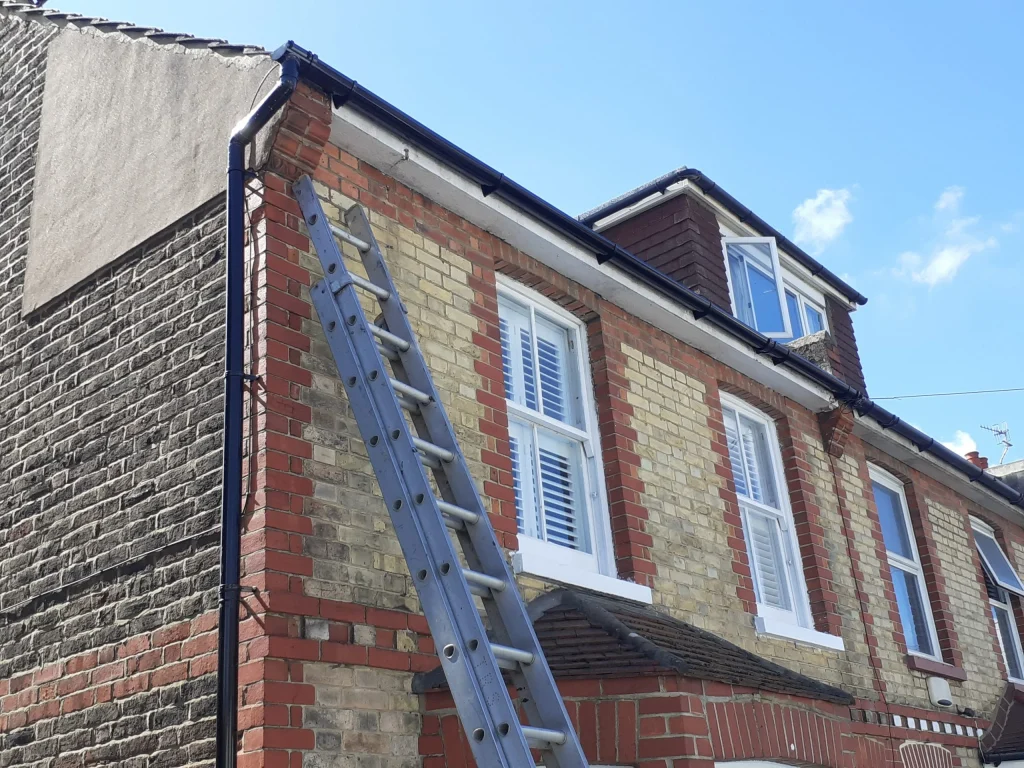
I get asked about window cleaning surprisingly often during roof inspections. It makes sense—when you’re up a ladder looking at someone’s gutters, they’ll naturally ask if you do windows too. The short answer is no, I stick to roofing. But the longer answer is more useful: understanding which jobs overlap and which don’t can save you money and prevent damage to your property.
Why Roofers and Window Cleaners See Different Problems
A window cleaner working across the Sussex coast will spot things I never would from a rooftop, and vice versa. They’re at eye level with your first-floor window frames, checking for rot in timber surrounds, failing putty, and condensation between double-glazed units. I’m above them, looking at how rainwater moves across the structure and whether addressing coastal weather damage is necessary. It is also a good time to check for period-correct tiling options if any have slipped or cracked over time.
The crossover point is your guttering. Window cleaners often clear gutters as an add-on service, and for basic debris removal that’s usually fine. But when I trace a damp patch on someone’s bedroom ceiling in Hove, the gutter is often where the investigation starts—and what I’m looking for goes beyond leaves and moss.
The Gutter Problems a Quick Clean Won’t Fix
Standing at ground level, you might see your gutters overflowing during a storm and assume they just need clearing out. Sometimes that’s true. But across the Victorian terraces of Brighton and Hove, I regularly find deeper issues:
- Lost fall: The gutter has sagged and no longer slopes toward the downpipe. Water pools in the middle, overflows, and soaks the fascia board behind it.
- Corroded brackets: Salt air from the Channel eats through metal fixings. The gutter might look fine from below but is barely hanging on.
- Joint separation: Thermal expansion pulls plastic gutter sections apart at the connectors. Even a 2mm gap creates a steady drip that tracks back into your brickwork.
- Back-edge overflow: When the front lip of the gutter sits higher than the back, water spills behind the system rather than over the front where you’d notice it.
A window cleaner scooping out debris won’t catch these mechanical failures. They’re not trained to, and it’s not their job.
When Damp Appears Below Your Windows
One pattern I see repeatedly in Brighton: damp patches appearing on internal walls directly beneath first-floor windows. The homeowner assumes the window is leaking. They call a window company, maybe even get new frames installed, and the damp returns within a year.
Nine times out of ten, the culprit is above the window, not in it. A blocked or failing gutter allows water to cascade down the brickwork. Victorian and Edwardian brick is porous—it absorbs moisture like a sponge. That water travels down inside the wall cavity and emerges as damp at the nearest cold spot, often just above a window lintel.
Before replacing perfectly good windows, it’s worth having someone trace the actual water path from the roofline down. The fix might be as simple as resetting a section of guttering or replacing a corroded bracket.
Coordinating Exterior Maintenance Sensibly
If you’re arranging window cleaning for your Brighton property, there’s a practical opportunity most people miss. Ask your window cleaner to photograph the gutters while they’re up there. Not to diagnose anything—just to document what they look like. Visible silt lines, sagging sections, rust stains on brackets, gaps at joints. A few phone photos can tell you whether your drainage deserves a closer look.
Similarly, when I’m inspecting modern waterproof membrane systems, I’ll always mention if the windows below look like they’re suffering from poor drainage rather than their own failures. It’s not my trade, but it saves the homeowner chasing the wrong problem.
Seasonal Timing That Actually Helps
Autumn gets all the attention for gutter clearing—everyone thinks about fallen leaves. But in my experience, late spring is when Brighton gutters cause the most damage. Here’s why:
Over winter, debris compacts into a dense sludge. The heavy spring rains then arrive before this has been cleared. Unlike autumn leaves that float and shift, this compacted material blocks outlets completely. Water backs up, overflows, and soaks into masonry that’s already saturated from the wet season.
A gutter check in April or May, before the worst of the spring storms, often prevents more damage than the traditional November clean.
What to Actually Look For Yourself
You don’t need to climb a ladder to spot gutter problems. Walk around your property during steady rain and watch where the water goes. Specifically:
- Water should flow visibly from each downpipe. If a downpipe is silent during rain, something’s blocked above it.
- Check for water streaming down walls rather than falling clear of the building.
- Look for tide marks—faint horizontal staining on brickwork that shows where water repeatedly reaches.
- Green algae growth concentrated in one section of wall usually indicates a persistent leak directly above.
These signs cost nothing to spot and tell you where to focus professional attention.
The Fascia Connection Most People Miss
Behind your gutters sit the fascia boards—the horizontal timber (or uPVC) strips that the guttering brackets bolt into. When gutters overflow at the back edge, this timber absorbs the water. Over a few seasons, you get rot.
The problem is that rotting fascia boards don’t look obviously rotten from the ground. Paint hides the damage. The first sign is usually gutter sections starting to pull away from the wall because the brackets have nothing solid left to grip.
If you’ve noticed your guttering seems to be sagging despite no obvious blockages, you might find that installing new protective roofline components is necessary. Fixing the gutters without addressing the rotten timber underneath just postpones the inevitable.
Practical Takeaways
Window cleaning and gutter maintenance serve different purposes, even when they happen from the same ladder. Regular window cleaning keeps your glass clear and gives you a reason to look up at your roofline periodically. Proper gutter maintenance—not just clearing but checking for mechanical failures—protects your walls and internal plaster from moisture damage.
If you’re dealing with persistent damp that seems connected to your windows or exterior walls, the answer often lies in tracing water movement from the roof down rather than focusing on the windows themselves. A quick inspection of how your drainage performs during actual rainfall can save you the cost of unnecessary window replacements.
For anyone trying to budget for roofline work, I’ve built online calculators across this site that let you estimate costs in about 30 seconds. It’s a straightforward way to understand what repairs might involve before arranging a visit.