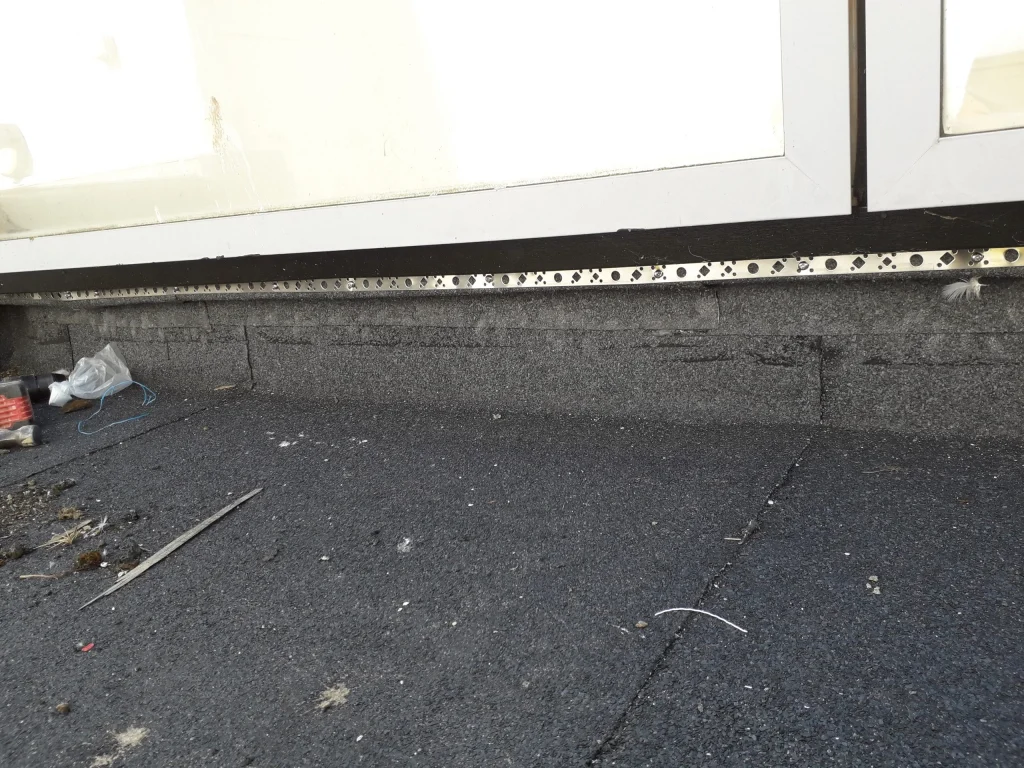
Sealing a Garage Roof Properly – Why Silicone Usually Fails
If your garage roof is leaking, the first instinct is often to seal it with silicone, mastic, or a liquid acrylic coating like Acrypol. I see this constantly across the Sussex coast, including Hove and Worthing. In most cases, these are temporary patch materials, not a structural roofing repair.
They can slow water ingress for a short period, but they do not properly accommodate thermal expansion, substrate movement, or deteriorated felt laps. On older local garages, especially where the deck has slight deflection or the mineral felt has become brittle from UV degradation and salt exposure, these products usually crack or lose adhesion within 1–3 years.
If water is already tracking into internal ceilings or adjoining living spaces, I usually recommend a far more robust repair using high-performance bitumen systems rather than surface-level sealants.
Why Garage Roof Sealants Fail
Many homeowners turn to protective liquid membranes when they spot a leak, but these products often struggle with the structural dynamics of an outbuilding.
Thermal Movement Breaks Surface Coatings
Structures like these expand and contract constantly. Mineral felt can move several millimetres across a span during seasonal thermal cycling. When considering a full structural waterproofing upgrade, it becomes clear that flexibility is the most important factor.
Liquid coatings like Acrypol cure as a flexible membrane, but repeated tensile stress at weak points like corners, upstands and splits eventually causes fatigue cracking. Silicone suffers similar bond-line failure where substrate contamination or moisture exists.
Capillary Water Tracking
When old felt laps open, water often enters beneath the visible defect. Surface-applied sealants trap moisture rather than eliminate the ingress path. This allows capillary action to continue drawing water laterally beneath the membrane.
This is why many DIY repairs appear successful initially, then fail after the first heavy rain cycle in the South East.
The Repair System I Actually Use
For long-lasting localised repairs, I use Tecnatorch SBS Torch-On Mineral Felt Charcoal.
This is a high-performance SBS-modified bitumen membrane designed to be heat-welded directly to the substrate using a gas torch. Once heated correctly, the underside activates and molecularly bonds into the existing bituminous surface.
This creates a fused waterproof layer rather than a surface coating.
How I Repair Leaking Areas
- Locate the true water ingress path, not just visible staining
- Prepare and clean the substrate thoroughly
- Remove failed surface treatments where required
- Heat-bond SBS felt directly over cracks, splits or failed corners
- Fully seal perimeter edges and reinforcement points
- Pressure-check lap integrity after cooling
In most repairs, I overband and overlap the leaking section to create a mechanically robust waterproof patch that moves with the structure.
This approach lasts substantially longer than acrylic coatings and the installed cost is usually very similar.
Emergency Half-Day Garage Roof Repairs
If water is actively entering your property and needs immediate containment, I offer dedicated half-day repair slots designed to restore watertightness quickly.
Where leaks are affecting adjoining rooms, tracing hidden moisture paths often requires a professional assessment, which you can arrange through my professional leak detection and maintenance service.
The Practical Takeaway
Sealants have their place for temporary mitigation, but if you want a repair that survives thermal cycling, UV exposure and the coastal weather, torch-bonded SBS felt is usually the correct technical solution.
Now that you understand the difference, you can use the free online calculator on my site and get an exact instant estimate for materials and labour in about 30 seconds.