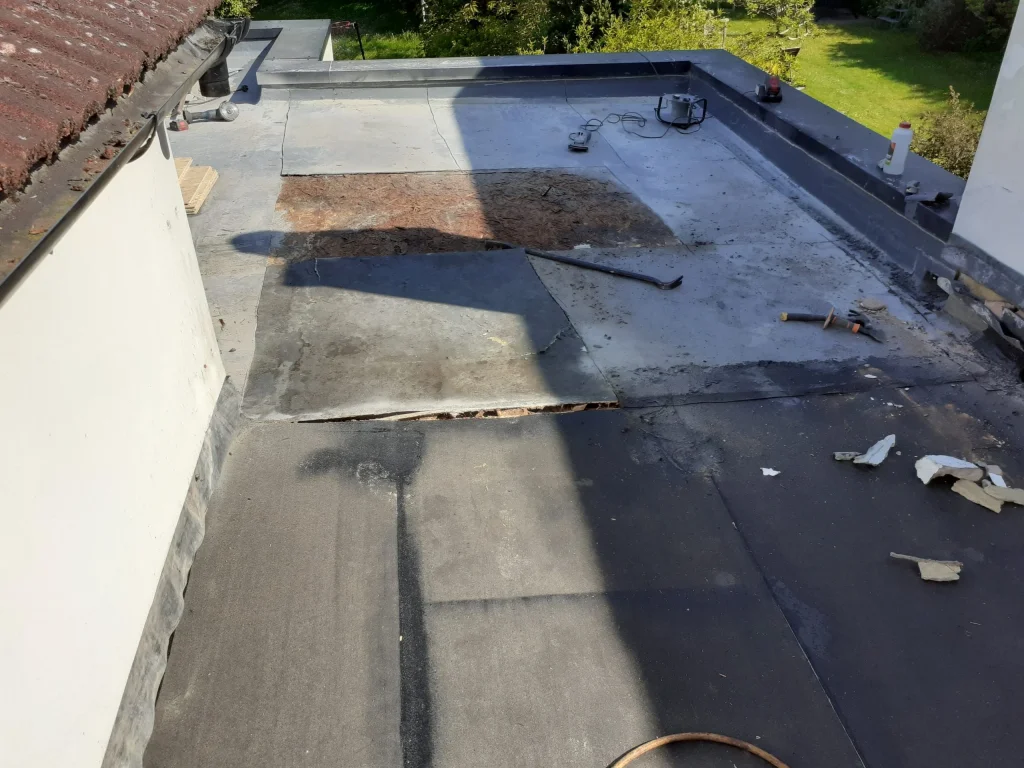
The Reality of Garage Roof Materials in Sussex
When you discover water pooling on your garage floor or damp patches on the timber decking, the immediate question is usually which material is best for a durable replacement. In my 18 years as a roofer—spending the last 12 diagnosing coastal weather damage across Brighton, Hove, and Worthing—I have seen the industry promote countless so-called miracle products. The truth is that a small outbuilding covering, whether it is a pitched structure on an outbuilding or an ageing waterproofing system ready for renewal, has to cope with severe thermal shock, high UV exposure, and coastal salt corrosion. Choosing the wrong material can lead to thermal bridging, perimeter shrinkage, and ultimately, serious water ingress.
Evaluating the Experiments: EPDM and GRP
Over the last couple of decades, the market has heavily pushed single-ply EPDM rubber and GRP fibreglass. While both materials have their place, they come with significant structural caveats for uninsulated outbuildings.
- GRP (Fibreglass): GRP is incredibly rigid. The problem is that the timber sub-decking underneath an older outbuilding covering naturally expands and contracts with moisture and temperature changes. GRP cannot absorb this movement properly. Over time, that differential movement turns into stress fractures and micro-cracks in the resin. Capillary action then draws rainwater directly into the timber, quietly rotting the deck from the inside out.
- EPDM (Rubber): EPDM is highly flexible, but it is also known for perimeter shrinkage. As the single-ply rubber ages and goes through repeated thermal cycling, it can physically shrink, pulling away from wall flashings and edge trims. Once that tension breaks the perimeter seal, driving coastal rain can penetrate the system with very little resistance.
The Time-Tested Solution: SBS-Modified Bitumen
After stripping off failed experimental systems year after year, I rely on materials that have proved themselves over time. When specifying a new covering for a small outbuilding, my primary focus and the core material I trust is Tecnatorch SBS Torch-On Mineral Felt Charcoal. For homeowners comparing options and pricing, my SBS-based outbuilding cost calculator gives a practical starting point for understanding the system.
Older pour-and-roll bitumen felts failed because they oxidised, became brittle, and cracked under UV light. Tecnatorch uses a completely different chemistry. Its SBS modifier, short for Styrene-Butadiene-Styrene, blends synthetic rubber with bitumen to give the membrane strong elasticity. That means it can stretch and recover as garage timber moves during a freezing Brighton winter or a hot summer day, without splitting at the first sign of stress. The thick charcoal mineral finish is not just cosmetic either; it acts as a durable UV shield, helping to protect the membrane from solar degradation.
Engineered for Sussex Weather
Even the best material will fail if the detailing is poor. We install the Tecnatorch system using a careful multi-layer build-up, including a venting base layer that allows trapped interstitial moisture in a cold garage environment to escape safely. This helps reduce the risk of condensation-related rot in the joists and decking. It is also the foundation of the low-slope waterproofing specifications we use across the Sussex coast, where wind-driven rain, UV exposure, and temperature movement all need to be considered together.
Calculate Your Roof Replacement Instantly
You do not need to gamble your property on experimental materials. Now that you understand the mechanics of thermal movement and why SBS-modified bitumen is a structurally reliable choice, you can plan the work with more confidence. Use the free online calculator on my website to get an instant price estimate for the materials and labour required to renew your garage covering, with transparent pricing and no hidden fees.