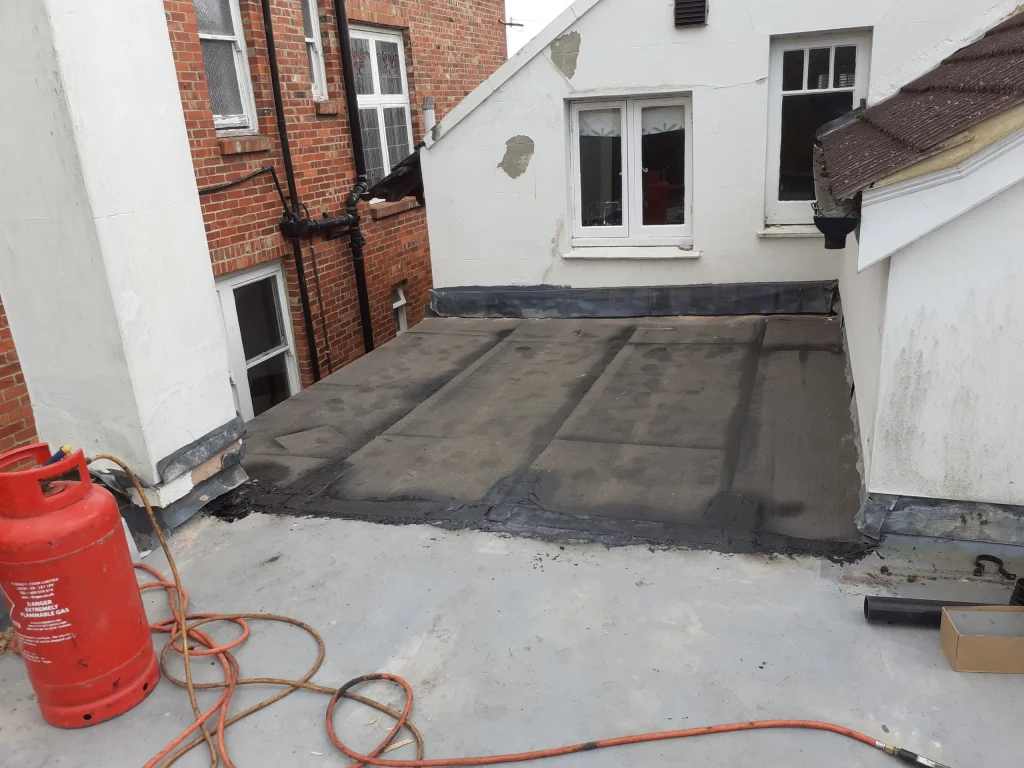
When to Replace a Garage Roof in Sussex
I’m called out to garage roofs in Brighton, Hove and Worthing almost every week, and the same pattern repeats itself. By the time a homeowner notices a leak inside the garage, the covering has usually been failing quietly for years. It rarely gives way all at once; it breaks down through micro-cracks, weakened overlaps, trapped moisture and gradual movement in the structure below.
If you’re wondering whether it is time to replace an ageing garage covering, the honest answer is often earlier than most people expect. Waiting until water is visibly dripping inside is usually the worst possible trigger point.
Technical Diagnosis: Why Garage Roofs Fail Gradually
For homeowners who want to understand the pricing side as well as the technical warning signs, my garage quotation guide explains what typically affects the final scope of work.
Slow water ingress and capillary action
Most felt or bitumen garage roofs do not fail in one obvious place. They fail across hundreds of tiny points. Water is drawn in through capillary action at laps, cracks and poorly bonded edges. This moisture then sits under the surface layer, especially in colder Sussex coastal conditions where evaporation is slow.
Thermal movement and material fatigue
Flat coverings expand in heat and contract in cold. Over 15–25 years, this movement breaks down older mineral felt or poorly installed membranes. Once the material loses elasticity, it starts splitting at stress points, usually around upstands, edges and board joints.
Timber decay hidden beneath the surface
This is the critical issue most homeowners do not see. By the time internal staining appears, the decking or joists are often already compromised. I frequently open up garage roofs where OSB decking is soft or where supporting timbers have begun to rot due to long-term moisture exposure.
When You Should Replace the Garage Roof, Not Repair It
- Repeated leaks in different areas of the roof
- Visible sagging or an uneven roof surface
- Blistering or bubbling in felt layers
- Persistent ponding water after rain
- Soft spots when walking on the roof, where access is safe
- Internal staining that keeps returning after localised water ingress repair work
If two or more of these signs are present, patching is usually a false economy. At that stage, I am not just replacing the surface layer; I am often replacing decking and sometimes joists underneath.
The Real Cost of Waiting Too Long
One of the biggest misconceptions I deal with is that delaying a replacement saves money. In reality, it often does the opposite. A job that could have been a straightforward overlay system can become a full strip-out once moisture has reached the deck.
For example, a simple calculator for small garage roofing work in Brighton, Hove and Worthing might initially cover stripping old felt and installing a new SBS-modified bitumen system. But if water has been ignored for years, I may need to replace rotten decking boards, upgrade insulation and repair structural timbers.
In many cases, delaying the work by just a few years can double or even triple the overall cost because the failure spreads from the surface materials into the structure itself.
Proper Replacement Method: What I Actually Do on Site
Full strip and structural inspection
I always start by removing the existing waterproofing layer completely. This exposes the decking so I can assess whether moisture has migrated into the timber structure.
Decking and timber repairs
If I find soft or delaminated boards, I replace them. In older garages across Sussex, especially near the coast, timber degradation is common due to long-term condensation and salt-laden air exposure.
Modern waterproofing system installation
Once the structure is sound, I install a high-performance SBS-modified bitumen system. Compared with older torch-on materials, modern membranes are far more resistant to thermal movement and provide better long-term sealing at laps and upstands.
For more complex low-slope structures or specification upgrades, I often align the system with the standards used for larger waterproofing projects across Brighton and Hove, making sure the drainage falls, edge detailing and ventilation strategy are properly considered.
Final Thoughts From Site
If there is one thing I always tell property owners, it is this: do not wait for a garage roof to start leaking visibly. By the time water is inside, the damage has usually already progressed into the structure.
Understanding the condition early gives you control. You can plan the replacement on your own timeline instead of reacting to an emergency repair situation.
When you are ready, you can use my online calculator to get a realistic, no-obligation cost in under 30 seconds. It helps you plan ahead properly without pressure or commitment.