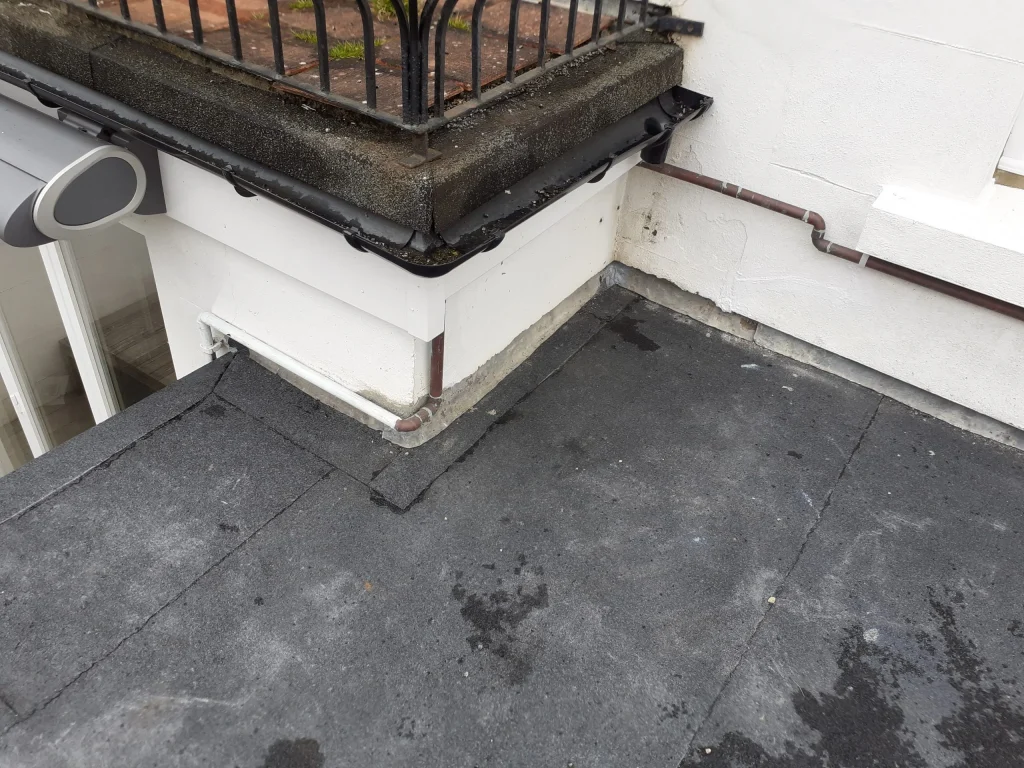
Is it Normal to See Water Pooling on a New Flat Roof?
If you have recently invested in a roofing upgrade for your home in Brighton, Hove, or Worthing, spotting a puddle after the first heavy rain can be concerning. As an independent roofer with 18 years of hands-on experience—and having spent the last 12 years serving property owners right here in Sussex—I get asked about this a lot. The primary question is: should you be worried about water pooling on a new modern waterproof covering? Let’s look at the technical facts and why, in many cases, there is no need to panic.
Understanding the 1.5 cm Rule for Ponding Water
In the industry, standing water is commonly referred to as ‘ponding’. Naturally, the ideal scenario is for rainwater to drain away completely. However, a small amount of water pooling on a new professional installation is actually quite common and generally acceptable. If the residual puddle is shallow—typically up to 1.5 cm deep—it does not necessarily mean your project is defective. With our coastal breezes and natural sunlight, this minor surface water will typically evaporate within a couple of days.
Why Does Water Pool on Newly Covered Roofs?
You might wonder why a brand-new surface wouldn’t have a perfect slope. This specific issue is most common on roofs where we apply an ‘overlay’ system. An overlay involves torching a new layer of high-performance bitumen membrane directly onto the old existing material, rather than stripping the structure down to the timber joists and installing brand new structural OSB boards.
Over decades, older timber decking naturally settles and develops very slight sags or dips. If we do not install fresh, perfectly level OSB boards to correct these underlying structural imperfections, those minor dips remain. Consequently, shallow water will naturally collect in these slight depressions on the new surface.
Will Standing Water Damage Your Roof?
The short answer is no, as long as the correct materials are used. Modern, high-performance SBS-modified torch-on felt is explicitly engineered to withstand standing water without deteriorating. While older, traditional bitumen systems might have cracked or perished under these conditions, the premium systems I install create a highly durable, seamless waterproof membrane that handles pooling effortlessly.
While the main deck is fully protected, it is equally important to ensure that vulnerable junction areas are sealed against moisture. This is why I highly recommend proper firewall and parapet felt capping. By capping these boundary walls with SBS-modified materials, we prevent damp from penetrating the brickwork and compromising your home’s interior, regardless of how much rain hits the surface.
Ensuring Maximum Protection for Your Home
If your goal is to guarantee absolutely zero water pooling, the only true method is a complete structural overhaul. During a comprehensive full system replacement, I strip the old materials entirely and install new OSB timber boards (often alongside firring strips) to create a distinct, uniform slope that forces all water to the edge.
Next Steps for Your Roofing Project
Ultimately, seeing a minor puddle up to 1.5 cm deep on your new surface is a cosmetic characteristic of an overlay system rather than a structural failure. Modern torch-on membranes are more than capable of protecting your home against standing water.
My business is built on transparency and providing long-term, practical solutions. If you are considering upgrading your property or need a reliable assessment of your current structure, I offer a convenient online calculator on my website. You can easily calculate the price of your project yourself in just 30 seconds, completely free of obligation or hidden fees. Once you have your estimate, I am happy to conduct a free on-site survey to provide you with a formal, fixed-price quote.