Can You Really Fix a Leak by Sealing a Felt Roof?
At least once a week, my phone rings with a homeowner asking a familiar question: “Jan, my kitchen extension has a leak. Can you just come round and paint some sealant over it?”
It is a completely understandable request. When water starts dripping onto your floor, buying a tin of liquid rubber seems like the quickest, most affordable fix. However, after 18 years of working on roofs across Sussex, I have to be honest. When it comes to sealing felt roof surfaces that have already failed, you are usually just throwing good money after bad.
The Myth of the Magic Paintbrush
Hardware stores sell countless tins of liquid sealants, promising an instant cure for leaking flat roofs. While these products can occasionally serve as an emergency stop-gap during a heavy storm, they are rarely a permanent solution, especially here on the coast.
In Brighton and Hove, our roofs are exposed to aggressive salt-laden air, high winds, and severe UV rays in the summer. Older pour-and-roll felt becomes incredibly brittle under these conditions. When the temperature drops rapidly in winter, the timber structure beneath the felt contracts. Because the old felt is completely rigid, it cannot stretch with the building. Instead, it snaps.
If you simply paint a thin layer of liquid sealant over a snapped seam, the next time that substrate movement occurs, the new sealant will just tear right open again.
The Danger of Sealing Over Trapped Moisture
There is a much bigger structural risk when you try sealing a roof without a proper diagnosis. When an old felt roof splits, rainwater does not just sit on the surface. Through capillary action, moisture is drawn underneath the membrane and saturates the timber deck below.
If a roofer just slaps a coat of sealant over the top of a failing roof, they are locking that moisture inside the structure. The water cannot evaporate. Over the next year, that trapped dampness will quietly rot the plywood deck and the supporting timber joists. What started as a simple leak eventually turns into a complete deck failure, requiring thousands of pounds of structural rebuilding.
When is a Roof Beyond a Patch Repair?
When I inspect a flat roof in Sussex, I am looking for signs that the waterproofing system has fundamentally failed. If I see severe moss growth, ponding water sitting in sagging areas, or felt that is blistered and pulling away from the parapet walls, I will tell you straight: a patch repair will not hold.
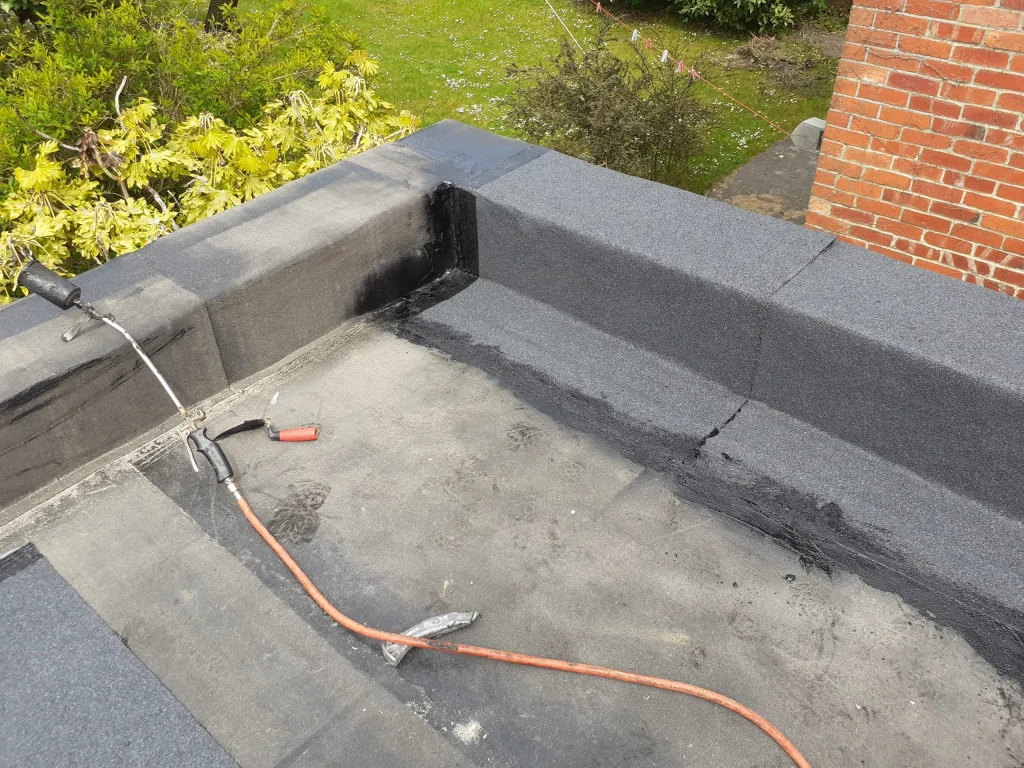
Instead of relying on temporary paints, the most reliable long-term solution is a proper flat roof replacement using modern, high-performance materials. I exclusively use SBS torch-on felt for this exact reason. Unlike older felts or liquid paints, SBS is modified with synthetic rubber. It actually stretches and moves with your property, easily handling the thermal shocks of the Sussex weather without cracking.
Final Thoughts on Quick Fixes
If water is pouring in and a storm is raging, an emergency sealant might buy you a few weeks to plan a proper repair. But as a long-term strategy, sealing an old, brittle felt roof is just kicking the can down the road. You have to fix the mechanics of the roof, not just paint over the symptoms.
If you are tired of patching the same leaks every winter and want to know what a permanent solution might cost, you do not even need to wait for a survey. You can use the quick pricing calculators on my website to get an honest estimate for your specific property in about 30 seconds.