The Anatomy of a Professional Roof Leak Inspection
When a damp patch appears on a ceiling in Brighton, Hove, or Worthing, the first reaction of many property owners is to look outside for a missing tile, a split seam, or a torn section of membrane. In my 18 years as a roofing technician, including 12 years working with the specific structural challenges of Sussex properties, I have learned that visible exterior damage is often only the surface symptom. A professional specialist water-ingress call-out assessment is not a quick glance from the top of a ladder; it is a structured diagnostic process.
Because water can travel along rafters, electrical conduits, insulation layers, and timber wall plates before it ever appears inside your living space, accurate diagnosis requires an understanding of building physics. I do not guess where the moisture is entering. I follow a methodical inspection sequence to isolate the failure point and reduce the risk of long-term timber decay.
The Inside-Out Approach: Starting in the Loft
The most important phase of any pitched covering inspection often takes place indoors, beneath the structural decking. For properties with active staining or recurring damp patches, my domestic water-ingress repair process starts by checking the roof void before assuming the fault is visible externally. When I enter a loft space, I look for three specific technical indicators:
- Tidemarks on Structural Timbers: When rainwater penetrates the external weathering layer, it can saturate rafters and adjoining timber. As the wood dries, it often leaves distinct white or brown mineral deposits known as tidemarks. Tracing these marks upwards frequently leads to the true point of ingress.
- Condensation vs. Ingress: Many suspected leaks are actually severe cases of interstitial condensation. If I find uniform black mould across the underside of the sarking felt, together with a damp, musty smell, the issue is often poor eaves ventilation trapping warm, moist air rather than an active breach from outside.
- Fungal Decay: I physically probe timber joists, rafters, and wall plates. If the wood feels soft, yields under pressure, or displays the cuboidal cracking associated with wet rot, the inspection must immediately shift towards assessing the structural safety of the frame.
Diagnosing the Perimeter: Eaves and Roofline Failures
One of the most frequently misdiagnosed areas during a leak inspection is the eaves detail: the perimeter where the pitched covering meets the rainwater system. In many traditional Sussex properties, the secondary waterproof membrane is intended to dress into the gutter so water can discharge safely away from the building.
Over decades of exposure to coastal salt spray and UV degradation, this exposed section of membrane can perish and shrink back. When that happens, rainwater running down the slope bypasses the gutter and pools behind the fascia board. During my inspections, I scrutinise this junction carefully. If the timber roofline is already compromised, simply patching the membrane is not a durable solution. The long-term mechanical repair usually involves stripping back the lower courses, installing rigid eaves support trays, and, where necessary, replacing decayed timber with low-maintenance uPVC roofline boards to restore a firm, watertight drip edge.
Tactile Exterior Checks: Decking and Membrane Integrity
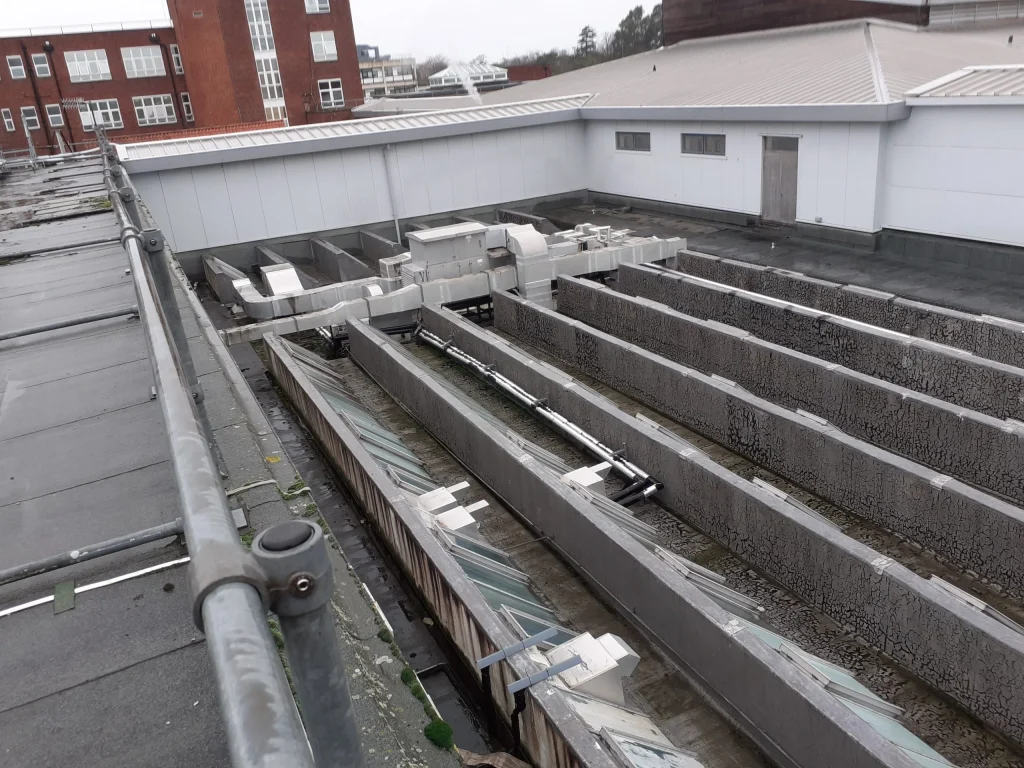
Once the internal diagnostics are complete, the exterior inspection begins. For modern flat roofs finished with SBS-modified bitumen, visual checks alone are not enough. I carry out a tactile assessment to understand how the system is performing beneath the visible surface.
As I walk the flat roof, I actively feel for sponginess, bounce, or deflection underfoot. High-performance torch-on felt is resilient, but if the underlying OSB or plywood decking has suffered prolonged moisture exposure, the structural core can delaminate and soften. A bouncy deck is a serious warning sign that water has breached the system, often through failed thermal expansion joints, split seams, or deteriorated lead upstands.
I also inspect the adhesion and seating of lead flashings. Leadwork may appear neatly dressed from a distance, but by applying controlled manual pressure, I can test whether the mortar chase has failed internally and is allowing wind-driven rain to bypass the flashing.
Transparent Diagnostics and Fixed Pricing
I do not believe in masking symptoms with cheap liquid sealants, and I do not believe in vague pricing. A proper leak inspection should give you clear information about the structural condition of your property and the exact steps needed to carry out a permanent, technically sound repair.
You should not have to wait weeks for an arbitrary quote. My approach to transparency means you stay in control of the costs from the beginning. For almost all roofing services, I have integrated a precise online calculator directly into my website. In around 30 seconds, you can enter your details and generate an instant, no-commitment price estimate.
If you are dealing with active water ingress or suspect hidden timber decay, calculate your likely costs online and arrange a technical site visit. I will carry out a thorough diagnostic survey and provide a fixed quote to help secure your home against Sussex weather.