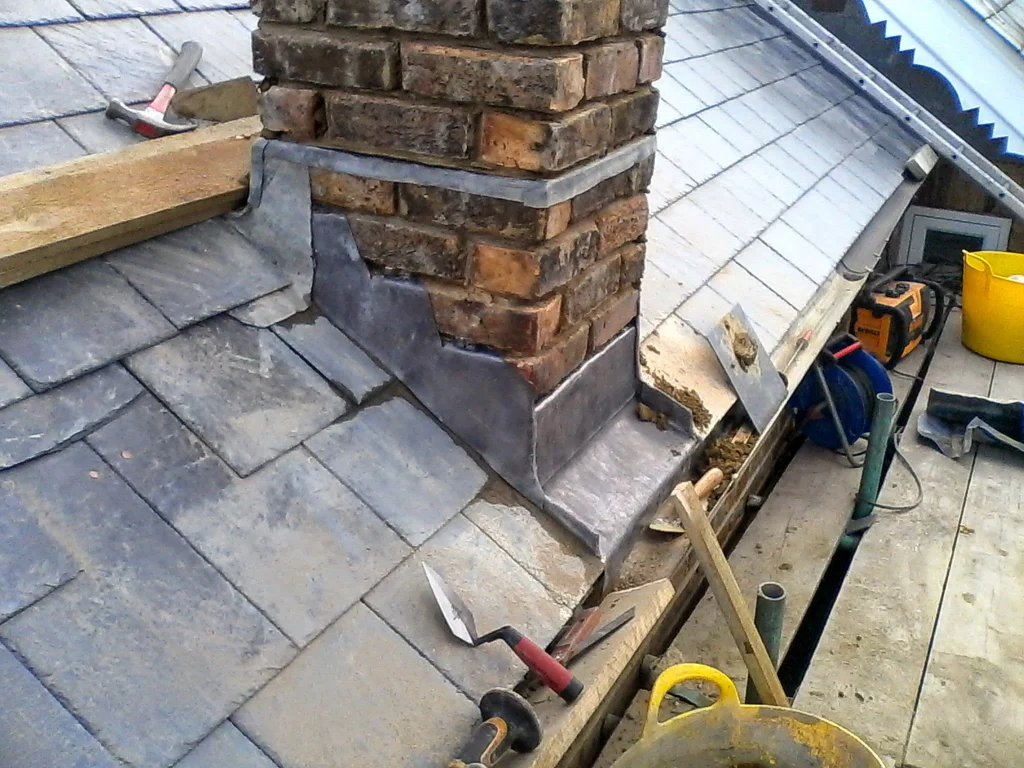
What patination oil does on lead flashing
Patination oil is a protective surface treatment applied to new lead flashing after it has been fitted and cleaned. Its main purpose is to help the lead weather evenly and reduce the risk of white carbonate staining on the surface of the lead and on nearby roof materials.
It is important to understand what patination oil is not. It is not a sealant, not a waterproofing repair, and not a product for stopping leaks. If lead flashing is loose, cracked, badly chased into the wall, or allowing water behind the roof covering, oiling the surface will not solve the problem. The leadwork itself must be correctly installed first.
For homeowners, the simplest way to think about patination oil is this: the lead flashing does the waterproofing, while the patination oil helps protect the appearance of the new lead as it begins to weather.
Why new lead flashing changes colour
Fresh lead has a bright grey surface when it is first installed. Once exposed to rain and air, it naturally oxidises and forms a duller protective surface. This ageing process is normal and expected.
During the early weathering stage, new lead can sometimes produce white staining. Rainwater can carry this residue onto tiles, slates, felt roofs, brickwork, render, glass, bay window roofs, porch roofs or guttering below. This is one reason patination oil is commonly applied soon after new lead flashing is fitted.
The oil helps control the first stage of surface weathering. It reduces uneven staining and helps the lead develop a more consistent patina. It does not make the lead permanently shiny, and it does not stop lead from ageing naturally.
Where patination oil is commonly used
Patination oil is most relevant when new lead is installed in visible or exposed positions. Common examples include chimney flashing, wall abutment flashing, lead above bay window flat roofs, porch roof flashing, dormer junctions, parapet wall details and leadwork above SBS torch-on felt flat roofs.
On properties in Brighton, Hove, Worthing and other Sussex areas, it is often used where new lead is fitted against older brickwork or above small flat roofs at the front or rear of the building. These details are visible from the street or garden, so staining and appearance matter as well as waterproofing.
Patination oil is especially useful where water from new lead could run across a finished surface below. For example, white staining on a newly finished flat roof or on a clean bay window roof can look untidy even when the waterproofing is technically sound.
When patination oil should be applied
Patination oil is normally applied after the lead flashing has been installed, dressed correctly, cleaned and checked. The lead surface should be dry and free from dust, mortar, sealant residue and handling marks before oil is applied.
The best timing is usually on the same day as the new leadwork is completed, before the first significant rain. If the lead is left untreated and rain washes across it repeatedly, staining may already begin before the surface has been protected.
In practical roofing work, this is usually treated as a finishing step. The main work is still the correct forming of the lead, proper chase cutting, secure fixing, suitable sealing and correct overlap over the roof material below.
How patination oil is applied in roofing work
The exact method depends on the product instructions, but the basic principle is straightforward. A thin, even coat is applied to the clean lead surface using a suitable cloth or applicator. The aim is to cover the exposed lead, not to flood the detail with oil.
A good application should avoid heavy runs, thick patches and oil marks on surrounding materials. Care is needed around brickwork, render, felt, tiles and gutters because excess oil can leave marks if it is spread carelessly.
For larger lead details, the application should be consistent across the full visible area. Patchy application can leave the lead weathering unevenly, which defeats the purpose of using the oil in the first place.
Why patination oil is not a leak repair
One of the most common misunderstandings is that patination oil somehow waterproofs old or defective lead flashing. It does not. If water is entering the roof, the problem is normally in the flashing detail, the wall, the roof covering, or the junction between them.
Patination oil will not repair cracked lead, failed silicone, loose mortar, shallow chasing, poor laps, missing soakers, failed felt upstands or porous brickwork above the flashing. These defects need proper inspection and repair.
If a homeowner sees damp near lead flashing, the first step is to identify the water path. Rain may be entering behind the lead, through the wall above it, through a chimney joint, through a failed flat roof upstand, or by capillary action through a narrow gap. Surface oil has no role in stopping those defects.
Signs that the issue is not about patination oil
Patination oil is mainly about appearance and surface protection. If any of the following signs are present, the lead flashing or surrounding roof detail needs to be checked rather than simply treated with oil:
- Damp staining inside the property after rainfall.
- Lead lifting away from the wall or chimney.
- Visible cracks, splits or holes in the lead.
- Old silicone or mastic pulling away from the chase.
- Loose mortar above the flashing.
- Water marks below a flat roof wall junction.
- White staining combined with an actual leak below the same area.
White staining on its own may be a surface weathering issue. Damp inside the property is a different problem and should be diagnosed as a potential roof leak.
Patination oil and lead flashing cost
Patination oil is usually a small finishing item compared with the cost of the lead flashing work itself. The main cost is normally determined by access, height, length of lead, roof type, wall condition, chase cutting, lead code, removal of old materials and whether the surrounding roof detail also needs repair.
For example, applying oil to a short low-level porch flashing is a very different job from installing and finishing lead around a high chimney or a long wall abutment. The oil is simple; the proper leadwork and safe access are what usually affect the price most.
When comparing likely costs, a lead flashing repair and installation calculator can help show how details such as chase cutting, Code 4 lead, sealing and patination oil fit into the overall scope of work.
Common mistakes with patination oil
The first mistake is applying it to dirty or wet lead. If mortar dust, rainwater or handling marks are left on the surface, the finish may become uneven. The second mistake is applying too much oil. A thin, controlled coat is normally more suitable than a heavy application.
Another mistake is treating patination oil as a substitute for good workmanship. New lead still needs correct laps, suitable lengths, movement allowance and a proper wall chase. If the lead is fitted badly, the oil may make it look more finished, but it will not make the flashing reliable.
There is also little value in applying patination oil to very old lead that has already weathered naturally, unless a specific manufacturer-approved maintenance approach is being followed. It is mainly used on new leadwork during the early weathering stage.
How a roofer should check new lead before oiling
Before patination oil is applied, the lead detail should be checked as a waterproofing detail, not only as a visible finish. This means checking that the lead is dressed correctly, the chase is secure, the seal is neat, and the lower edge gives enough cover over the roof material below.
On a flat roof, the upstand beneath the lead should also be checked. If the SBS torch-on felt or other waterproofing layer does not turn up properly behind the lead, the flashing finish alone will not protect the junction long term.
On a chimney or wall abutment, the brickwork and mortar above the lead matter as well. Water can enter through cracked pointing or porous masonry and appear to be a lead flashing problem, even when the lead itself is not the main defect.
Practical takeaway for homeowners
Patination oil is a useful finishing product for new lead flashing. It helps the lead weather more evenly, reduces white staining, and protects the appearance of the new work during the early exposure period.
It should be seen as part of good finishing practice, not as a roof leak solution. If the lead flashing is new, sound and correctly installed, patination oil is a sensible final step. If the roof is leaking, the flashing detail, wall, chimney, flat roof upstand or surrounding roof covering needs proper inspection before any surface treatment is considered.
The key distinction is simple: lead flashing keeps water out when it is fitted correctly; patination oil helps the new lead age more cleanly once the waterproofing detail has already been made sound.