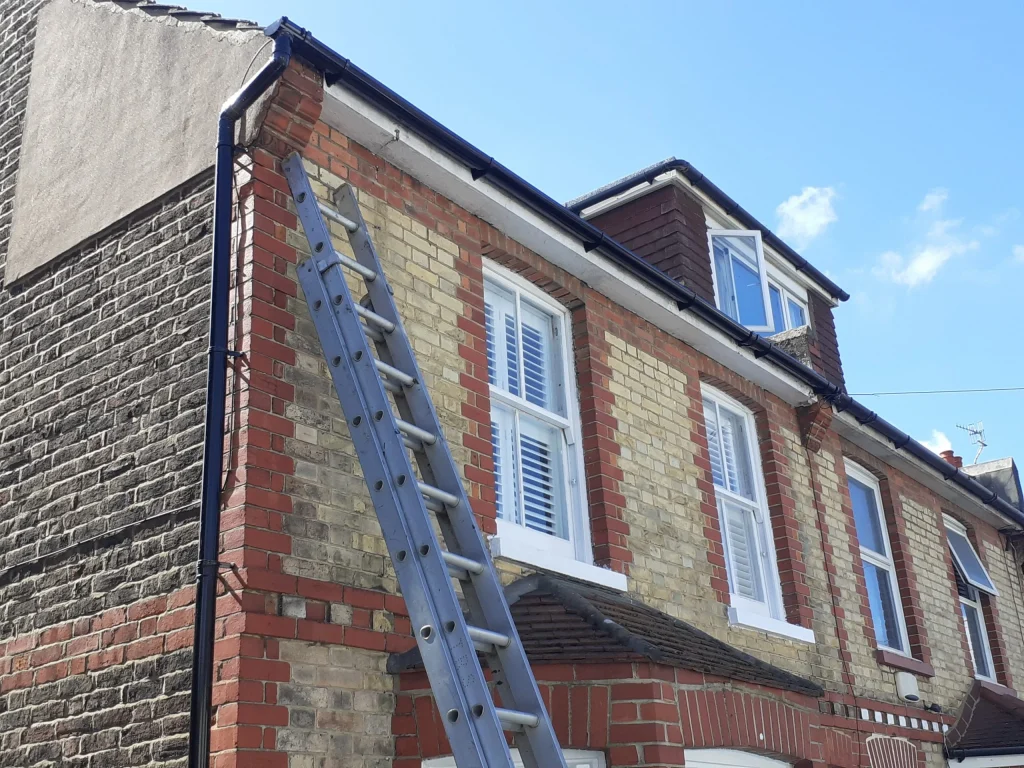
The damp patch that starts at the roofline
I often get calls from homeowners in Brighton and Hove who have noticed penetrating damp forming at the very top of their exterior walls, just below the roofline. Naturally, they assume the main covering above has failed badly. But when I get up on the ladder, the tiles, underlay and roof structure are often completely sound. The actual culprit is usually a failed rainwater drainage system.
When coastal roofline drainage stops managing water correctly, the rainwater does not just disappear. It cascades down your brickwork, splashes back against your timber fascias, and slowly creeps into your property through capillary action. By the time you notice damp patches inside your bedroom or living room, the exterior wall has usually been absorbing moisture for months.
Clearing a blockage versus a full replacement
Many property owners hope that a quick clear-out will solve their overflowing rainwater system. If the channels are simply packed with autumn leaves from a nearby tree, scooping them out will restore the flow. But if you have had them cleared and water is still dripping from the joints, sagging in the middle, or running behind the line of the system, cleaning is no longer the answer.
In my 18 years of diagnosing roofline and weatherproofing issues in Sussex, I have seen exactly how our local climate ages plastic and metal components. Constant exposure to coastal UV rays makes older uPVC brittle, while salt-laden winds corrode metal brackets. Over time, the rubber gaskets inside union joints shrink and perish. When this happens, thermal movement—the plastic expanding in summer and contracting in winter—pulls the joints apart permanently.
The hidden knock-on effect: Fascia and soffit deterioration
One of the most destructive things about leaking roofline drainage is what it does to the timber holding it up. When a gutter joint fails, or when incorrect falls cause ponding water to overspill, that water often runs down the back of the channel directly onto the wooden fascia board.
Eventually, this leads to severe fascia and soffit deterioration. As the timber rots and turns soft, the screws holding your brackets lose their grip. The rainwater channel starts to sag under the weight of trapped water, which creates an even deeper pool and accelerates the failure. If I inspect a roofline and find that the supporting timbers are rotten, simply fixing new drainage components into soft wood is a waste of your money. In these cases, installing rot-resistant uPVC fascia protection alongside the new rainwater system is the only way to guarantee a secure, long-lasting fix.
Why standard gutters struggle with low-slope extension roof details in local weather
Older terraced houses and extensions in our area were often fitted with standard half-round rainwater channels. Thirty years ago, these were usually sufficient. Today, however, we are experiencing much heavier, concentrated downpours.
When I carry out a replacement around a Brighton property, I frequently recommend upgrading to a deep-flow system. Deep-flow profiles hold a significantly larger volume of water and move it toward the downpipes much faster. This prevents the system from being overwhelmed during sudden coastal storms. Managing this flow properly is essential to protect your property’s foundations and exterior walls from sustained moisture ingress.
Getting the gradient right
A new rainwater system will only function correctly if the gradient—or “fall”—is perfectly aligned. Water cannot flow uphill. If an installer rushes the job and leaves a section completely level or slightly dipped, water will sit in the channel indefinitely. This stagnant water collects silt, breeds moss, and adds unnecessary weight to the fascia.
When I install new downpipes and high-capacity rainwater channels, I run string lines to ensure the exact correct fall toward every outlet. This guarantees that when the rain stops, the system empties completely, leaving a dry, clean channel.
Practical next steps
If you step outside during the next heavy rainstorm and see water pouring over the sides of your roofline drainage, or dripping consistently from the joints, do not ignore it. Left unresolved, a relatively straightforward roofline issue can turn into a very expensive structural damp problem.
If you are wondering what a proper replacement might cost for your property, I have set up pricing calculators across my website where you can estimate costs in about 30 seconds. For a more detailed assessment, I am always happy to visit your property, check the condition of your fascias and brackets, and give you honest, practical advice on the best way forward.