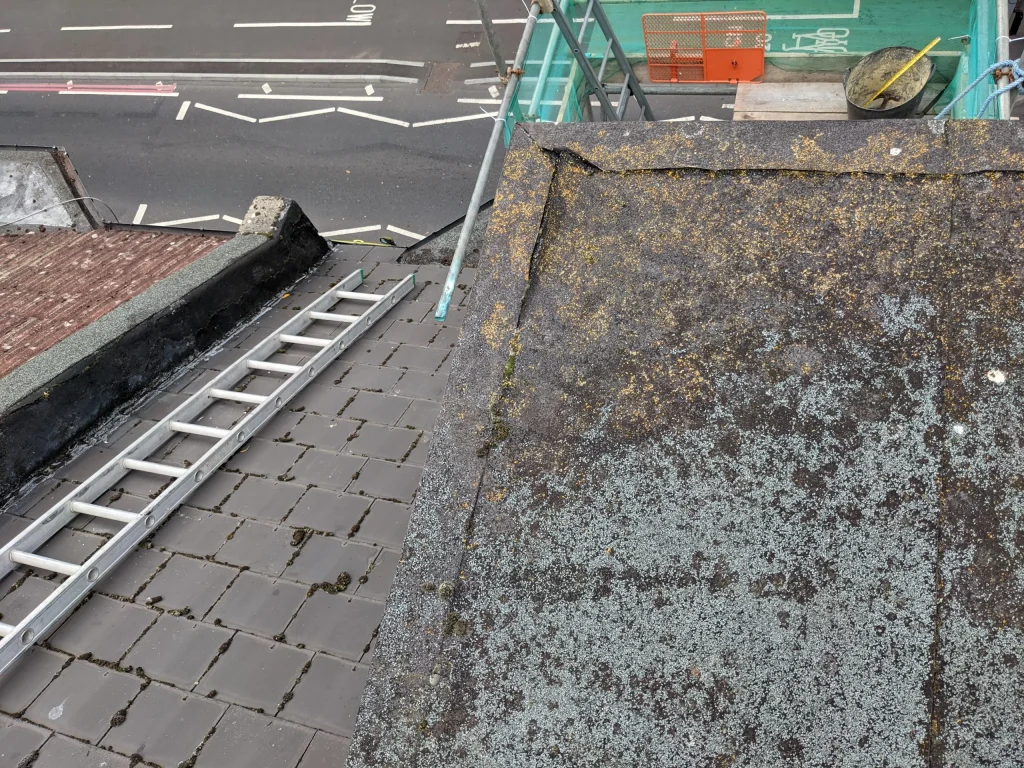
Garage Flat Roof Replacement: When an Old Felt Roof Has Reached the End of Its Life
Most garage flat roofs I inspect across Brighton, Hove and Worthing reach the end of their serviceable life at around 25 to 30 years. At that point, the original bituminous felt usually becomes brittle, UV-degraded, and starts failing around lap joints due to thermal cycling. Even if your waterproofing on a detached structure is not leaking today, many homeowners want to plan ahead and understand the likely replacement cost years in advance. That is exactly why I built my instant pricing tool for Sussex outbuildings — it gives an instant fixed estimate based purely on your bituminous covering dimensions.
If your measurements are accurate, the final installed cost should not materially differ from the online estimate.
Why Flat Roofs Fail After 25–30 Years
Older structures often require specialist maintenance for outbuildings because they usually fail due to cumulative thermal movement. Flat roof decks expand under summer solar gain and contract sharply during winter cooling cycles. Over decades, this repeated movement fatigues bitumen reinforcement layers.
Common failure points I see
- Lap joint separation caused by repeated expansion and contraction
- UV oxidation breaking down exposed bitumen compounds
- Capillary water tracking beneath failed edge details
- Deck movement causing stress cracking
- Ponding water accelerating membrane deterioration
On Sussex garages, coastal salt exposure also speeds deterioration of metal drip trims and fixings, especially on older untreated steel edge details.
In Many Cases, Full Strip-Off Is Not Necessary
A lot of homeowners assume replacement means stripping the entire roof back to timber. In reality, if the substrate is structurally sound and dry, I can often overlay the existing asphalt or aged felt with a modern SBS-modified torch-on mineral cap sheet such as Tecnatorch SBS Torch-On Mineral Felt Charcoal.
This works because SBS-modified bitumen remains flexible across wide thermal ranges and tolerates structural movement far better than traditional oxidised felt systems.
Single-layer overlay system
Where the existing substrate is stable, I can weld a single mineral-finished cap sheet directly over the prepared surface. This provides fresh waterproofing and UV protection.
I offer a 5-year workmanship guarantee on this specification. In practice, I expect it to last significantly longer, but I guarantee conservatively because movement stresses depend on the condition of the underlying structure.
Two-layer SBS system (best practice)
Proper modern replacement should ideally use a fully bonded underlay plus mineral cap sheet. This dual-layer system absorbs thermal stress far better because movement is distributed between membranes rather than concentrated at one welded layer.
This is why I confidently issue a 15-year guarantee on two-layer systems. Realistically, these roofs usually exceed that lifespan comfortably. Some of the first garage roofs I installed 18 years ago are still watertight today — generally just covered with surface moss.
How I Diagnose Whether Overlay Is Suitable
Before recommending anything, I inspect:
- Moisture content beneath existing membrane
- Deck integrity and flex tolerance
- Edge restraint condition
- Upstand detailing and flashing security
- Drainage falls and standing water patterns
If hidden moisture ingress exists, I may recommend requesting a professional structural survey before specifying replacement.
Plan Ahead With an Exact Price Estimate
Garage flat roof replacement is usually predictable if the dimensions are known. Now that you understand how these systems fail — and why overlay replacement often works perfectly well — you can use my online calculator to price either a single-layer or two-layer replacement in about 30 seconds.
It is designed for homeowners planning years ahead, not just those dealing with immediate leaks.
Interested in this service?
Check out the complete details and get a quote on our main page.
Go to: Garage Roof