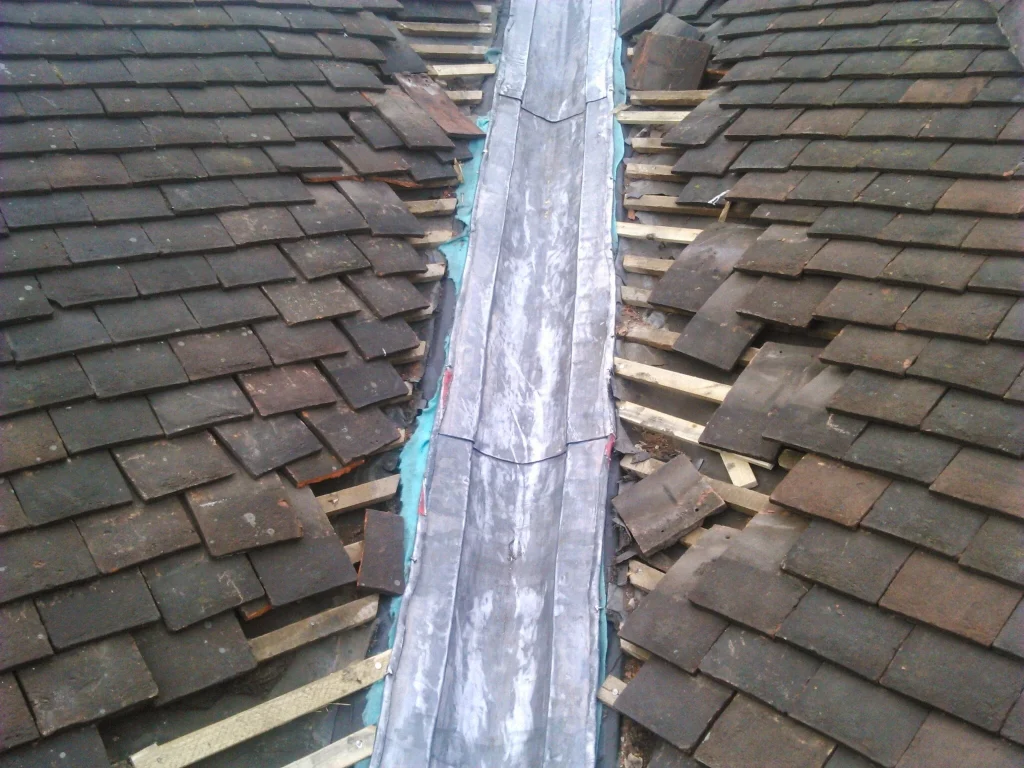
What roof valley flashing means
Roof valley flashing is the weatherproof channel fitted where two pitched roof slopes meet and direct rainwater down towards the gutter. Unlike wall flashing or chimney flashing, which mainly protect a junction between a roof and a vertical surface, a roof valley is part of the drainage path itself.
This matters because a valley carries more water than an ordinary section of tiled roof. During heavy rain, water from both roof slopes is concentrated into one narrow line. If the valley flashing is cracked, blocked, too narrow, badly supported, or poorly finished at the tile edges, water can overflow, track sideways, or reach the underlay and roof timbers below.
On many older properties in Brighton, Hove, Worthing and across Sussex, valley leaks are often linked to ageing leadwork, broken mortar bedding, slipped tiles, debris build-up, or earlier repairs that have narrowed the water channel. The correct repair depends on how the valley is built and where the water is escaping.
How a roof valley works
A pitched roof is designed to shed water down the slope. Where two slopes meet internally, the valley collects that water and guides it away. The valley may be formed with lead, GRP valley troughs, valley tiles, or another proprietary system depending on the age and type of roof.
When lead is used, it must be wide enough for the roof area it drains, properly supported underneath, and laid so water can move freely without being trapped by tight tile cuts or heavy mortar. The tiles or slates on each side should finish neatly above the valley, leaving a clear open channel for rainwater and small debris to pass through.
A valley is therefore not just a strip of flashing. It is a high-flow drainage detail. If it is poorly designed, blocked, or patched incorrectly, even a roof with generally sound tiles can still leak around the valley line.
Why roof valley flashing fails
Valley problems usually develop for one of several practical reasons. Some are simple maintenance issues, while others indicate that the flashing or roof structure needs more substantial work.
- Debris build-up: leaves, moss and broken mortar can collect in the valley and slow the flow of rainwater.
- Cracked or fatigued lead: old lead can split, especially if it has been installed in long unsupported lengths or without movement allowance.
- Tile cuts too close to the valley: if the open channel is too narrow, water can be pushed under the tile edges during heavy rain.
- Failed mortar bedding: older valleys may rely on mortar along the tile edges, which can crack, loosen or fall away.
- Poor previous repairs: thick mastic, cement, tape or coating can restrict water flow and hide the real defect.
- Rotten valley boards: if water has been entering for a long time, the timber support beneath the valley can weaken.
- Blocked gutter outlet below: water leaving the valley may back up if the gutter or downpipe cannot discharge it properly.
Warning signs of a leaking valley
A leaking roof valley does not always show as water directly below the outside valley line. Water can travel along felt, battens, rafters or ceiling boards before it appears indoors.
Common signs include damp staining on the ceiling below a roof junction, water marks near an internal corner, damp around the top of a bedroom wall, staining in a loft space near the valley rafter, or visible moss and debris sitting in the valley channel. From outside, cracked lead, loose mortar, tight tile cuts or a dark water-stained line beside the valley can also suggest a problem.
The timing of the leak is useful. If damp appears mainly after prolonged or wind-driven rain, the valley is more likely to be involved. If moisture appears in cold weather without rain, condensation or ventilation may also need to be considered.
How roof valley flashing differs from chimney or wall flashing
Roof valley flashing is often confused with other types of lead flashing, but the job it performs is different. A chimney flashing protects the base of a chimney stack. A wall flashing protects a roof-to-wall junction. A valley flashing carries concentrated rainwater down the roof.
This difference affects the repair method. Re-sealing a wall chase may solve a loose wall flashing, but it will not fix a valley where the water channel is too narrow or blocked. Likewise, applying sealant over a cracked valley may only provide a short-term patch if the lead has failed because of age, stress or poor support.
For valley work, the inspection must focus on water flow as well as visible waterproofing. The roofer needs to check how rain moves through the channel, whether the tile edges allow enough clearance, whether debris is collecting, and whether the flashing is properly supported underneath.
What a proper valley inspection should include
A practical inspection starts by following the water path from the upper roof slopes down to the gutter. The roofer would normally check the condition of the tiles or slates on both sides, the width of the open valley, the state of the lead or valley liner, the mortar edges, and the drainage point at the bottom.
In the loft, the underside of the valley should be checked where access is possible. Water staining on rafters, underlay or boards can help confirm whether the leak is coming through the valley or from another nearby detail such as a chimney, dormer, ridge, or broken tile.
Access also matters. Some valleys are easy to inspect from a ladder, while others sit between steep roof slopes or high rear elevations. Where the diagnosis is uncertain, a roof inspection for suspected valley leaks can help confirm whether the problem is the flashing, the surrounding tiles, the guttering below, or another roof defect.
Repair options for roof valley flashing
The right repair depends on the condition of the valley and the reason it is leaking. A valley filled with moss and loose debris may need careful cleaning and minor maintenance. A valley with loose mortar along the edges may need local re-bedding or re-pointing if the flashing below is still sound.
If the lead is cracked, badly creased, too narrow, or heavily patched, replacing the valley flashing is usually more reliable than adding another surface repair. This may involve lifting tiles on both sides, removing the failed valley material, checking the timber support, fitting new valley flashing or a suitable valley system, and re-cutting or re-laying the tile edges correctly.
In some cases, the problem is not the valley material itself but the way the roof drains into it. Poorly aligned tiles, a blocked gutter, or a narrow outlet at the bottom can cause water to back up. Repairing the flashing without improving the drainage can leave the same problem returning during heavy rain.
When replacement is more sensible than a patch repair
A small local repair may be enough if the valley flashing is generally sound and the defect is limited. Replacement becomes more sensible when the valley has several splits, old layers of sealant, failed mortar along both sides, rotten support boards, or repeated leaks in the same area.
Replacement is also worth considering when the existing detail was built too narrow for the roof area it drains. A valley that regularly overflows in heavy rain is not always a simple leak; it may be a drainage design problem. The new detail must give water enough room to move freely and safely into the gutter.
For traditional pitched roofs, valley work may sit within wider pitched roof repairs. If broken tiles, ageing battens, weak mortar, ridge defects or general roof wear are also present, a pitched roof repair calculator for terraced houses can give a useful starting point for understanding the likely scope before a full inspection.
What affects the cost of roof valley flashing work
The cost of roof valley flashing repair or replacement depends less on the word “flashing” and more on the access, roof pitch, valley length, material type, and how much surrounding roof covering must be lifted and reinstated.
- Valley length: longer valleys require more material, more tile removal and more labour.
- Roof height and access: steep or high roofs may need additional access equipment for safe working.
- Existing material: lead valleys, GRP valleys and tiled valleys require different repair methods.
- Condition of surrounding tiles: brittle, slipped or broken tiles can increase the amount of reinstatement needed.
- Hidden timber damage: long-term leaks may damage valley boards or adjacent roof timbers.
- Debris and drainage issues: blocked gutters or poor outlets may need correcting at the same time.
- Previous patch repairs: removing old cement, mastic or tape can add time before proper repair work begins.
An online calculator cannot replace inspection where the defect is hidden, but it can help a homeowner understand why one valley repair may be a small local job while another may involve tile lifting, new flashing and timber repairs.
Practical takeaway
Roof valley flashing is one of the most important drainage details on a pitched roof because it carries water from two roof slopes in one concentrated channel. A leak in this area may be caused by cracked lead, blocked debris, tight tile cuts, failed mortar, poor drainage or hidden timber damage.
The sensible approach is to inspect the whole valley line, not just seal the most visible gap. If the flashing is sound and the defect is minor, a local repair may be enough. If the valley is cracked, poorly formed, repeatedly patched or no longer draining properly, replacement is often the more reliable solution.