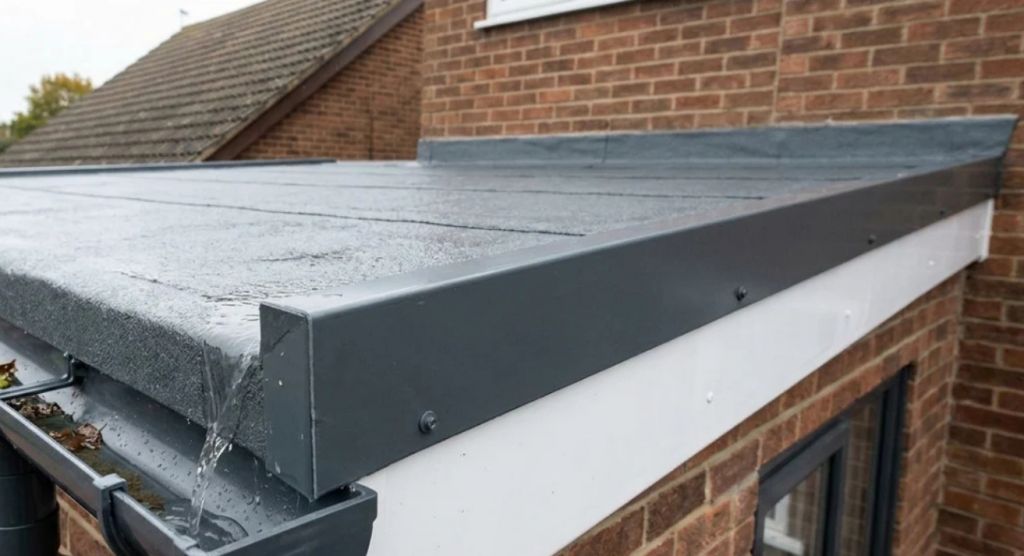
That does not mean every fibreglass roof must fail. A small, simple roof over an entrance or a very basic flat area may sometimes perform acceptably if the preparation, decking, drainage and detailing are all right. But larger domestic flat roofs are a much harder test, especially when they include parapet walls, old timber decking, several upstands, poor falls, outlets, edge trims, corners, pipes or awkward penetrations.
If you are dealing with water ingress through a fibreglass covering, the useful question is not only where the water is visible today. The more important question is why the roof allowed that leak to form in the first place. With GRP, the visible crack is often only the final symptom. The real cause may be movement in the structure, ponding water, a weak trim, trapped moisture, a failed wall junction or a roof detail that was too rigid from the beginning.
Why a Strong-Looking Fibreglass Roof Can Still Become a Weak Roof
Fibreglass feels strong because it is hard. That is one reason homeowners often trust it. When it is new, the surface can look smooth, sealed and solid. The problem is that a flat roof is not a fixed piece of furniture. It is exposed to rain, wind, frost, heat, cold nights, foot traffic, moisture inside the building and normal movement in the structure below.
A low-slope roof covering needs more than surface strength. It also needs to tolerate movement. Timber decking can expand and shrink. Joists can flex slightly. Boards can move at their joints. A wall junction can move differently from the roof deck. A parapet wall, outlet, corner or edge trim can concentrate stress into one small area.
If the waterproofing layer cannot absorb enough of that movement, the stress eventually shows somewhere. With fibreglass, I often see that stress appear as small hairline cracks around corners, trims, upstands, board joints and changes in level. The crack may look too small to matter, but rainwater does not need a large opening. On a low-slope roof, water can sit over the same small defect again and again until it finds a route in.
Once water gets beneath the hard surface, it may not travel straight down. It can track sideways through narrow gaps, soak into OSB boards, enter insulation, run along timber, or move into a wall before it finally appears indoors. That is why the damp patch inside the room may not be directly below the visible crack outside.
The Main Weakness: Limited Movement Tolerance
The biggest practical weakness I see with leaking fibreglass flat roofs is limited tolerance for movement. A hard surface can look reassuring when everything underneath is stable. But if the substrate below is moving, flexing, swelling, shrinking or already holding moisture, the covering is being asked to do a much harder job.
This is especially important on older domestic roofs around Sussex. Many flat roofs are built over timber structures that have already moved over many years. Some have old decking, mixed roof levels, poorly fixed boards, previous repairs, tired edges or weak drainage. When a rigid covering is applied over an imperfect structure, the weak points often appear later around the same details: trims, corners, outlets, wall upstands and board joints.
This is why I am more cautious with fibreglass on larger or more complicated roofs. A small square roof with minimal movement and simple edges is one thing. A larger roof with several changes of direction, parapet walls, outlets, awkward wall details and standing water is another. The more stress points the roof has, the more opportunities there are for a hard GRP surface to crack, lift or fail at a detail.
Sussex Weather Makes Weak Details Show Up Faster
Brighton, Hove, Worthing and the surrounding Sussex areas get plenty of wind-driven rain. On exposed properties, rain does not always fall neatly from above. It can be pushed sideways against edge trims, upstands, coping stones, parapet walls, render and lead flashing. If a fibreglass roof has a tiny crack, weak edge or poorly prepared junction, that kind of weather can find the weakness faster than a homeowner expects.
Coastal conditions can also make roof details work harder. Salt air, long damp spells and strong winds all test the perimeter of a roof. A trim that looks acceptable in dry weather may become a leak point when rain is driven sideways against it. A wall junction that seems minor can become a serious problem if water gets behind the upstand and starts tracking under the surface.
Older Sussex properties add another layer of difficulty. Victorian and Edwardian buildings often have ageing brickwork, old render, parapet walls, uneven roof levels and timber structures that have moved over time. A rigid roof covering has to meet all those imperfect details. If the preparation, falls, flashing or edge work are not excellent, the roof may look fine at first but later start leaking from the places where movement and water pressure are concentrated.
The Most Common Places I Find Fibreglass Flat Roof Leaks
Most leaking fibreglass flat roofs I inspect are not leaking from one dramatic hole in the middle of the roof. The problem is usually at a detail or stress point. These are the areas I check first:
- Edge trims: drip edges, perimeter trims and corner trims can become weak points where wind-driven rain works underneath the detail.
- Wall junctions and upstands: leaks often form where the fibreglass meets brickwork, render, lead flashing, a rear wall or a parapet wall.
- Internal corners: movement is concentrated where two planes meet, so small cracks often appear in these areas first.
- Outlets and drainage points: these areas are constantly tested by water, especially if the roof has poor falls or blocked drainage.
- Board joints: if the deck below moves independently, the fibreglass surface above can crack along the joint line.
- Old repair patches: repeated patches often show that the real cause was never corrected.
- Pipes and awkward penetrations: difficult details around old services can create stress points and small gaps where water can enter.
- Parapet walls and coping details: water can come through the wall above the roof and appear to be a failure in the flat surface.
These are not unusual defects. They are the normal places where a hard waterproof surface gets tested on a real roof. Once water finds one small opening, the visible damage inside the property may appear much later, and by that time the deck, insulation or wall detail may already have been wet for some time.
Ponding Water Makes Small Fibreglass Defects Worse
Ponding water is one of the most important warning signs on a fibreglass flat roof. A small amount of water immediately after rain is not always a disaster, but water that sits for a long time should not be ignored. It adds weight, highlights poor falls, and keeps weak areas wet for much longer than they should be.
On fibreglass roofs, I become especially cautious when standing water sits near a trim, wall junction, outlet, internal corner or visible crack. Water will keep testing that same weak point every time it rains. If there is a pinhole, split, loose edge or tiny gap, repeated ponding can make the defect show up much faster.
This is one of the reasons I do not like judging a fibreglass roof only by how the surface looks on a dry day. A hard GRP surface can appear clean and solid, but if water sits over the same area after every spell of rain, the roof is under constant pressure. Once water gets beneath the surface, it can travel sideways under the hard shell and remain hidden for some time.
Good drainage matters on every low-slope roofing system, including SBS torch-on felt, liquid systems and single-ply membranes. But fibreglass can be particularly unforgiving once ponding water and movement appear together. The water keeps the weak point active, while the movement keeps stressing the same detail.
How to Judge Whether Pooling Water Is Serious
The seriousness of pooling water depends on where it sits, how long it remains, and what condition the surrounding details are in. A shallow puddle in the middle of a stable roof is different from water sitting against a wall, trim, outlet or existing crack.
I would be more concerned if the water:
- sits for a long time after rain has stopped;
- collects around an outlet instead of draining properly;
- sits against an edge trim or drip detail;
- ponds near a wall junction, parapet or upstand;
- covers a visible crack, old repair patch or bubbling area;
- appears because the deck has dipped or become soft;
- keeps returning in the same place after every heavy rainfall.
Pooling water is not only a surface issue. It may be telling us that the falls are wrong, the deck has sagged, the outlet is blocked, or the roof structure below has weakened. That is why the question should not be only “Can I cover the puddle?” The better question is “Why is water collecting there in the first place?”
I would not recommend walking on a leaking or ponding fibreglass roof yourself to investigate. A flat roof can be weaker than it looks, especially if water has already reached the OSB or timber deck. Photos taken safely from a window, ladder position or neighbouring viewpoint can help, but they rarely show the full condition of the roof build-up.
Common Reasons Water Pools on a Fibreglass Flat Roof
When I see water pooling on a fibreglass flat roof, there are usually a few possible causes. Sometimes the problem is obvious. Other times the surface water is only a symptom of a deeper failure in the deck, outlet or roof design.
- Poor falls from the original installation: if the roof was not built with enough fall, water has no proper route to the outlet or gutter.
- Blocked outlets or drainage points: leaves, debris and silt can slow the drainage and leave water sitting on the surface.
- Sunken decking: if OSB or timber has softened, the roof can dip and create a low point where water collects.
- Parapet walls trapping water: roofs enclosed by walls need reliable outlets and overflows because water cannot escape freely at the edges.
- Incorrect edge detailing: a trim that sits too high or has been poorly formed can hold water back instead of letting it run away.
- Previous repairs changing the surface level: repeated patches can create ridges, humps and shallow areas where water begins to sit.
In some cases, drainage improvements may be part of the answer. Gutters, outlets, downpipes and overflow routes should all be checked before assuming the fibreglass surface alone is the problem. If the roof cannot move water away properly, any local repair is being asked to work under poor conditions from the start.
GRP Trims, Edges and Corners: Why Small Details Decide the Roof
Fibreglass flat roof trims are often where small defects become real leaks. The main field of the roof may still look acceptable, but the perimeter is where wind, rain, movement and fixing points all meet. That makes edge trims, drip trims and corner trims important parts of the whole waterproofing system, not just finishing pieces.
Wind-driven rain can work under a weak edge. Capillary action can pull water into narrow gaps. A poorly bonded trim can lift slightly. A corner can crack because movement is concentrated into a small area. Once that happens, the leak may not be dramatic from above, but the roof can still allow moisture into the deck or fascia area.
Internal corners are another common weak point. Where two planes meet, the roof covering has to cope with movement from more than one direction. If the fibreglass is too rigid, poorly reinforced or bonded to a moving substrate, a tiny split can form in the corner. That split may only open slightly, but it can still be enough for water ingress during heavy rain.
Pipes and awkward penetrations make the situation even harder. A flat roof with an old service pipe, cast-iron pipe, cable penetration or tight corner is not the same as a simple square roof. Every penetration creates another junction that must be waterproofed, reinforced and allowed for. When too many difficult details are squeezed into one small area, fibreglass has less margin for error.
This is why I do not see trim problems as cosmetic issues. A failed trim can be the place where the whole roof starts to take in water. If the edge detail is loose, cracked, poorly bonded or repeatedly patched, it needs to be treated as part of the leak diagnosis, not as an afterthought.
Wall Junctions, Flashing and Parapets Should Not Be Ignored
Not every leaking fibreglass roof is leaking only through the fibreglass surface. Around Sussex, I often have to check brickwork, render, lead flashing, parapet walls and coping stones as carefully as the roof covering itself. Water can come through a wall and appear to be a roof leak. It can also get behind a weak upstand and travel under the roof surface.
Where a fibreglass flat roof meets a wall, the waterproofing has to turn up vertically, bond correctly and work with the flashing or capping above. If the upstand is too low, poorly bonded, cracked in the corner, or not protected properly, wind-driven rain can get behind the detail even when the main flat surface looks acceptable.
Brighton and Hove have many older properties with parapet walls, party walls, old brickwork and complicated rear extension details. These structures can absorb moisture, move differently from the roof deck and create difficult junctions. A rigid roof covering against ageing masonry can become a weak point if the detail has not been designed and prepared carefully.
When I see staining near a party wall, rear wall, chimney side or parapet, I do not automatically blame the fibreglass surface alone. I check the wall above it, the render, the lead flashing, the coping stones, cracks in the masonry and the way the roof covering finishes into the upstand. In some cases, waterproofing for parapet walls is just as important as the flat roof covering itself.
Why the Leak May Have Started Before You Noticed It
A leaking fibreglass roof does not always show itself immediately on the ceiling. With low-slope roofs, water rarely behaves in a simple straight line. It may soak into insulation, sit in the deck, run along timber, enter a wall, or move sideways between layers before it finally becomes visible indoors.
I have seen roofs where the homeowner only noticed the problem after a ceiling stain appeared, but the roof had clearly been holding moisture for much longer. Sometimes there is no obvious dripping because the water is travelling into masonry, fascia areas, insulation or the deck instead of falling straight into the room.
That hidden moisture still matters. OSB boards can soften. Timber can start to decay. Insulation can hold water. Fixings and edge details can weaken. The roof may continue to look acceptable from above while the structure below is slowly being damaged.
These are warning signs I would take seriously:
- damp smells in the room below;
- bubbling, lifting or hollow areas on the roof surface;
- soft or springy areas underfoot;
- stains around fascia, soffit or wall areas;
- mould, peeling paint or recurring damp patches inside;
- old repair patches that keep cracking again;
- water marks that appear after wind-driven rain rather than light rain.
The absence of a ceiling stain does not always mean the roof is dry. It may only mean the water has not yet reached the visible internal finish.
Condensation Can Confuse the Picture
Condensation can sometimes be confused with a roof leak, especially in poorly ventilated extensions, cold roof structures or rooms with high internal moisture. This is one reason I prefer diagnosis before repair. If the wrong problem is treated, the homeowner may spend money on the roof surface while the internal moisture issue continues.
Condensation often shows as more widespread dampness, mould growth, moisture on cold surfaces, or a pattern that becomes worse in cold weather. A genuine rainwater leak usually has a stronger relationship with rainfall, wind direction, ponding water or storms. However, the situation is not always clean and simple. A property can have both condensation and a roof leak at the same time.
That is why I look at the timing of the damp, the location of stains, the condition of the roof, the insulation build-up, the ventilation and the external details. A damp ceiling below a fibreglass roof should not automatically be dismissed as condensation, but it should not automatically be treated as a simple surface crack either.
Common Misunderstandings About Leaking Fibreglass Roofs
“It only needs another coat.”
Sometimes a coating or local repair can help, but only when the roof is dry, stable and the defect is genuinely local. If the roof is moving, holding water, or already wet underneath, another coat may only hide the problem for a short time.
“The crack is tiny, so it cannot be serious.”
A tiny crack can still allow water in. On a flat or low-slope roof, water can sit over that small crack repeatedly. The size of the visible crack does not always match the amount of moisture travelling below the surface.
“There is no ceiling stain, so the roof is not leaking.”
Water does not always come straight through the ceiling. It can travel into insulation, timber, walls or fascia areas before it becomes visible inside. A fibreglass roof can be leaking even if there is no obvious internal stain yet.
“Fibreglass is strong, so it should not fail.”
Strength is not the only issue. A flat roof covering also needs flexibility, correct detailing, good drainage and a sound deck below it. A hard material can still crack if the structure below moves or if water keeps sitting in the same areas.
“Pooling water only looks bad.”
Standing water is not only a visual problem. If it sits near a crack, trim, wall junction, outlet or old repair, it can keep testing that weak point until water finds a way into the roof build-up.
The First Rule: Diagnose Before Repairing
The worst repair on a leaking fibreglass flat roof is the one done too quickly. If the source of the leak is guessed rather than found, the repair usually becomes another temporary layer over the same failure. The surface may look freshly sealed for a short time, but the movement, trapped moisture, poor drainage or weak detail may still be there underneath.
Before choosing any repair method, I want to understand what the roof is actually telling us. A visible crack is only one clue. The real question is whether the roof has one local defect, or whether the fibreglass system is starting to fail across several areas.
Before I would think about any repair, I would want to know four things:
- Where the water is entering: the internal stain may not be directly below the external defect.
- Why the fibreglass failed: movement, ponding water, failed trims, wall details and deck problems all need different answers.
- Whether the roof structure is still sound: soft OSB, swollen boards, rotten timber or a sagging deck change the whole job.
- Whether the repair can realistically last: some defects can be patched, but some roofs are already past sensible local repair.
That is why I do not like blind recoating. A repair should follow the diagnosis. It should not replace it.
Can a Leaking Fibreglass Flat Roof Be Repaired?
Yes, sometimes. I would not automatically say that every leaking fibreglass roof needs replacing. That would not be fair. A small isolated crack on a dry, stable deck is very different from a roof with movement cracks, failed trims, soft boards, standing water and old patches that have already failed.
A repair may be worth considering when the damage is local, the fibreglass is still bonded properly, and the deck underneath feels firm. For example, one small crack away from a major stress point may be repairable if the surface can be cleaned, dried, prepared and rebuilt correctly with compatible materials.
I would be more open to repair when:
- the leak is clearly coming from one small area;
- the surrounding fibreglass is still firmly bonded;
- the roof deck below feels solid and dry;
- there is no widespread cracking;
- ponding water is not sitting over the repair area;
- the wall, trim or outlet detail can be corrected properly;
- there are no repeated failed patches in the same place.
Even then, I would be honest with the homeowner about expectations. A local repair is not the same as renewing the whole roof system. It may solve one defect, but it will not turn an old, moving or damp fibreglass roof into a new roof.
When a Small Local Repair May Be Enough
A small repair may be reasonable when the rest of the roof is in decent condition. The important words are dry, stable and local. If the defect is isolated and the roof around it is sound, a careful repair may be a fair option.
Small repairs can sometimes work for:
- one isolated hairline crack;
- a minor defect around a trim;
- a small puncture from foot traffic or impact damage;
- one failed corner detail on an otherwise stable roof;
- a localised section where the surrounding fibreglass is still well bonded.
Preparation matters. The surface has to be clean, dry and suitable for bonding. Loose material needs removing. The repair should be built into a sound area, not simply smeared over the crack. If moisture is already trapped below the surface, the repair may seal in the damp rather than solve the leak.
Why Fibreglass Repairs Often Fail Again
Fibreglass repairs often fail again because the patch does not remove the original cause. If the crack appeared because the deck is moving, patching the crack does not stop the deck moving. The same stress can reopen the repair or create a new crack beside it.
If the problem is ponding water, the repaired area will continue to be tested every time it rains. If the problem is a weak wall junction, water may still be getting behind the upstand. If the problem is a failed trim, a surface patch in the middle of the roof will not stop water entering at the edge.
Moisture is another problem. If water has already entered beneath the fibreglass, a new coat can trap damp inside the build-up. On warm days that moisture can expand, cause bubbling, weaken adhesion and make the roof harder to repair later.
This is why repairing the crack is not always the same as repairing the roof. The crack is only the place where the failure became visible. The actual weakness may be in the structure, the drainage, the trim, the wall detail or the deck below.
When I Would Not Trust a Patch
There are situations where patching a leaking fibreglass flat roof is unlikely to be a fair long-term answer. I would be cautious if I found several of these signs together:
- cracks in different areas of the covering;
- water sitting on the surface after rain;
- soft or springy decking underneath;
- failed trims around the edges;
- leaks near parapet walls or complicated upstands;
- bubbles, hollow areas or lifting fibreglass;
- old patches that have already failed;
- damp insulation or signs of long-term moisture ingress;
- staining around fascia, soffit, wall or outlet areas.
In those situations, another fibreglass layer can become a false economy. It may reduce the leak for a short time, but the roof is still being asked to cope with the same movement, wet deck, poor falls or weak detailing that damaged the original system.
When Replacement Becomes the More Sensible Option
Replacement becomes more sensible when the roof has several problems at once. If I see cracks in different areas, failed trims, long-term moisture ingress, soft decking, old failed patches and water sitting on the surface, I do not like pretending that one more patch will solve it.
At that stage, the roof needs to be treated as a complete system: deck, insulation, falls, drainage, upstands, flashing, edges and waterproofing. The covering is only the top layer. If the structure below is wet, soft or moving, the surface cannot be judged on its own.
In many cases, I would look at a more repairable low-slope roofing system, such as a properly installed SBS torch-on felt build-up, depending on the roof type and structure. For homeowners comparing options, my page on Tecnatorch SBS felt replacement in Brighton and Hove is usually the most relevant place to understand the type of flat roofing work involved.
Why I Often Prefer Tecnatorch SBS Torch-On Mineral Felt Charcoal
For many domestic flat roofs, especially where I want a practical and repairable system, I often prefer Tecnatorch SBS Torch-On Mineral Felt Charcoal. It is not because it sounds more fashionable. It is because, from a roofer’s point of view, SBS torch-on felt gives me a more forgiving and maintainable waterproofing system when fitted over a proper deck.
SBS-modified felt has flexibility built into the material. That helps it deal with normal substrate movement better than a hard, brittle or poorly bonded surface. It also remains more straightforward to repair later if the structure is still sound. A compatible felt repair or additional cap sheet is often more realistic than trying to make an old cracked fibreglass covering behave like new again.
This does not mean felt solves everything by magic. The deck still has to be sound. The roof still needs proper falls. The edges, outlets, upstands and lead flashing all need to be detailed correctly. Poor workmanship can ruin any flat roofing system. But when the whole area is being reset, I usually find a well-installed SBS torch-on felt system gives the homeowner a more practical long-term result.
What a Proper Replacement Usually Involves
If the fibreglass roof is beyond sensible repair, replacement should not mean simply covering the old material and hoping for the best. A proper job normally means stripping back enough to understand what is happening underneath.
Depending on the roof, that may involve:
- removing the failed fibreglass covering;
- checking the OSB or plywood deck;
- replacing any soft, swollen or damaged boards;
- repairing weak joists, timber edges or perimeter details;
- improving falls where the structure allows;
- checking outlets, gutters and drainage routes;
- rebuilding edge details and trims;
- checking wall upstands, lead flashing, render and parapet details;
- installing a suitable SBS torch-on felt build-up over a sound deck.
The important point is that replacement should reset the roof as a system. If the same poor falls, wet boards, weak outlets or bad wall details are left in place, the new covering is starting with the same disadvantages as the old one.
Temporary Weatherproofing Has Its Place
Temporary weatherproofing can be sensible when water is actively entering the property and the full repair or replacement cannot be done immediately. In bad weather, the first priority may be to reduce water ingress and protect the room below.
But a temporary repair is not a full roof renewal. It may buy time, but it should not be sold as a long-term solution if the fibreglass has failed across the roof. This is especially relevant in Sussex, where wind-driven rain can quickly expose weak details again.
If the covering is leaking during bad weather, stopping immediate water ingress may be sensible. The underlying problem still needs proper assessment once conditions allow. Otherwise, the same leak often returns after the next spell of heavy rain.
What I Check During an Inspection
When I inspect a leaking fibreglass flat roof, I do not only look for the most obvious crack. I normally check the roof in a practical order so the repair decision is based on the whole system, not one visible symptom.
- the internal damp pattern and when it appears;
- whether the leak relates to rain, wind direction, cold weather or condensation;
- the direction of falls and where water sits after rain;
- the condition of outlets, gutters and drainage points;
- the condition of trims, drip edges and corners;
- all wall junctions, upstands and lead flashing;
- parapet walls, coping stones, render and brickwork above the roof;
- corners and changes in level;
- signs of movement along board joints;
- bubbling, hollow areas, lifting or old repair patches;
- the condition of the deck where it can be assessed safely;
- whether repair, temporary weatherproofing or replacement is the fair recommendation.
If the source is uncertain, proper diagnosis is usually better than paying for repeated small repairs. For unclear leaks, a technical roof inspection in Brighton and Sussex can help separate a repairable defect from a covering that is failing more widely.
What I Would Tell a Homeowner Before They Spend Money
If a homeowner asked me how to repair a leaking fibreglass flat roof, I would not start by selling them a new roof. I would start by checking whether a repair has a fair chance of working. That means asking the right questions before money is spent.
- Is the defect genuinely local, or are there cracks in several places?
- Is the deck firm and dry, or does it feel soft and springy?
- Is water ponding over the damaged area?
- Are the trims, outlets and wall junctions still sound?
- Has the same area already been patched before?
- Is the damp pattern definitely rainwater ingress, or could condensation also be involved?
- Will the repair deal with the cause, or only cover the symptom?
Those questions matter because repair, temporary weatherproofing and replacement are three different decisions. A cheap patch can be useful in the right situation, but it can also waste money if the roof is already wet, moving or failing in several areas.
My Honest View on Leaking Fibreglass Flat Roofs
I do not say that every fibreglass roof must fail. A small, simple roof with good preparation, minimal movement, correct detailing and a skilled installer may perform acceptably. I have no reason to claim otherwise.
But on larger or more complicated low-slope roofs, especially where there are wall junctions, parapets, poor falls, ponding water, edge trims, outlets and timber movement, I am cautious. From what I have seen on real leaking roofs around Brighton, Hove, Worthing and wider Sussex, fibreglass can be an unforgiving material. It can look strong while hiding small cracks and moisture problems that are already developing underneath.
If your fibreglass flat roof is leaking, the useful question is not only where the water is coming in today. The better question is why the roof allowed that leak to form in the first place. If it is one local defect on a sound roof, repair may be enough. If it is movement, poor drainage, wet decking or repeated cracking, another surface layer may only buy a short amount of time.
My advice is simple: diagnose before repairing. A low-slope roof leak should be treated as a system problem until proven otherwise. That approach saves homeowners from spending money twice and gives a much clearer decision between a small repair, temporary weatherproofing, or proper replacement.