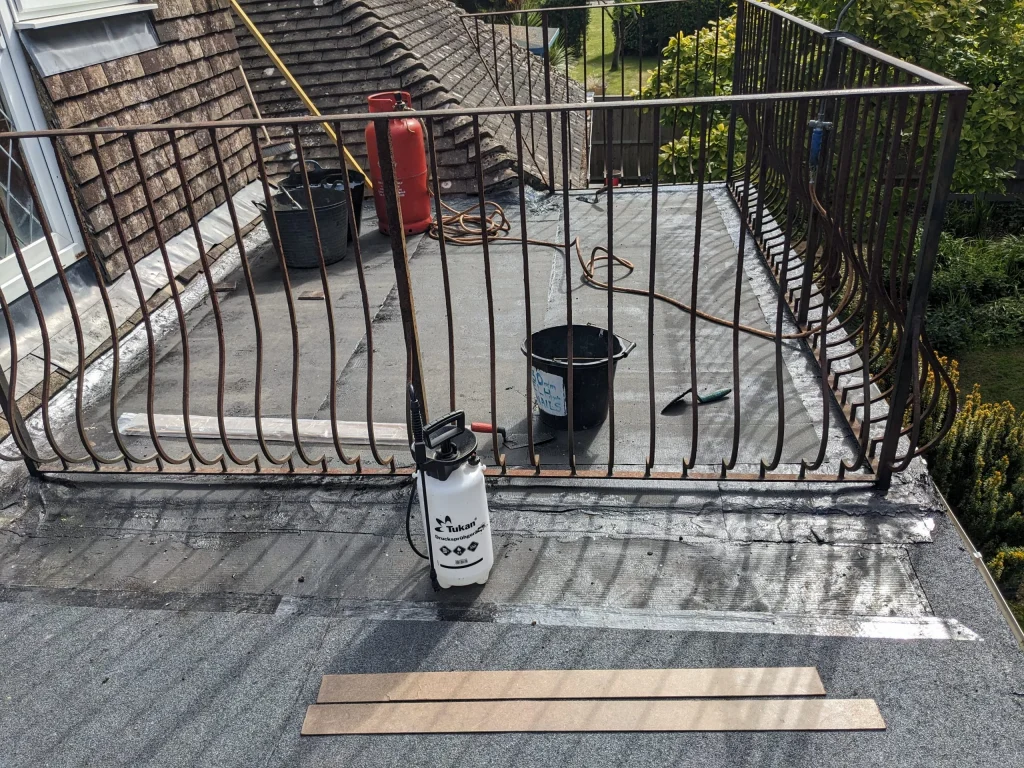
When I price or specify a new garage roof, I do not only think about how the roof will look on the day it is finished. I think about how it will behave after ten, twenty, or even thirty years of Sussex weather. That is one reason I often prefer Tecnatorch SBS Torch-On Mineral Felt Charcoal for garage roofs. It is not the most fashionable-looking material when compared with some modern plastic membranes, but from a practical roofer’s point of view, it has one major advantage: it is far easier to maintain and repair later.
A garage roof is usually a working roof, not a showroom roof. It has to cope with rain, wind, standing water, temperature movement, foot traffic during maintenance, and sometimes poor ventilation inside the garage. The best material is not always the one that looks cleanest in a brochure. It is the one that can be detailed properly, repaired sensibly, and kept waterproof for the long term.
Why material choice matters on a new garage roof
Most garage roofs in Brighton, Hove, Worthing, and nearby Sussex areas are flat or very low pitched. That means water does not run away as quickly as it would on a steep tiled roof. If the falls are poor, water can sit on the surface after rain. This is called ponding water, and over time it tests every lap, edge trim, joint, and outlet.
On a new garage roof, the waterproofing layer must deal with more than just rain from above. It also has to handle normal movement in the timber deck below. OSB boards and timber joists expand and contract slightly with moisture and temperature changes. A rigid or ageing membrane can split when the substrate moves beneath it.
This is where SBS torch-on felt is useful. SBS-modified felt has flexibility built into the material, so it can cope better with ordinary movement than older, harder felt systems. When installed properly over a sound deck, it creates a tough waterproof covering that suits many domestic garage roofs very well.
Why I recommend Tecnatorch SBS Torch-On Mineral Felt Charcoal
I recommend Tecnatorch SBS Torch-On Mineral Felt Charcoal because it is a proven, practical material for flat and low-slope garage roofs. The charcoal mineral finish gives the top layer protection from weathering, while the SBS bitumen underneath gives flexibility and waterproofing strength.
The main reason I like it is simple: it remains repairable. If a garage roof covered with this type of felt starts leaking after many years, I can usually inspect the defect, clean and prepare the area, and bond compatible torch-on felt over it. In some cases, after around 25 years, a further cap sheet layer can be applied over a suitable existing felt roof, making the roof look fresh again and giving it a renewed waterproofing surface.
That does not mean every old felt roof can simply be covered. The deck must still be firm, dry enough, and structurally sound. If the OSB is soft or the timber joists are rotten, the roof covering is not the real problem anymore. But where the base is still solid, SBS torch-on felt gives much better long-term repair options than many homeowners realise.
The repair advantage compared with plastic membranes
Plastic roofing membranes can look very neat when they are new. I understand why homeowners are attracted to them. A clean plastic sheet can give a smooth modern appearance, especially on the first day. The issue is what happens years later when the surface has been exposed to UV light, weather, dirt, and movement.
Over time, UV exposure can affect the surface of some plastic membranes. The material may become harder, less receptive to bonding, or more awkward to patch cleanly. When a leak appears, the repair is not always as simple as sticking on a neat patch. The old membrane may need careful preparation, specialist adhesives, compatible materials, and good conditions for the repair to bond properly.
With Tecnatorch SBS torch-on felt, the repair principle is usually more straightforward. Because it is a bitumen-based felt system, new compatible felt can often be heat-bonded to the existing surface if the roof is suitable. For a homeowner, that matters. A roof that can be repaired properly later is often a better long-term investment than a roof that only looks impressive while it is new.
What I check before fitting a new garage roof
Before I fit a new garage roof, I do not just look at the old surface. I check the whole roof as a system. A good felt covering will not save a weak structure underneath it.
- Deck condition: OSB or plywood must be firm. If it feels soft, swollen, or springy, it should be replaced.
- Falls and drainage: The roof should shed water as well as the structure allows. Standing water shortens the life of any flat roof material.
- Edge details: Wind-driven rain can creep under weak trims by capillary action if the edges are poorly formed.
- Wall junctions: Where a garage roof meets a wall, the flashing or upstand detail must be properly waterproofed.
- Ventilation and condensation: Some garages suffer from internal moisture, especially when warm air meets a cold roof deck.
- Timber structure: Joists, fascias, and perimeter timbers need checking before new felt goes on.
In Sussex, I also pay attention to wind exposure and salt corrosion. Garage roofs near the coast can suffer more at trims, fixings, and exposed edges. That is why I prefer robust detailing rather than relying only on the surface material.
One layer over an old roof or a proper replacement?
Sometimes a homeowner asks whether a new layer can simply be put over the existing garage roof. The honest answer is: sometimes, but not always. If the existing felt is dry, well bonded, reasonably flat, and the deck underneath is firm, an overlay may be possible. If the roof is holding moisture, lifting in several places, or hiding rotten boards, covering it again only traps the problem.
For a proper new garage roof, I normally want the surface prepared correctly, weak boards replaced, edges rebuilt where needed, and the felt installed with proper laps and detailing. The best material still needs good workmanship. A badly fitted premium felt will fail sooner than a modest system fitted with care.
For homeowners comparing realistic options, my page on garage roof replacement options in Brighton, Hove and Worthing is usually the most relevant starting point because it focuses specifically on this type of roof.
Why long-term maintainability is important
A new garage roof should not be judged only by the first few years. I prefer materials that leave the homeowner with sensible options later. With Tecnatorch SBS Torch-On Mineral Felt Charcoal, future maintenance is usually more practical because the system is compatible with further felt repairs or an additional cap sheet when the existing roof is still structurally sound.
This matters especially on garages because they are often not inspected regularly. A small leak may go unnoticed behind stored boxes, tools, or timber. By the time the homeowner sees staining, the roof may already have been wet for a while. A repairable roof covering gives more flexibility when dealing with ageing and local defects.
Signs your garage roof may be ready for replacement
I would start thinking seriously about a new garage roof if I saw several of these signs together:
- felt cracking across large areas rather than one small split
- water sitting on the roof for days after rain
- soft or spongy boards underfoot
- repeated patch repairs that no longer hold
- edges lifting in strong wind
- damp timber smell inside the garage
- rot around fascia boards or roof edges
- water entering near the wall junction or gutter line
One small defect does not always mean the whole roof has failed. But when the covering, deck, edges, and drainage are all showing age, replacement is usually the cleaner and more reliable route.
My practical view
For a new garage roof, I would rather use a material that performs well, can be detailed properly, and can still be repaired years later. That is why I trust Tecnatorch SBS Torch-On Mineral Felt Charcoal on many garage roofs. It is a sensible, proven SBS torch-on felt rather than a fragile cosmetic finish.
Plastic membranes can look attractive when new, but long-term repairability is where I often see the difference. After years of UV exposure and weathering, patching some membrane systems can become awkward. With a compatible SBS felt roof, future repair or renewal is usually more straightforward, provided the deck below is still sound.
If you are planning a new garage roof, think beyond the first appearance. Ask what happens if the roof needs attention in 20 or 25 years. Ask whether the material can be repaired cleanly. Ask whether the deck, edges, trims, and drainage are being dealt with properly. That is what decides whether a garage roof is just new, or genuinely built to last.
If the size and structure are straightforward, you can often estimate the likely cost online in around 30 seconds before arranging anything. That makes it easier to compare a basic replacement, a stronger felt build-up, or any extra work such as OSB board replacement.