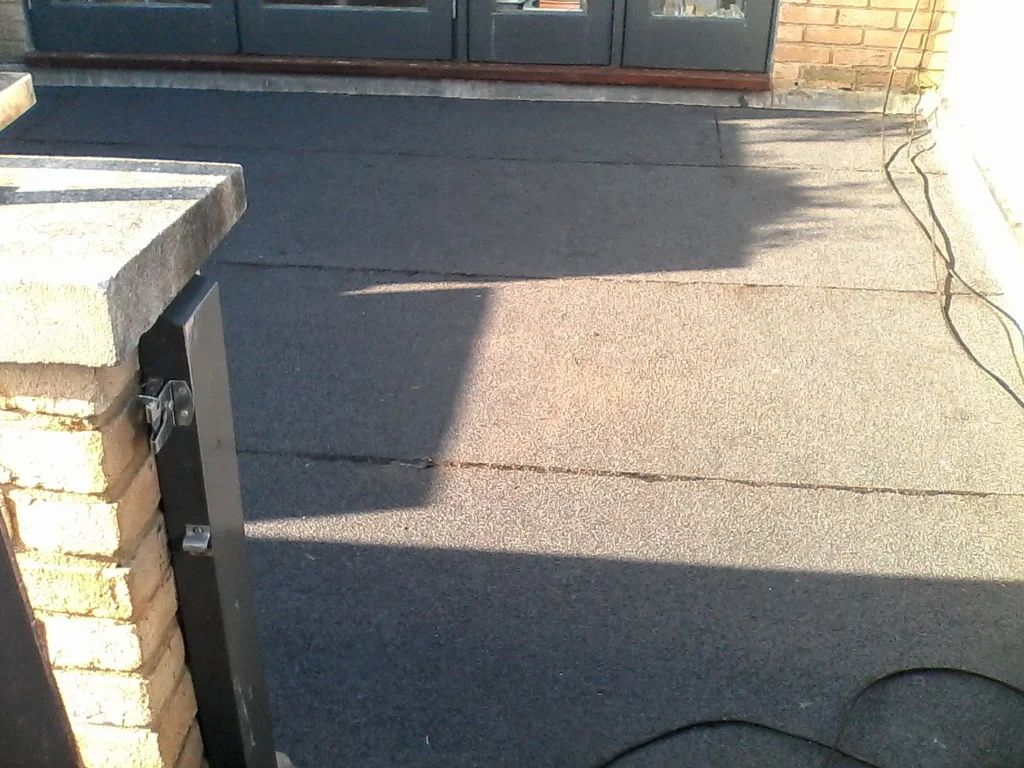
My garage roof is leaking is one of those problems where the right answer depends on how far the water has already travelled. Sometimes I can make a sensible half-day repair and stop the leak without stripping the whole roof. Other times, once the felt is lifted, the OSB deck or timber joists underneath are soft, swollen, or starting to fail. That is when the job changes from a small repair into a proper garage roof rebuild. For local context, my guide to garage roofing help around Sussex explains how I usually assess these smaller flat structures.
When I inspect leaking garage roofs around Brighton, Hove, Worthing, and wider Sussex, I try not to jump straight to replacement. I look first at the roof covering, edges, trims, gutter line, upstands, and the deck below. A leaking garage roof might only need a local repair, but if the structure is holding moisture, a patch will only buy a little time.
Why garage roofs leak in the first place
Most garage roof leaks I see are not caused by one dramatic hole in the middle of the surface. They usually start at weak details: felt laps, edges, outlets, cracked trims, old fixings, or a junction against a wall. Water then tracks underneath the covering and appears somewhere completely different inside the garage.
On older felt systems, the material often becomes brittle. Once the felt loses flexibility, normal substrate movement can open cracks at the joints. Sussex weather makes this worse because coastal wind drives rain sideways, and salt air can speed up corrosion on metal trims, nails, screws, and old fixings.
Another common problem is ponding water. A garage covering should shed water properly. If water sits for days after rain, it slowly tests every lap and weak point. Even modern SBS torch-on felt needs a firm, dry base and reasonable falls. Good felt on a soft deck is still a poor installation. I see the same principle with other low-slope coverings too, including standing water problems on fibreglass systems, where the water often exposes weak details rather than creating the only defect.
When a half-day garage roof repair can be enough
A half-day repair is usually realistic when the leak is localised and the rest of the garage covering still has enough life left in it. I would normally consider this if the deck feels firm, the felt is not breaking down everywhere, and the problem is coming from one clear area.
- A small split in the felt surface.
- One open lap where the felt has lifted.
- A loose edge trim allowing wind-driven rain underneath.
- A failed gutter edge causing water to creep back into the deck.
- A minor puncture caused by foot traffic, tools, branches, or stored items.
- A short section of failed flashing where the garage covering meets a wall.
In these cases, I can often clean the area, dry it properly where possible, and carry out a targeted repair using compatible roofing materials. The important word is compatible. Random sealant smeared over old felt may stop rain for a short while, but it is not the same as rebuilding the failed detail correctly.
When the leak is really a deck problem
The part homeowners often cannot see is the deck. On many garage roofs, that means OSB or plywood boards sitting over timber joists. Once water gets past the waterproof covering, those boards can swell, delaminate, and lose strength. You may not notice it from below until the ceiling stains, the surface sags, or the felt starts dipping between joists.
When I walk a garage roof carefully, soft areas tell me a lot. A firm deck has a solid feel underfoot. A structure with deck failure can feel spongy, hollow, or uneven. If the OSB has gone soft, there is no point pretending that a surface patch is a long-term repair. The waterproof layer depends on the structure below it.
This is where the job becomes more involved. The old felt may need stripping, damaged OSB boards replaced, and any rotten or weakened timber joists repaired before a new SBS torch-on felt system is installed. That is not the same job as sealing a small split. It takes more time, more materials, and more judgement.
Repair, temporary repair, or full replacement?
I usually explain garage roof options in three practical levels.
1. Local repair
This is for a garage roof that is mostly sound. The goal is to deal with the specific leak without unnecessary stripping. It can be a good option when the roof has one failed lap, one edge problem, or one small damaged section.
2. Temporary weatherproofing
This is useful when the roof is in poor condition but the homeowner needs time. I can sometimes carry out a temporary repair to reduce water ingress and give the customer breathing space to budget for the proper work. I am always clear about this: temporary means temporary. It is not a new covering disguised as a cheap repair.
3. Full garage roof replacement
This becomes the sensible route when the felt has failed across the area, the OSB deck is soft, several previous patches have already failed, or the timber structure has started to deteriorate. For this type of work, the garage has to be treated as a system: covering, deck, joists, falls, edges, drainage, and wall details.
For homeowners comparing options, my page on garage roof replacement costs in Brighton, Hove and Worthing is the most relevant starting point, especially if you want to understand likely costs before booking anything.
Why the calculator helps with garage roof decisions
Garage roof repairs can be difficult to price blindly because two roofs with the same surface area can be completely different underneath. One may only need a straightforward felt repair. Another may need new OSB boards, several timber joists, new edge details, and better drainage.
That is why I use a calculator for larger garage roof work. Instead of waiting for a rough guess, the customer can enter the garage size in square metres, choose whether OSB boards need replacing, and add how many timber joists may need attention. The calculator then gives a much more realistic guide price in around 30 seconds.
It is not there to pressure anyone into replacement. It is there to make the decision clearer. If the garage roof is badly deteriorated, the customer can see what a proper repair or rebuild is likely to cost. If that is not affordable immediately, we can discuss whether a temporary repair is sensible while they prepare for the more robust option.
Signs your garage roof may need more than a patch
I would be cautious about relying on a small repair if I saw several of these signs together:
- Water sitting on the roof long after rain has stopped.
- Several old patches in different places.
- Soft or springy areas underfoot.
- Felt cracking across the surface rather than in one isolated spot.
- Rotten timber visible inside the garage.
- Black staining, mould, or a damp timber smell.
- Water entering near electrics or stored equipment.
- Edges lifting in the wind.
- Fascia or roofline timber starting to deteriorate.
One warning sign does not always mean the garage roof is finished. But several signs together usually mean the leak is part of a wider failure, not just a small defect.
Condensation can confuse the diagnosis
Not every damp garage ceiling is a true roof leak. Some garages suffer from condensation, especially if warm moist air is trapped inside and the deck gets cold. Condensation tends to show as widespread dampness, mould, or droplets rather than a clear leak after rain.
That said, many garages are unheated and poorly ventilated, so condensation and water ingress can exist together. I check both. If rainwater is getting into the OSB and the garage also has poor airflow, the structure can deteriorate faster than the homeowner expects.
What I would do first if your garage roof is leaking
If the leak has just started, move anything valuable away from the wet area and avoid walking on the garage roof yourself. These structures can be weaker than they look, especially when the deck has been wet for a long time. Take photos of where the water appears inside and note whether it happens after heavy rain, wind-driven rain, or cold weather.
If water is actively coming in, an urgent leak assessment for a garage roof may be the right first step. If the situation is less urgent, it is usually better to inspect the area properly and decide whether a half-day repair, temporary weatherproofing, or full replacement makes the most sense.
My practical view
A leaking garage roof does not always need replacing, but it should not be guessed at. If the covering is sound apart from one clear defect, a half-day repair may be enough. If the OSB deck is soft or the timbers are deteriorating, the job needs a more serious repair plan.
The useful thing is that homeowners do not have to make that decision blindly. A temporary repair can sometimes buy time, and the garage roof calculator can give a clear idea of the cost for a more robust repair when OSB boards or joists need replacing. The right answer is the one that matches the actual condition of the structure, not the cheapest patch or the most expensive replacement by default.