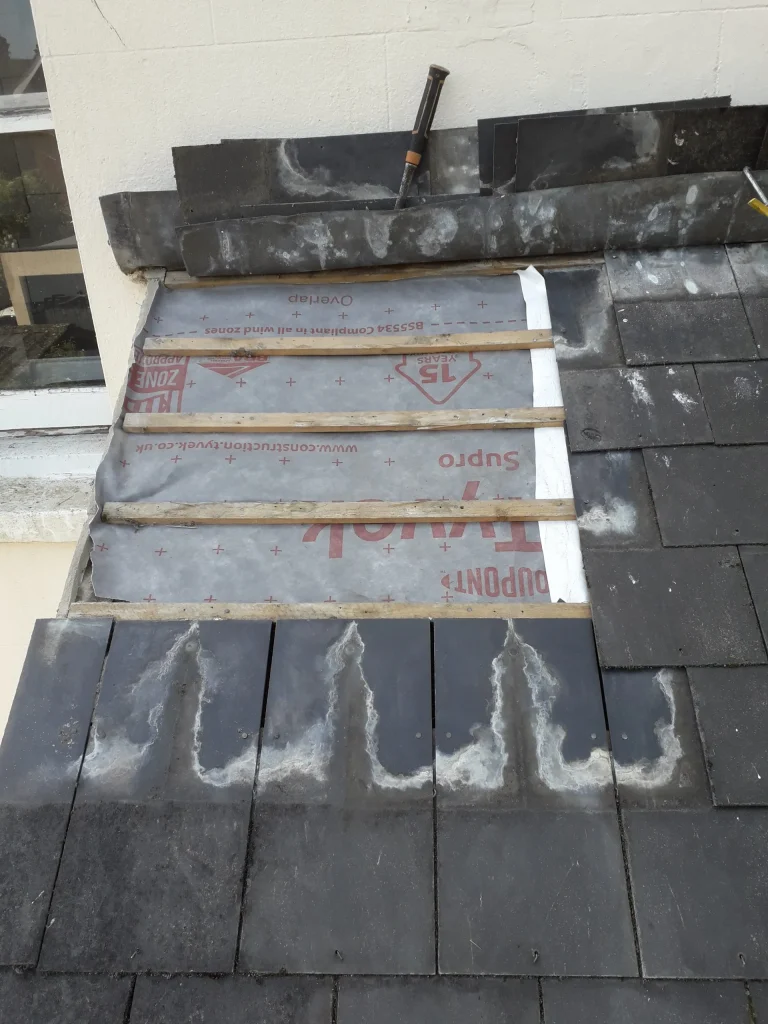
Flat Roof Flashing Repair: Why Most Leaks Start at Roof Junctions
When property owners search for flat roof flashing repair, they often assume the main membrane has failed. After 18 years working on roofs, including 12 years specifically across Brighton, Hove, and Worthing, I can tell you that many leaks on low-slope coverings actually begin at junctions, edges, and abutments rather than across the open centre of the surface.
That is why a wider preventative condition check can be useful before assuming the whole covering needs major work. Flashing acts as the transition point between different roofing elements. Wherever a flat roof meets brickwork, parapet walls, chimney stacks, bay windows, or roof penetrations, this detail becomes the critical waterproof barrier.
For a more focused explanation of leadwork defects, my guide to flashing failure around low-slope junctions explains why cracks, poor chasing, and restricted movement often lead to hidden water ingress. Once flashing deteriorates or separates, water begins exploiting microscopic gaps that often remain invisible from ground level.
In Sussex, coastal weather creates additional stress. Salt-heavy air accelerates corrosion, while strong lateral winds force rain sideways beneath vulnerable junctions. A small flashing defect can allow moisture to travel underneath roofing layers long before visible staining appears indoors.
What Is Flat Roof Flashing and Why Does It Fail?
Flashing is designed to create a watertight seal where a flat roof connects to vertical surfaces. Depending on the roof type, I commonly work with lead flashing, aluminium edge trims, felt upstands, and modern mechanically fixed flashing systems.
Most flashing failures happen because of one of these technical problems:
- Thermal movement: Flat roofs expand in warm weather and contract during colder months. Over time, repeated expansion stresses rigid joints and weakens waterproof seals.
- Mortar deterioration: On older Sussex homes, mortar holding lead flashing often becomes porous or cracks due to age and freeze-thaw cycles.
- Poor original detailing: Some roof installations fail because flashing was never installed deep enough into masonry or lacked adequate overlap.
- Capillary action: Water can travel sideways beneath poorly sealed flashing joints, especially during heavy wind-driven rain.
- Coastal exposure: Properties around Hove’s seafront and nearby streets can deteriorate faster because of salt corrosion and aggressive weather exposure.
One of the biggest mistakes I see is homeowners applying sealant over flashing without addressing why movement or separation occurred in the first place. Temporary patching rarely survives long-term thermal movement.
Signs Your Flat Roof Flashing Needs Repair
Many flashing problems develop slowly before becoming major leaks. Some of the most common warning signs I see include:
- Damp patches appearing where ceilings meet walls.
- Water staining after wind-driven rain rather than constant dripping.
- Cracked mortar around wall junctions.
- Lifting felt around roof edges or abutments.
- Rust staining around metal flashing details.
- Mould growth in upper corners of rooms.
What makes flashing failures difficult is that water often travels invisibly beneath roofing materials. The visible damp patch inside your property may sit several metres away from the actual entry point.
Why Flashing Problems Are Common on Sussex Flat Roofs
Brighton, Hove, and Worthing contain many Victorian and Edwardian properties where structural movement gradually affects roof junctions. Terraced houses are particularly vulnerable because neighbouring buildings shift independently over time, placing stress on flashing around party walls.
I frequently inspect roofs where the waterproof membrane still performs adequately, yet moisture enters through deteriorated parapet walls or failed abutments. In these situations, repairing the felt alone will not stop the problem.
If dampness consistently appears near shared walls or raised brick sections, the issue may involve failing parapet protection rather than the main roof surface. In these cases, I often recommend reviewing specialist parapet wall weatherproofing details to help prevent recurring moisture penetration.
My Process for Diagnosing Flat Roof Flashing Problems
I avoid guessing. Before recommending any repair, I assess how water is actually moving across the roof system.
My inspection process typically includes:
- Checking flashing junctions for separation or lifting.
- Inspecting mortar chases around lead flashings.
- Assessing roof falls and drainage behaviour.
- Identifying signs of hidden moisture migration.
- Checking whether condensation is being mistaken for a leak.
- Evaluating whether repairs remain viable or replacement offers better long-term value.
In some cases, the flashing only needs localised work. In others, the surrounding upstand has already failed and the junction needs rebuilding properly to restore waterproof continuity.
Repair or Replace? When Flashing Repairs Make Sense
Not every flashing problem requires major work. I generally recommend repair when:
- The roof membrane still remains structurally sound.
- Water ingress is isolated to one junction area.
- Lead flashing can be reset or re-dressed.
- Mortar joints require local repointing rather than structural rebuilding.
However, if flashing failures are combined with blistering felt, saturated decking, or repeated leaks, a broader low-slope covering solution may prove more cost-effective. In these cases, homeowners often use my online pricing estimator for replacement systems to understand likely costs before arranging a survey.
Final Thoughts on Flat Roof Flashing Repair
Flat roof flashing repair is rarely about simply sealing a visible gap. The real challenge is understanding why the waterproof junction failed and whether structural movement, ageing materials, or poor detailing allowed moisture to enter.
My approach is always technical rather than sales-driven. I focus on identifying the source of water ingress and explaining whether a targeted repair is genuinely viable or whether another solution would save money long term.
For most roofing services, I also provide an instant online calculator where property owners can estimate likely costs themselves in around 30 seconds before arranging a proper inspection.