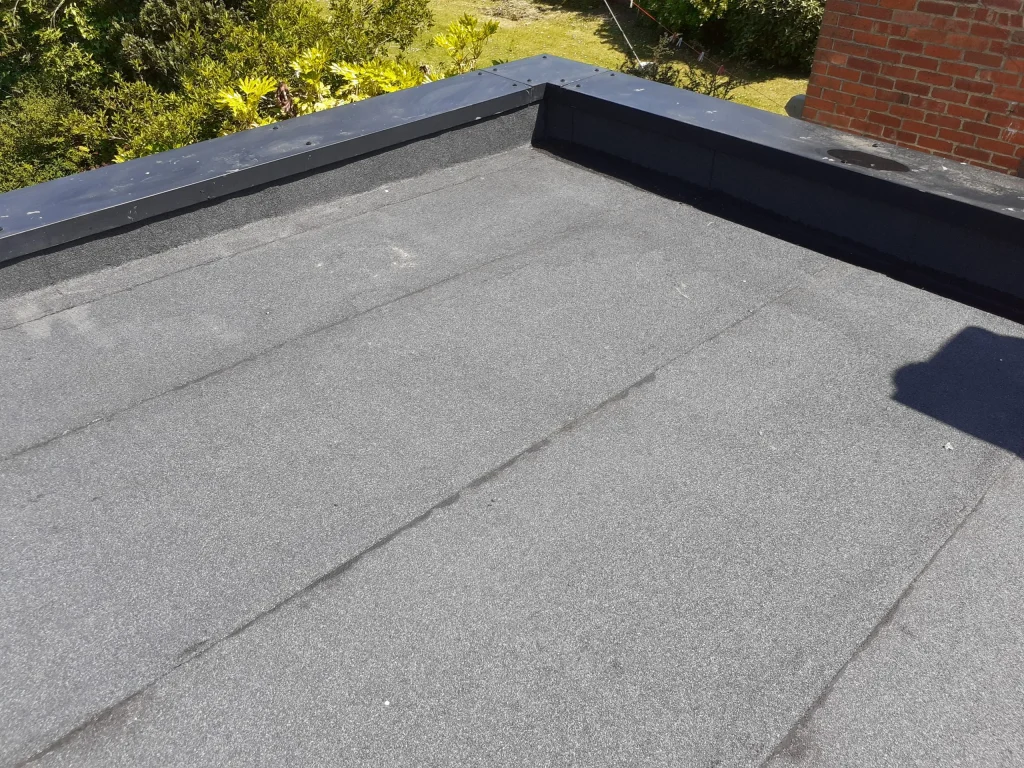
Flat Roof Services in Sussex: Why a Technical Assessment Matters Before Any Repair
When property owners search for flat roof services, they are often already seeing warning signs: standing water, blistering felt, damp patches near ceilings, cracked edges, or visible deterioration around roof junctions. Across Brighton, Hove properties exposed to coastal weather, and Worthing, I regularly inspect low-slope roofs that appear to need full replacement but actually suffer from one technical failure that has gone unnoticed.
After 18 years working on roofs, including the last 12 years focused specifically on Sussex properties, I have learned that successful flat roof servicing is not about applying quick patches. My job is to identify why the waterproofing system has started failing and whether the issue comes from thermal movement, poor drainage, saturated insulation, failed detailing, or structural movement beneath the roof deck. Where the weakness appears around wall abutments or edge details, a focused review of low-slope flashing and junction defects is often more useful than guessing from the visible stain alone.
What Flat Roof Services Should Actually Include
Many homeowners expect flat roof work to focus only on replacing felt. In reality, a professional flat roof assessment should examine the entire waterproofing system rather than the visible surface alone.
When I inspect a flat roof, I typically assess:
- Drainage performance – checking whether water exits correctly or remains trapped in ponding areas.
- Membrane integrity – inspecting splits, shrinkage, blistering, or weak seams in the waterproof layer.
- Upstands and abutments – identifying weaknesses where roofing meets walls, parapets, or chimney structures.
- Thermal expansion stress – assessing movement damage caused by repeated heating and cooling cycles.
- Sub-deck condition – checking for moisture penetration into timber decking or insulation layers.
- Perimeter detailing – examining trims, drip edges, and mechanical fixings vulnerable to coastal exposure.
In coastal Sussex, strong winds combined with salt-heavy air often accelerate deterioration around vulnerable roof edges faster than many property owners expect.
Why Modern SBS Torch-On Systems Perform Better
One of the biggest upgrades in modern flat roof services is the move toward SBS-modified torch-on felt systems. I generally recommend these systems because they remain flexible under thermal movement, which is especially important in Brighton and Hove where roofs can experience rapid weather changes throughout the year.
Older mineral felt roofs often fail because they become brittle over time. Small fractures may not immediately leak, but water slowly tracks underneath the surface through capillary action and eventually saturates insulation or timber decking.
Where homeowners are considering replacement or major repair, I often recommend reviewing my cost guide for SBS torch-on waterproofing work to understand likely pricing before damage escalates into structural repairs.
Common Hidden Failures I See on Sussex Flat Roofs
One mistake I often see is assuming visible damage marks the source of the leak. Water behaves unpredictably on flat roofs.
For example, a ceiling stain may appear several metres away from the actual point of failure. Wind-driven rain can travel beneath lifted edge detailing, migrate across decking, and appear internally in a completely different location.
Some of the most common technical problems I diagnose include:
- Ponding water caused by inadequate roof falls or settlement.
- Failed wall junctions where flashing no longer seals properly.
- Micro-fractures created through repeated expansion and contraction.
- Condensation mistaken for leaks, especially in poorly ventilated warm roof systems.
- Water bypassing through parapet walls instead of entering directly through the membrane.
In situations involving sudden water ingress or difficult-to-trace moisture, I often advise homeowners to arrange a targeted inspection of failed flashing details so the actual entry point can be separated from secondary damp marks.
If water is already entering the property, a priority water-ingress visit can help prevent moisture from reaching structural timbers, insulation, or internal electrics.
Flat Roof Services for Different Property Types
Not every flat roof behaves the same way. A garage roof, rear extension, dormer roof, bay window roof, and balcony system all experience different structural stresses.
For example, flat roofs above living spaces require far greater thermal efficiency than detached garages. Older dormers in Brighton often suffer from inadequate insulation, cold bridging, and outdated felt systems that no longer tolerate movement properly.
Victorian terraces also introduce additional complexity because movement between neighbouring properties can gradually stress waterproof junctions over time.
Repair or Replacement: How I Decide
Property owners often ask whether a flat roof can still be repaired or whether replacement makes more financial sense.
My answer depends on three main factors:
- Age of the membrane – older felt nearing end-of-life usually becomes less economical to maintain.
- Extent of moisture penetration – saturated insulation dramatically reduces performance.
- Structural stability of decking – weakened timber often requires stripping back rather than patching.
I do not automatically recommend replacement simply because a roof looks old. Some systems can continue performing for years with proper localised repairs if the underlying structure remains sound.
Transparent Flat Roof Services Without Guesswork
I believe homeowners should understand likely costs before committing to work. That is why, for most roofing services, I provide a fast online calculator where you can estimate pricing yourself in around 30 seconds.
Once I inspect the roof properly, I can explain the technical cause of failure, whether repair remains viable, and which solution offers the best long-term value for your specific property in Sussex.