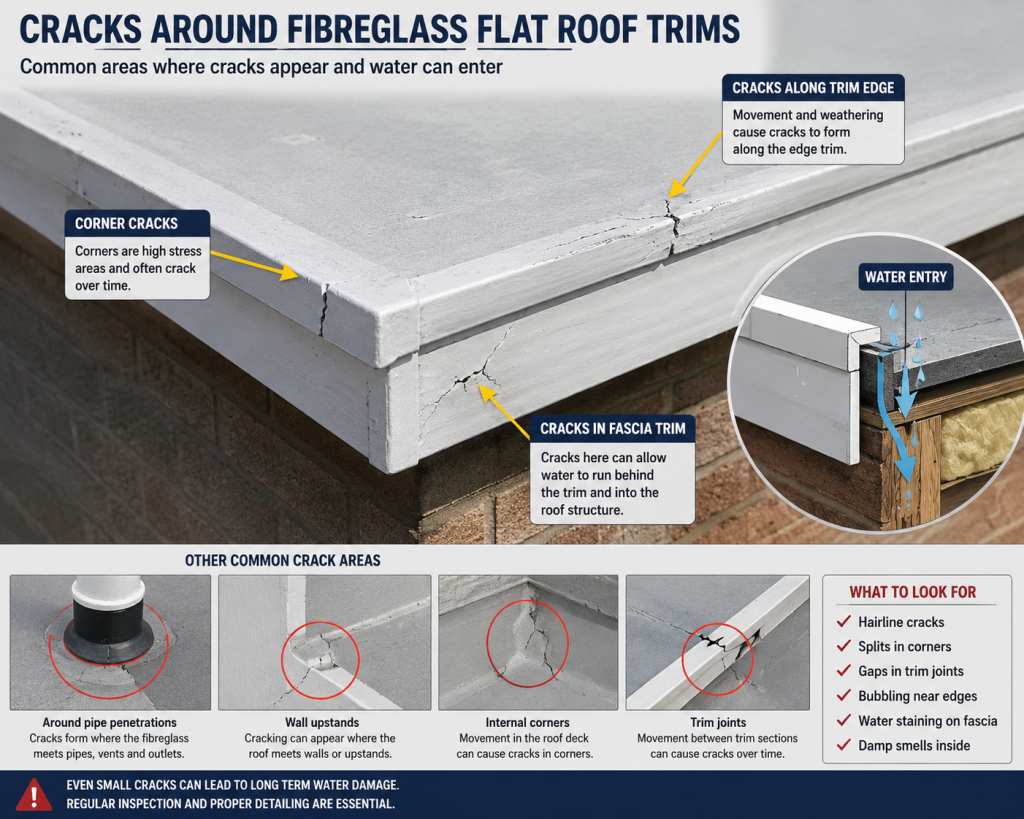
If you have a leaking fibreglass roof in Sussex, you are definitely not alone. I have inspected many GRP and fibreglass flat roofs around Brighton, Hove, Worthing and nearby areas, and the pattern is often very similar. The roof may have looked clean, solid and modern when it was first installed, but later the water starts showing around an edge trim, wall junction, outlet, corner, crack or old repair patch.
I do not install GRP trim and edge-detail systems myself, so I am not writing this from the point of view of somebody trying to defend fibreglass. I usually see these roofs when something has already gone wrong. From that side of the work, my honest view is simple: fibreglass can be very unforgiving on roofs that move, hold water, or contain too many complicated details.
If you are already looking at options for repairing a leaking GRP roof, the first step should not be simply adding another coat over the top. The first step should be finding out why the roof is leaking. I am also very cautious when I see standing water on a fibreglass roof, because ponding water can make small cracks, weak trims and poor details fail much faster.
You Are Not the Only Homeowner With a Leaking Fibreglass Roof
One thing I would say straight away is this: a leaking fibreglass roof does not automatically mean you made a bad decision as a homeowner. Many people choose fibreglass because they are told it is strong, seamless, modern and long-lasting. At the time, it can look like a sensible option.
The problem is that a flat roof is not a static object. It moves. The timber below expands and shrinks. The building shifts slightly with temperature and age. The roof is exposed to rain, wind, frost, heat, moisture and long periods of damp weather. Around Sussex, this can be made worse by coastal conditions, wind-driven rain and older building details.
A small, simple fibreglass roof over an entrance or a very basic area may sometimes perform reasonably well if it has been installed properly. But larger flat roofs, roofs with parapet walls, roofs with poor falls, roofs with outlets, corners, trims, upstands and old timber decking are a much harder test. This is where I often see fibreglass start to show its weaknesses.
Why Fibreglass Roofs Often Leak in the Same Places
When I inspect a leaking fibreglass roof, I rarely find that the entire surface has failed in one dramatic way. More often, the roof has started leaking from a stress point. The surface may still look hard and clean, but a small crack, loose trim or weak junction is allowing water into the roof build-up.
The most common leak points I see are:
- edge trims where wind and rain work against the detail;
- wall junctions where the fibreglass meets brickwork, render or flashing;
- internal corners where movement is concentrated;
- outlets and drainage points where water sits after rain;
- board joints where the deck underneath has moved;
- old repair patches where another layer has been added without solving the real cause;
- areas around pipes or awkward penetrations where the roof surface has too many difficult details.
These are not rare problems. They are the normal weak spots where a hard waterproof surface gets tested on a real roof. Once water finds one small opening, the visible damage inside the house may appear much later.
The Main Weakness: A Hard Roof Covering Has Limited Movement
Fibreglass feels strong because it is hard. But that hardness is also one of the reasons I am careful with it on many domestic flat roofs. A roof covering does not only need strength. It also needs to tolerate movement.
The boards below the roof can expand, shrink and flex. Timber joists can move slightly. A wall can move differently from the roof deck. A parapet, trim or outlet can put stress into one small area. If the waterproofing layer cannot absorb enough of that movement, the stress eventually appears as a crack, split or failure at a detail.
This is why leaking fibreglass roofs often show tiny hairline cracks rather than large holes. Many homeowners look at the crack and think it is too small to be serious. In reality, water only needs a very narrow route in. On a low-slope roof, water can sit over the same defect again and again. Over time, that small defect can allow moisture into OSB boards, insulation or timber below.
Once water gets beneath the surface, it may travel sideways before it shows indoors. The damp patch on the ceiling may not be directly below the crack outside. This is one of the reasons these leaks can be frustrating to diagnose.
Sussex Weather Makes Weak Details Show Up Faster
Brighton, Hove, Worthing and the surrounding Sussex areas get plenty of wind-driven rain. On exposed properties, rain does not always fall neatly from above. It can be pushed sideways against trims, upstands, walls, coping stones and flashing details.
If the fibreglass has a weak edge, a small crack or a poorly prepared junction, wind-driven rain can find that weakness faster than the homeowner expects. A roof that looked acceptable during dry weather can start leaking badly during a long spell of heavy rain.
Older Sussex properties can make the situation more difficult. Victorian and Edwardian buildings often have ageing brickwork, old render, parapet walls, uneven roof levels and timber structures that have moved over many years. A rigid roof covering has to meet all those imperfect details. If the preparation and detailing are not excellent, the weak point usually appears later as a leak.
The Leak May Have Started Before You Noticed It
A leaking fibreglass roof does not always show itself immediately on the ceiling. Water may soak into insulation, sit in the deck, run along timber, or track into a wall before it finally becomes visible indoors.
I have seen roofs where the homeowner only noticed the problem after a ceiling stain appeared, but the roof had clearly been holding moisture for much longer. Sometimes there is no obvious dripping because the water is travelling into masonry, fascia areas, insulation or the roof deck instead of falling straight into the room.
That hidden moisture still matters. OSB boards can soften. Timber can start to decay. Insulation can hold water. The roof may continue to look acceptable from above while the structure below is slowly being damaged.
This is why I take warning signs seriously, including damp smells, bubbling, soft areas, stains around fascia boards, mould, peeling paint or repeated small leaks after heavy rain. These signs often mean the roof has been wet for longer than the homeowner realises.
Common Misunderstandings About Leaking Fibreglass Roofs
“It only needs another coat.”
Sometimes a coating or local repair can help, but only when the roof is dry, stable and the defect is genuinely local. If the roof is moving, holding water, or already wet underneath, another coat may only hide the problem for a short time.
“The crack is tiny, so it cannot be serious.”
A tiny crack can still allow water in. On a flat or low-slope roof, water can sit over that small crack repeatedly. The size of the visible crack does not always match the amount of moisture travelling below the surface.
“There is no ceiling stain, so the roof is not leaking.”
Water does not always come straight through the ceiling. It can travel into insulation, timber, walls or fascia areas before it becomes visible inside. A fibreglass roof can be leaking even if there is no obvious internal stain yet.
“Fibreglass is strong, so it should not fail.”
Strength is not the only issue. A flat roof covering also needs flexibility, correct detailing, good drainage and a sound deck below it. A hard material can still crack if the structure below moves or if water keeps sitting in the same areas.
When a Leaking Fibreglass Roof May Still Be Repairable
I would not say that every leaking fibreglass roof must be replaced. That would not be fair. Some roofs can be repaired if the defect is small, local and found early enough.
A repair may be realistic if:
- there is one clear defect rather than cracking in several places;
- the surrounding fibreglass is still firmly bonded;
- the roof deck below feels solid and dry;
- there is no serious ponding water over the defect;
- the leak is not coming from a complicated wall or parapet detail;
- there are no repeated failed patches in the same area;
- the trims, outlets and upstands are still in reasonable condition.
Even then, the preparation has to be right. A repair over damp, dirty, loose or unstable fibreglass is unlikely to last. The roof needs to be inspected properly before money is spent on the surface.
When I Become More Concerned About the Roof
I become more cautious when the roof shows signs of wider failure. These are the situations where a small patch may not be honest advice:
- cracks around several edges, corners or trims;
- ponding water sitting on the roof after rain;
- bubbling, lifting or hollow areas in the fibreglass;
- soft or springy roof decking;
- staining near parapet walls, upstands or outlets;
- water marks around fascia, soffit or wall areas;
- several old repairs that have failed again;
- leaks that return after every spell of heavy rain;
- signs that OSB boards or insulation may already be wet.
In these cases, the roof may need more than a surface repair. The deck, drainage, falls, trims, wall junctions and existing build-up all need checking. If the structure below has been wet for a long time, the fibreglass surface is only one part of the problem.
Why Recoating a Fibreglass Roof Can Be a Short-Term Answer
One of the most common things I see is another layer added over a leaking fibreglass roof. Sometimes this is done as a quick attempt to stop the water. Sometimes it is done because the visible crack looks small and the roof still appears solid.
The difficulty is that a new coat does not automatically solve movement, trapped moisture, poor drainage or weak details. If water has already entered the deck, sealing the top can sometimes trap moisture inside the roof build-up. If the roof is still moving, the same stress may simply open the repair again later.
This is why diagnosis matters. Before any repair is agreed, the real question should be: is this a dry, stable roof with one local defect, or is this a roof system that is starting to fail in several places?
Why I Often Compare Fibreglass With SBS Felt
When a fibreglass roof has failed badly, I often discuss replacement with a more practical low-slope roofing system, especially SBS torch-on felt. I frequently use Tecnatorch SBS Torch-On Mineral Felt Charcoal because it is flexible, repairable and proven when installed correctly over a sound deck.
The main difference, from my point of view, is long-term maintainability. Fibreglass can become awkward once it has cracked, lifted, trapped moisture or been patched several times. A properly installed SBS torch-on felt system is usually easier to detail, repair and renew later, especially on domestic roofs with difficult wall junctions, trims and outlets.
That does not mean felt is magic. Poor workmanship can ruin any roofing system. But on many real flat roofs around Sussex, I prefer a system that gives the homeowner more practical repair options in the future.
Do Not Ignore Walls, Flashing and Parapets
Not every leaking fibreglass roof is leaking only through the fibreglass itself. Around Sussex, I often have to check brickwork, render, lead flashing, parapet walls and coping stones. Water can come through a wall and appear to be a roof leak. It can also get behind a weak upstand and travel under the roof surface.
If your roof meets a parapet or party wall, that wall detail deserves proper attention. In some cases, waterproofing for parapet walls is just as important as the roof covering itself.
If you want a more detailed breakdown of typical causes, I have also written about common causes of GRP leaks on low-slope roofs.
What I Would Check Before Agreeing to a Repair
Before choosing any repair method, I would want to understand what the roof is actually telling us. That means checking more than the most visible crack.
My usual approach is:
- look at the internal damp pattern and when it appears;
- inspect the roof surface for cracks, bubbles and previous repairs;
- check whether water is ponding after rain;
- inspect trims, edges, outlets and upstands;
- look carefully at brickwork, render, lead flashing and parapet walls;
- check whether the deck feels soft, springy or moisture damaged;
- decide whether repair, temporary weatherproofing or replacement is the fair recommendation.
That order matters. A repair should follow the diagnosis. It should not replace it.
My Honest View on Leaking Fibreglass Roofs
If your fibreglass roof is leaking, you are not the only one with this problem. I have seen many leaking GRP roofs across Sussex, and it does not always mean the homeowner was careless or unlucky. Often, the roof has simply reached the point where movement, water, poor falls or weak details have exposed the limits of the system.
A small local repair may be fair when the roof is mostly sound. But if the fibreglass has cracked in several places, the deck is wet, the trims are failing, or water keeps sitting on the surface, I would be careful about spending money on another short-term patch.
The best next step is to find the real route of water ingress before deciding what to do. Sometimes that leads to a sensible repair. Sometimes it shows that replacement is the more honest answer. Either way, the roof should be judged by its actual condition, not by what the material looked like when it was first installed.