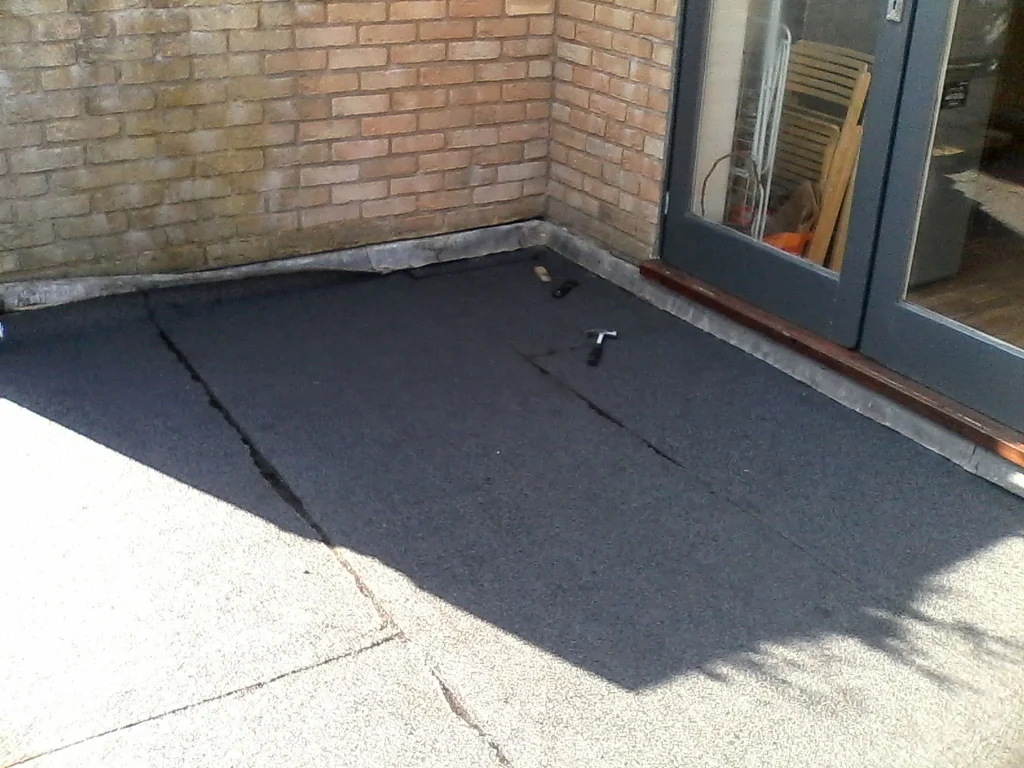
Flat roof bitumen is still one of the most practical roofing materials I use on domestic flat roofs, but only when it is installed as a proper system. I often see bitumen roofs around Brighton, Hove and Worthing that have not failed because bitumen is a bad material. They have failed because the roof was laid over poor decking, the falls were wrong, the edges were weak, or the wall junctions were never detailed properly.
Bitumen flat roofing is not just black felt on a roof. Modern SBS-modified bitumen felt is flexible, layered and designed to cope with normal roof movement. The important question is whether the roof below it, and the details around it, are good enough to let the material do its job.
What flat roof bitumen actually means
When homeowners talk about a bitumen flat roof, they usually mean a felt roof. In modern flat roofing, that normally refers to a torch-on felt system made from bitumen modified with polymers such as SBS. SBS helps the felt stay more flexible than older traditional felts, especially when the roof expands and contracts through temperature changes.
A proper bitumen felt roof is normally installed in layers. The build-up can vary depending on the roof, but the idea is always the same: create a continuous waterproof covering with strong laps, secure edges and correctly sealed details around outlets, walls and penetrations.
The material itself can perform very well. The failures I inspect are usually caused by one of three things: poor preparation, poor drainage, or poor detailing.
Why bitumen is still used on flat roofs
There are many flat roofing systems available now, including EPDM rubber, GRP fibreglass and liquid-applied membranes. Even so, bitumen remains useful because it suits many real-world roofs, especially garages, extensions, dormers, porches and bay roofs.
In my experience, bitumen works well when the roof has:
- a firm and dry timber deck
- reasonable falls toward the outlet or gutter
- sound edges and upstands
- proper wall flashing
- limited foot traffic
- details that can be safely formed with torch-on felt
It is also repairable in many situations. If the existing system is not too far gone, a localised defect can sometimes be repaired without replacing the full roof. That is one reason I do not like judging every bitumen roof by age alone.
Old bitumen felt versus modern SBS torch-on felt
Older flat roof felts often became brittle, cracked and thin with age. Many of the old roofs I remove have lost flexibility completely. When the deck moves or the roof heats up in summer, the felt cannot stretch with it, so it splits at laps, corners or edges.
Modern SBS torch-on felt is different. The SBS modification gives the bitumen more elasticity, which helps the roof cope with movement. That matters on timber decks because roofs are never completely still. They expand, contract, flex slightly under load and react to heat, cold and moisture.
That does not mean SBS felt is indestructible. If it is laid over damp boards, rotten plywood, trapped moisture or a roof with standing water, it can still fail early. The better material cannot compensate for a bad base.
Where bitumen flat roofs usually fail
When I inspect a leaking bitumen flat roof, I rarely find a random hole in the middle of the roof. Most failures happen where water is slowed down, trapped or allowed to creep under the membrane.
Open laps
The laps are the joins between felt sheets. If they were not heated and bonded properly, water can work into the seam. On exposed Sussex roofs, wind-driven rain can make this worse because water is pushed sideways rather than simply falling straight down.
Cracked edges
Edges take a lot of stress. They deal with wind uplift, temperature movement and water running off the roof. If trims are loose or the felt has not been dressed correctly, the roof may start failing from the perimeter inward.
Ponding water
Bitumen can cope with normal wet weather, but persistent ponding is a different problem. If water sits for days, the roof is under constant stress. Dirt collects, algae grows, UV protection wears unevenly and older bitumen can soften or blister over time.
Failed outlets
Outlets are common leak points because they combine water flow, joints, movement and debris. If leaves block the outlet, water backs up and looks for another route. I always check outlets carefully before blaming the whole roof covering.
Wall junctions and lead flashing
Where a bitumen roof meets a wall, the detail has to be right. Failed lead flashing, cracked mortar, porous brickwork or a low upstand can allow water behind the roof covering. In that situation, the bitumen may be blamed even though water is entering above it.
Bitumen roofs on Sussex properties
Brighton, Hove and Worthing create a few extra challenges for flat roof bitumen. Coastal wind can lift weak edges. Salt in the air can corrode metal trims, fixings and flashing clips faster than many homeowners expect. Older brickwork can hold moisture, especially around parapet walls and party wall details.
On Victorian and Edwardian properties, I often see bitumen roofs added to rear extensions or bay windows where the roof covering is newer than the surrounding brickwork. If the old wall above the roof is cracked or porous, water can bypass the felt completely. That is why I look at the whole detail, not just the black surface.
If parapet walls are part of the problem, proper parapet wall waterproofing and felt capping may be more important than another patch on the flat roof itself.
When bitumen roof repair is enough
A bitumen flat roof can often be repaired if the problem is local and the rest of the roof is still in reasonable condition. I look for flexibility in the felt, a firm deck underfoot and a clear source of water entry.
Repair may be sensible when:
- one lap has opened but the surrounding felt is sound
- there is a small puncture or split
- an outlet detail has failed but the main roof is healthy
- a short section of edge trim has lifted
- lead flashing needs attention above an otherwise good roof
The repair still needs to be compatible with the existing bitumen. Smearing general sealant over cracks is usually a temporary measure, not a proper long-term repair. It may buy time in bad weather, but it should not be confused with rebuilding a failed detail correctly.
When a bitumen flat roof needs replacement
Replacement becomes more realistic when the bitumen has failed across the roof rather than in one location. If the felt is brittle, blistered, cracked in several areas, patched repeatedly, or lifting at multiple edges, a local repair may only move the leak somewhere else.
I also take replacement more seriously when the deck is soft. A bitumen roof depends on the deck below it. If water has reached the plywood or OSB and the boards have started to delaminate, the roof covering cannot be trusted, even if a patch looks tidy from above.
For a full replacement, I would normally consider the deck, falls, insulation, outlet position, edge trims and flashing details together. My page on SBS bitumen flat roof replacement in Brighton and Hove gives a useful starting point for homeowners comparing options.
Bitumen overlays: useful or risky?
Overlaying a bitumen roof means installing a new layer over the existing roof covering. Sometimes it is acceptable. Sometimes it is a mistake.
An overlay may work if the existing roof is dry, firmly bonded, reasonably flat and structurally sound. It can reduce waste and avoid unnecessary stripping when the roof below is still stable.
I avoid overlays when there is trapped moisture, soft decking, heavy blistering, major ponding, poor falls or unknown layers beneath. Covering wet material with more bitumen traps the problem inside the roof. The finished surface may look better, but the structure below continues to deteriorate.
Condensation can be mistaken for bitumen failure
One of the most important checks on any flat roof is whether the damp is actually caused by rain. On older cold roof constructions, warm moist air from inside the property can reach the cold underside of the deck and condense. The homeowner then sees damp plaster and assumes the bitumen roof is leaking.
Condensation often behaves differently from rainwater leaks. It may appear during cold weather, affect a wider ceiling area or show mould rather than a clear brown water stain. If condensation is the issue, adding more bitumen on top will not solve the problem. The roof build-up, insulation and ventilation need to be considered.
How long should a bitumen flat roof last?
A well-installed SBS bitumen flat roof can often last around 20 to 25 years. Some last longer when the roof is sheltered, drainage is good and the details are maintained. Some fail much earlier because of poor installation, standing water, weak edges or unresolved wall moisture.
The lifespan depends less on the brand name and more on the whole system. A good membrane on a bad deck is still a bad roof. A cheaper-looking job can become expensive if it ignores falls, flashing, outlet levels and trapped moisture.
Signs your bitumen flat roof needs attention
Homeowners can often spot early warning signs before a leak becomes serious. I would not ignore these:
- cracks in the felt surface
- blisters or bubbles in the bitumen
- water sitting on the roof several days after rain
- loose trims or lifted edges
- open seams between felt sheets
- soft areas underfoot
- repeated small patches in different places
- damp appearing near a wall junction or parapet
- rotting fascia boards below the roof edge
One warning sign does not always mean full replacement, but it does mean the roof should be checked properly. The earlier the cause is found, the more likely a repair may still be practical.
My practical view on flat roof bitumen
Flat roof bitumen is not outdated when it is used properly. Modern SBS torch-on felt remains a strong, practical system for many domestic flat roofs. But it has to be installed on the right base, with proper falls, dry preparation, secure edges and well-formed details.
When bitumen roofs fail, the cause is often hidden in the build-up or around the junctions. Before choosing repair, overlay or replacement, I would want to know whether the roof is leaking through the membrane, through the wall detail, through the outlet, or because condensation is forming below the deck.
If you are budgeting for work, a quick online calculator can give a rough cost idea in around 30 seconds. For the right technical decision, the roof needs to be inspected as a complete system rather than judged only by the visible felt surface.