The most common roofing mystery I see in Brighton
I regularly get called out to properties in Brighton and Hove where the homeowner is completely baffled. From the street, their roof tiles look perfectly aligned, intact, and largely undamaged. Yet, every time we get a heavy coastal storm blowing in from the Channel, water drips through their bedroom ceiling.
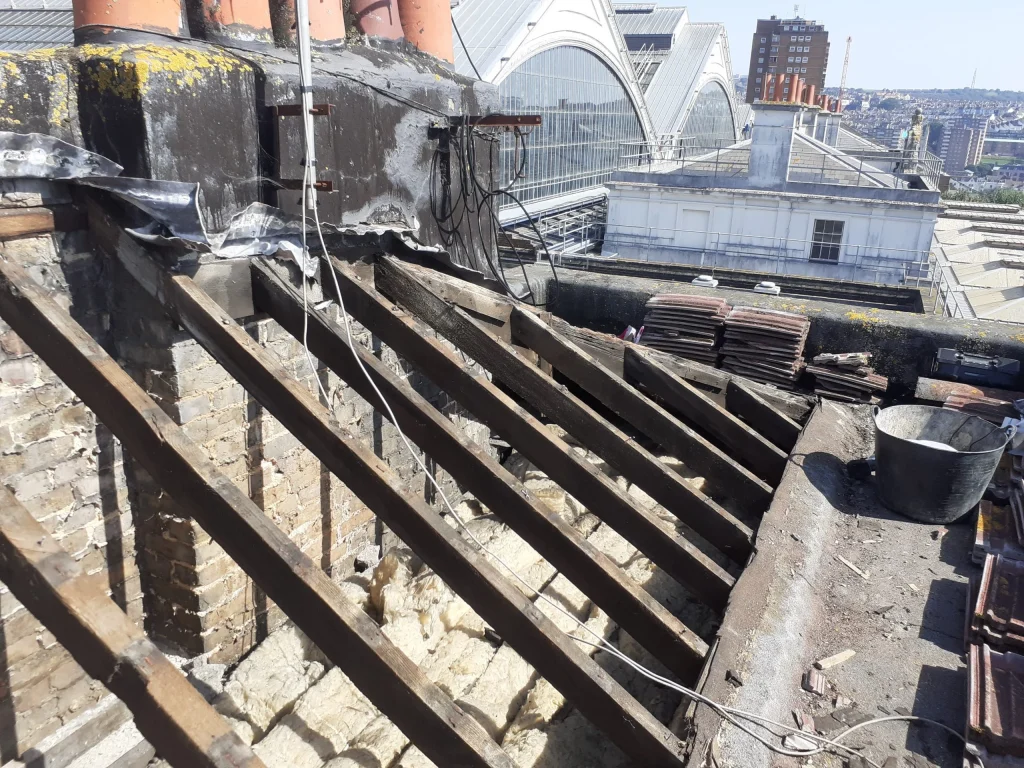
The immediate assumption is usually a cracked tile or a slipped slate. But when I get up into the loft space with a torch, the real story reveals itself: the original roofing felt has completely perished, and the timber battens holding the tiles are rotting away.
In my 18 years of roofing, I have seen countless ceilings ruined simply because a homeowner kept paying for patch repairs on the outside, instead of addressing the failed felt and battens underneath.
Why your roof tiles are only half the defense
There is a common misconception that roof tiles are 100% waterproof. They are not. Tiles and slates are designed to shed the vast majority of rainwater, but they are not a sealed system. Here in Sussex, we frequently experience severe wind-driven rain. When wind pushes rain horizontally, it forces moisture up and under the overlaps of your tiles.
This is exactly why your roof has an underlay (the felt) and timber supports (the battens). The felt acts as a crucial secondary barrier, catching any water that bypasses the tiles and safely directing it down into your gutters. The battens provide a secure, straight fixing point so the tiles do not rattle or lift in high winds.
When the felt tears or degrades, that wind-driven rain has nowhere to go but straight down onto your plasterboard.
Three hidden signs your roof needs re-felting and battening
You rarely need to climb onto your roof to know the felt has failed. The best evidence is usually right above your head in the loft. When I conduct inspections, these are the three main symptoms I look for:
- The “black dust” warning: Older Victorian and mid-century properties usually have traditional bitumen roofing felt. Over decades of baking in summer heat and freezing in winter, bitumen becomes incredibly brittle. If you see black, flaky dust covering your loft insulation, your felt is disintegrating.
- Daylight through the timbers: Turn the lights off in your loft during the day. If you can see clear streaks of daylight shining through the tile gaps, you have zero secondary weather protection.
- Sagging rooflines: If the battens have been repeatedly soaked because of failing felt, the timber will eventually rot. From the outside, this looks like a distinct dip or sag in the roofline. Sinking battens also pull the tiles out of alignment, creating even larger gaps for water ingress.
The upgrade: Moving to breathable membranes
When we undertake roof re-felting and battening in Brighton, we never replace old materials with the same outdated technology. The biggest shift in pitched roofing over the last twenty years has been the move to breathable roofing membranes.
Old bitumen felt was essentially a plastic bag over your house. It stopped rain getting in, but it also stopped warm, moist air from getting out. This caused massive condensation issues inside lofts, where warm air from bathrooms and kitchens hit the cold underside of the felt, turned to water, and dripped back down—often mimicking a genuine roof leak.
Modern breathable membranes solve this. They are highly waterproof from the outside, but vapor-permeable from the inside. This allows your roof space to breathe naturally, drastically reducing the risk of hidden timber decay and dampness.
The reality of replacing battens
You cannot effectively re-felt a roof without replacing the battens. The old battens must be stripped off to lay the new membrane flat over your rafters. When we rebuild this support structure, we use modern, pressure-treated timber battens.
Setting the battens at the correct gauge (the spacing between each horizontal run) is critical. If the gauge is wrong, the tiles will not overlap properly, and water will creep up the back of the tiles through capillary action. Given our local wind exposure, we also ensure every batten is securely fixed to handle coastal uplift forces without flexing.
Because many of our local terraced houses share party walls and chimney stacks, stripping the roof down to the rafters requires careful detailing at the boundary lines. If you live in a traditional property, my guide on pitched roof repairs for Brighton terraced houses explains exactly how I manage these shared structural junctions safely.
Is a full re-felt always necessary?
I always prefer to repair rather than replace if it makes technical sense. If you have a single tear in your felt near the eaves, we might be able to slide a localized felt support tray in. But if your underlay is crumbling to dust across the entire span of the loft, local patch repairs are a waste of your money. The next storm will simply expose the next weak point.
The good news is that if your existing tiles or slates are still in excellent condition, they can often be carefully set aside, cleaned, and re-used once the new felt and battens are installed. You preserve the historic character of your property while gaining a completely modern, weatherproof system underneath.
If you suspect your felt is failing, the best first step is to poke your head into the loft. If you see daylight or crumbling black debris, it is time to act. To help property owners plan ahead without pressure, I have added pricing calculators across my website where you can estimate roofing costs in about 30 seconds. For a definitive diagnosis of your timbers and membrane, I am always happy to inspect the roof space properly and show you exactly what is going on.