The Hidden Vulnerabilities: Why Roof Junctions Fail
In my 18 years as a roofing technician—with 12 of those years specifically tackling the coastal gales and salt spray of Brighton, Hove, and Worthing—I have seen every type of water ingress imaginable. When property owners call me for leak repairs, they often assume a tile has blown off or the integrity of a waterproofing membrane has randomly punctured. However, the technical reality is much more specific: the vast majority of leaks occur at the structural junctions where dissimilar materials meet.
A roof is not a single, static shield. It is a dynamic system. When you have traditional slates, lead flashing, mortar, and SBS-modified bitumen all interacting, they expand and contract at completely different rates during seasonal temperature shifts. This is known as the thermal expansion coefficient. Over time, this constant micro-movement creates shear stress at the junctions—such as chimney abutments, valley troughs, and wall step-flashings—causing the watertight bond to fracture.
The Danger of Dissimilar Materials
One of the most common failure points I see on older properties is where a modern extension covering ties into the original Victorian masonry. Often, previous contractors simply bonded the flat roof felt directly to the porous brickwork. As the building settles and the materials expand under the Sussex sun, this bond inevitably shears. Proper leak repairs in these scenarios do not involve patching; they require physically chasing out the mortar joints and installing a traditional lead cover flashing to allow independent thermal movement while maintaining a watertight seal.
DIY Sealants vs. Structural Leak Repairs
I cannot stress this enough: applying a thick layer of liquid rubber, silicone, or acrylic mastic over a leaking junction is not a repair. It is a temporary masking agent that often accelerates structural damage. When moisture has already penetrated the building envelope, slapping a non-breathable sealant over the top traps that water inside the timber decking and rafters.
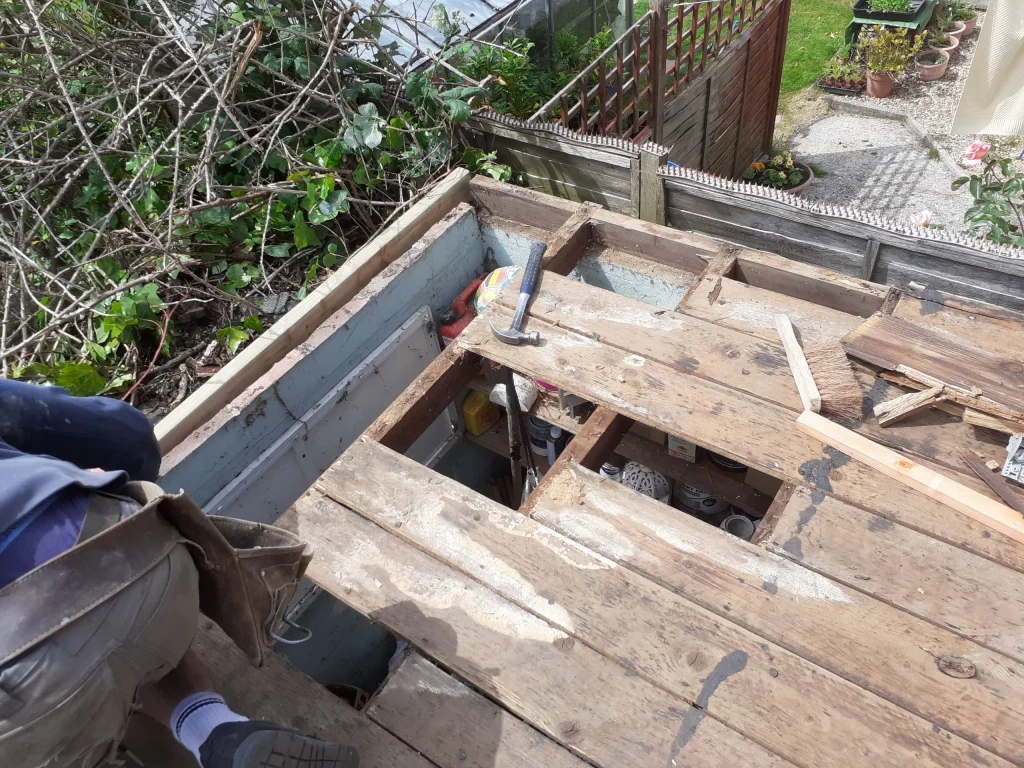
This trapped moisture creates an incubator for wet rot and fungal decay. When I perform professional leak repairs, my first priority is to expose the substrate. If I am dealing with slated or tiled surfaces on period homes, I carefully remove the affected slates or tiles to inspect the timber battens and breathable membrane beneath. Saturated timbers must be allowed to dry, or entirely replaced, before a new, mechanically sound waterproofing layer is introduced.
Upgrading Abutments and Valleys in Sussex
To execute a permanent fix, you must address the mechanics of water flow. Heavy rain in coastal areas rarely falls straight down; it is driven horizontally by high winds. If your roof valley (the internal angle where two pitched roof slopes meet) is lined with degraded mortar or undersized lead, wind-driven rain will push water upwards, defying gravity through capillary action, until it spills over the internal upstand.
My methodology for resolving these complex leaks involves:
- Complete Substrate Exposure: Stripping back the immediate failure zone to assess the structural integrity of the supporting joists and decking.
- Raking and Repointing: Mechanically grinding out degraded lime or cement mortar from the brickwork upstands to a minimum depth of 25mm to ensure a secure chase for new flashings.
- Installing Code 4 or 5 Lead: Using heavier gauge lead for valleys and step-flashings, which resists thermal fatigue far better than standard thin alternatives.
- Proper Expansion Joints: Ensuring that SBS torch-on felt overlaps and lead soakers are installed with adequate expansion gaps, allowing the building to breathe and move without tearing the membrane.
My Technical Approach to Lasting Repairs
I do not guess when it comes to the structural integrity of your home. A lasting repair requires accurate diagnostics, high-performance materials, and strict adherence to building regulations. I focus on correcting the mechanical flaws in the roof’s construction, ensuring that water is effectively diverted away from vulnerable junctions rather than just plugging a hole.
I also believe that technical expertise should be matched with absolute pricing transparency. You should never be left waiting weeks for a contractor to provide a vague estimate. For most of my professional maintenance solutions, you can use the online calculator directly on my website. It takes just 30 seconds to input your roof’s dimensions and receive an instant, highly precise price estimate for materials and labour. If you are dealing with water ingress, calculate your costs online and book a free site survey. I will diagnose the root cause and provide a fixed quote to secure your property.