The Anatomy of a Leak: Why the Drip Isn’t the Source
When you notice a damp patch spreading across your ceiling, the immediate instinct is to look directly upward and search for a visible opening above it. However, in my 18 years as a roofing technician—12 of them spent diagnosing complex structural issues across Brighton and Hove—I can say with confidence that water rarely travels in a straight vertical line. For a lasting solution in our coastal climate, the first step is to trace the water ingress back to its source, rather than treating only the stain you can see indoors.
Rainwater is highly opportunistic. Once it passes the primary exterior covering, it can travel several metres along rafters, joists, underlay laps, masonry joints, and electrical routes before finally pooling on your plasterboard. Simply sealing the area directly above the internal drip with roofing mastic is almost always a short-term failure. To protect the complete weatherproofing system, I carry out a forensic diagnostic survey that follows the moisture path back to the true point of entry.
The Role of Capillary Action and Wind-Driven Rain in Sussex
Properties in Sussex face demanding weather conditions, particularly heavy south-westerly gales coming in from the Channel. Wind-driven rain behaves very differently from vertical rainfall; the force of the wind can push moisture horizontally and even upwards. This is where capillary action becomes a critical factor. Capillary action is the ability of water to move through narrow spaces without the assistance of gravity, and sometimes in direct opposition to it.
For example, if your lead flashing is poorly dressed or the mortar pointing has degraded, high winds can force water upwards beneath the lead. Porous brickwork then acts like a sponge, drawing moisture into the building envelope. Solving this properly requires cutting out compromised mortar, installing suitable code 4 or 5 lead, and forming a deep, watertight chase that physically interrupts the capillary draw.
Tracing and Fixing Leaks on Period Properties
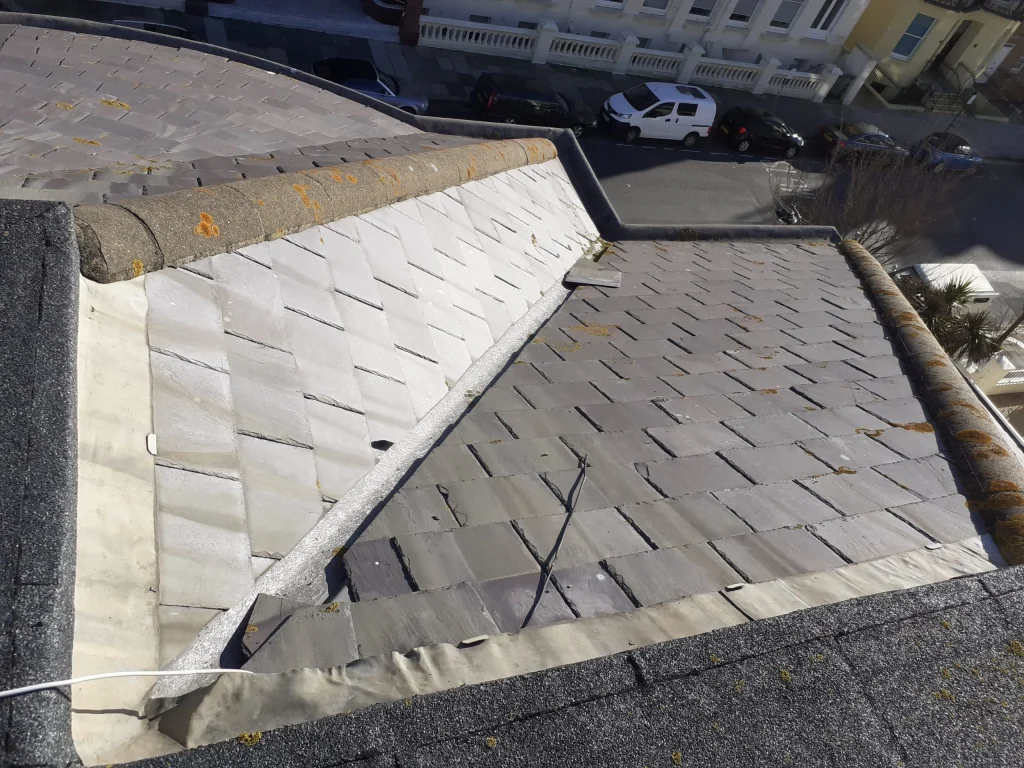
Brighton and Hove are known for their Victorian and Edwardian architecture, but older building materials bring specific diagnostic challenges. When I inspect pitched coverings on Brighton terrace properties, I often find that the slate or tile surface appears intact, while the property still suffers from persistent dampness near party walls.
In these cases, junction-related water ingress is often caused by failed lead soakers beneath the slates or severely degraded lime mortar on the firewall. The thermal bridging effect of cold, damp masonry transferring temperature into a warm interior can also mimic external water entry by creating intense internal condensation. Accurately identifying whether the issue is damp masonry, hidden leadwork failure, or poor loft ventilation is what separates a permanent technical fix from a temporary and wasteful patch.
Flat Roof Diagnostics: Membrane Failure vs. Condensation
Low-slope coverings can fail suddenly when they have been built with outdated materials, but a wet ceiling beneath this type of structure does not always mean the outer membrane has split. In some cases, poor ventilation or a missing vapour control layer allows warm, moist air from inside the home to rise, hit the cold timber decking, and condense. This is known as interstitial condensation, and it can rot structural decking from the inside out just as aggressively as external water entry.
If the membrane has genuinely failed, the cause is often thermal movement snapping rigid, aged mineral felt. To produce a lasting result, I strip back the damaged section and inspect the deck beneath before installing new waterproofing. Once the structural integrity is confirmed, I use high-performance SBS-modified bitumen, commonly known as torch-on felt. The elastomeric properties of SBS allow it to expand and contract through seasonal temperature changes without fracturing.
My Methodology for a Permanent Fix
I do not believe in masking symptoms. Applying a thick layer of liquid sealant over a wet substrate traps moisture inside the structure and accelerates timber decay. A proper intervention requires exposing the substrate, allowing saturated timbers to dry, and correcting the root mechanical failure—whether that means reforming a drip edge, rebuilding a deteriorated upstand, or replacing shattered slates.
You deserve transparency when dealing with property maintenance. I know that the anxiety of water ingress is often made worse by uncertainty around cost. That is why I have built a precise online calculator directly into my website. Instead of waiting weeks for an arbitrary quote, you can enter your property details and receive an accurate, no-commitment price estimate in around 30 seconds. If you are dealing with active moisture inside your home and need a definitive technical assessment, you can arrange a professional site visit today. I will inspect the structural reality of your property and provide a fixed quote to resolve the problem properly.